In July of 2021 I published a piece called Tether being a fraud teaches us more about fiat than it does about cryptos.
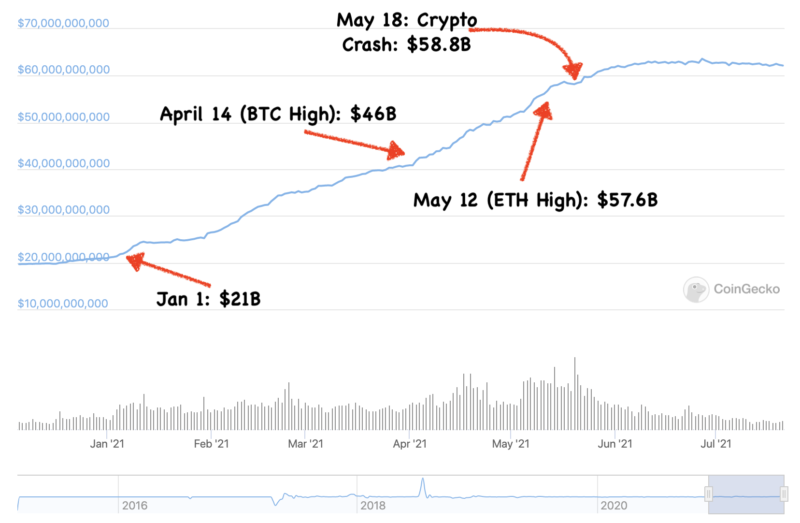
I’d just come off a Grant Williams podcast with Bennett Tomlin and George Noble, and I came away persuaded that Tether could very well be a scam. I wrote that “the case for Tether being a fraud may be essentially correct.” My defensive posture for readers was blunt: don’t hold any value in Tether, and if you have to use a stablecoin, use USDC or DAI.
Five years later, I think Tether is one of the most consequential financial institutions of the decade, and that history will rank it alongside the Medici and the Rothschilds.
That’s a big reversal, so it’s worth laying out how I got here.
What I got right in 2021
Even at peak skepticism, the argument I made wasn’t the one the skeptics were making.
The George Noble “casino chips” analogy, where everyone tries to cash out their Tethers and finds the window empty, assumed the only exit from crypto was through Tether. That was never true. And the bigger point I kept circling was this: if Tether really was minting dollars out of thin air and using them to buy Bitcoin, that was “an exact microcosm of what central banks have been doing with intensified zeal since 2008.”
They weren’t pretending to mint Bitcoin, because they couldn’t. Nobody can. They were pretending to mint a peg to fiat dollars, which are themselves created at will and backed by nothing.
So the conclusion I landed on was that a Tether crisis would be significant, non-trivial, and not existential for crypto. Tether was a microcosm of the dollar, played out in fast-forward.
I was right about the microcosm. I was wrong about the direction.
What changed: the Stablecoin Standard
For years, the open question in these pages was what the base layer of the next financial system would be. Bitcoin, obviously, but something had to sit between Bitcoin and the legacy dollar system. Our bet drifted between Ethereum and various contenders, and “or possibly stablecoins” was usually thrown in as an afterthought.
By July 2025 it was no longer an afterthought. In the issue I called The Stablecoin Standard, the conclusion was that US policymakers were looking to stablecoins to extend, by a few more decades, the exorbitant privilege of the global reserve currency.
Then Treasury Secretary Scott Bessent removed all doubt. Asked whether crypto threatened the dollar, he said the opposite:
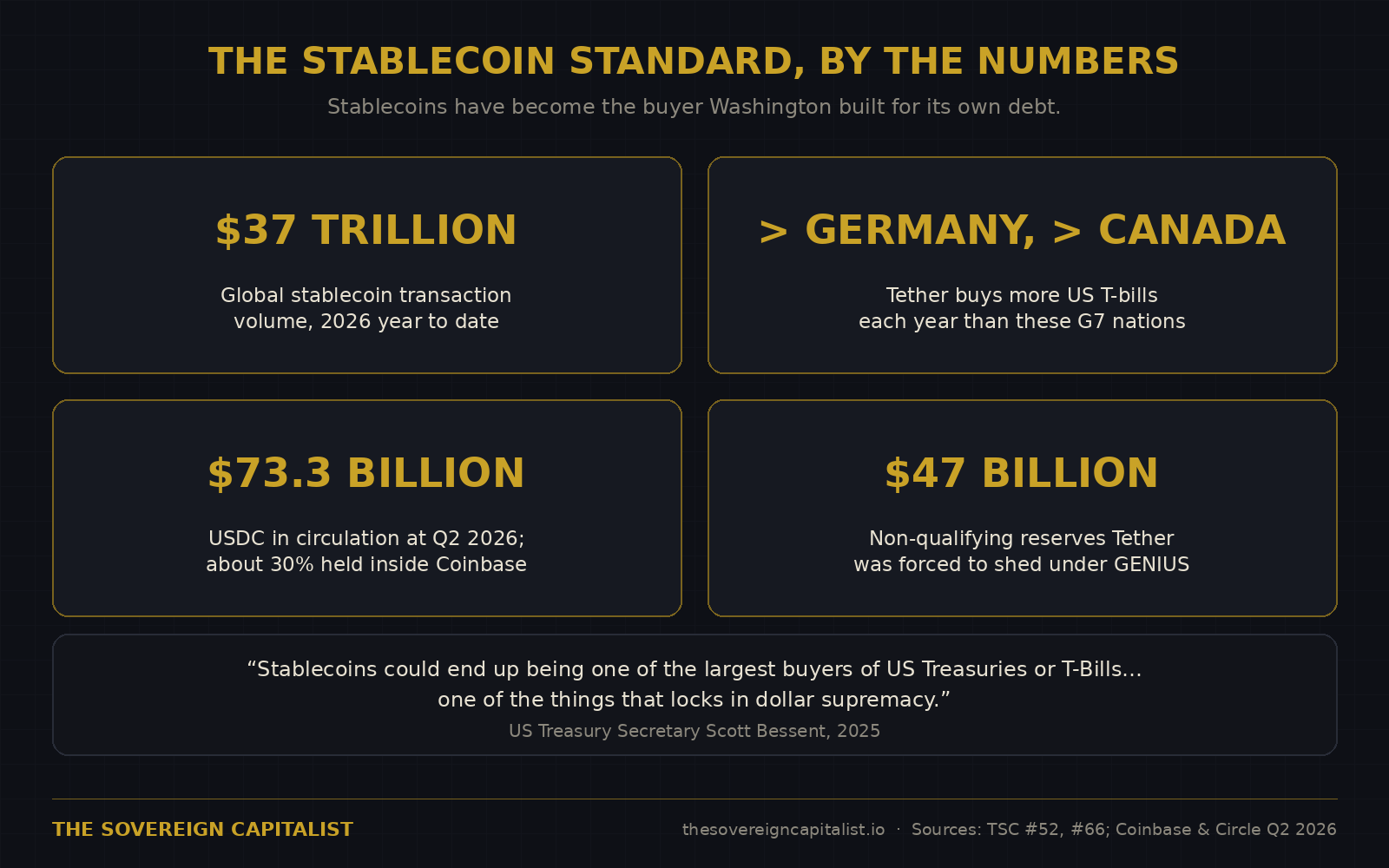
“I think stablecoins could reinforce dollar supremacy because with stablecoins [they] could end up being one of the largest buyers of US Treasuries or T-Bills… there’s a very good chance that crypto is actually one of the things that locks in dollar supremacy.”
We already knew Tether was among the largest holders of US T-bills in the world, buying more annually than G7 nations like Germany and Canada. Bessent was telling us that this was now the plan.
The GENIUS Act became law. Every compliant stablecoin in the country is now a forced buyer of short-term Treasury debt. In Bolivia, merchants post prices in USDT while the official inflation rate runs in the double digits. The economy just switched, informally, out of the boliviano and into Tether.
Where it stands in September 2026
The numbers from this summer’s earnings season tell you how far this has gone:
- Global stablecoin transaction volume reached $37 trillion year to date.
- USDC in circulation stands at $73.3 billion; roughly 30% of it sits inside Coinbase, which now runs an agentic-finance platform on Amazon’s Bedrock so AI agents can transact in stablecoins directly.
- After the August 8 Notice of Proposed Rulemaking under GENIUS, Tether was forced to shed $47 billion of non-qualifying reserves. It absorbed that and kept going.
- The Clarity Act, the market-structure half of the framework, now looks likely for November.
That’s the Stablecoin Standard, folks. Just wait until they become the buyer of last resort for that increasingly tenuous US debt paper.
Because that’s the other half of the story. The 30-year Treasury blew past 5% in August, the Treasury Department doubled its long-bond buybacks, and gold has overtaken US Treasuries as a share of central bank reserves. The world’s reserve asset is having trouble finding buyers. Stablecoins are the buyers Washington has built for it.
Why Medici
The Medici didn’t become the most powerful family in Europe by having the best bank. They became powerful by being the bank to the sovereign: financing the papacy, holding its deposits, moving its money across borders, and eventually placing their own people inside the institutions they served.
Look at what Tether has done. It printed its own money to bootstrap a conglomerate at sovereign scale. It buys more US government debt each year than most G7 nations. It is now buying the most desirable assets of the Exponential Age, energy, Bitcoin mining, payments rails, and doing so with Washington’s blessing, because every Tether in circulation is another bid for a T-bill.
It has done this under a cloud of suspicion for as long as I can remember, including from me. That cloud never lifted. It just stopped mattering.
This isn’t a conversion to Tether. I still think everything I wrote in 2021 about what it reveals about fiat money is true. What I got wrong was assuming that revelation would be Tether’s undoing. The dollar system didn’t reject the disingenuousness of minting value ex-nihilo, it doubled-down on it.
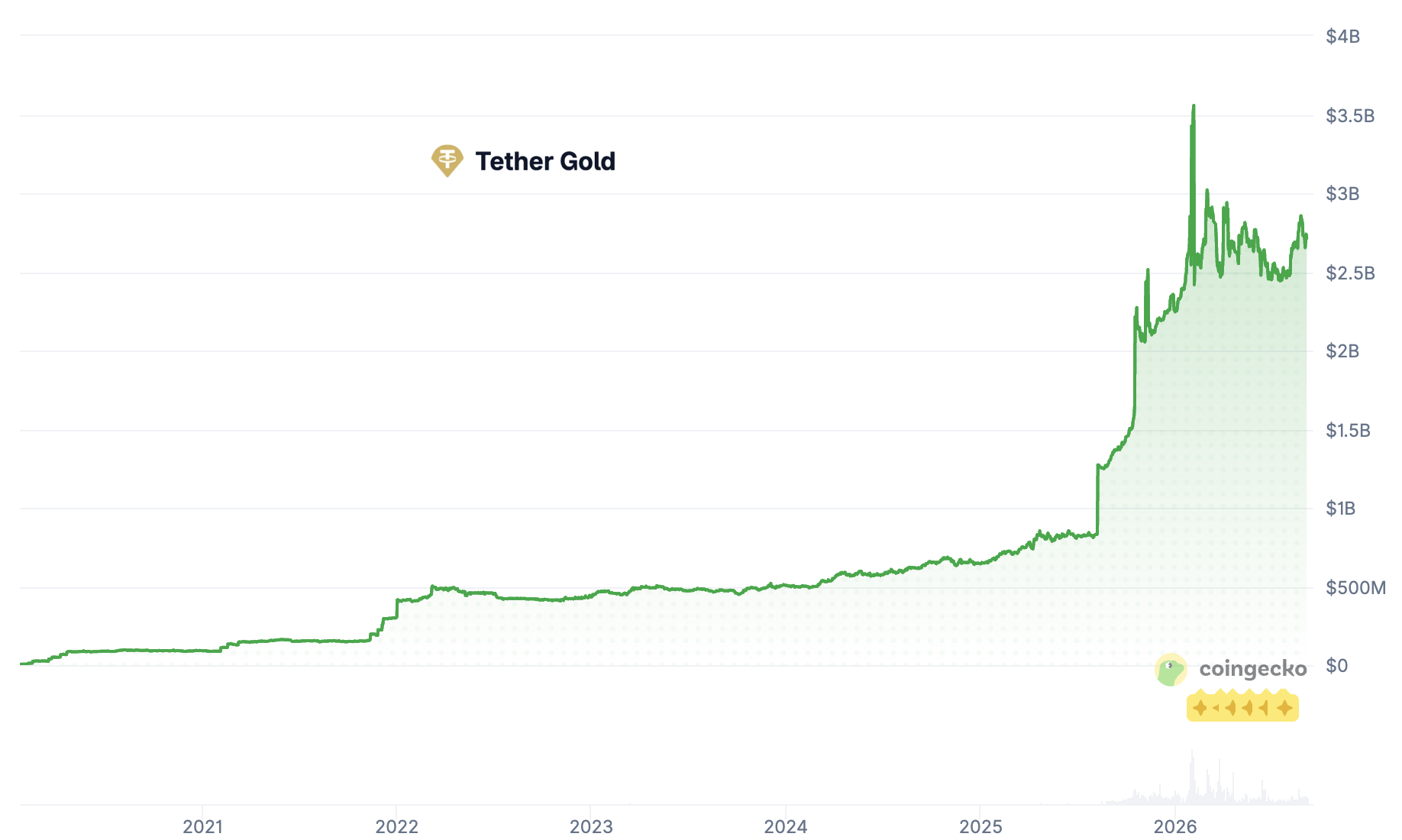
The marshalling-area thesis I’ve been writing about is now visible in the open: stablecoins extend dollar hegemony, and in doing so they build the rails and the balance sheets that funnel capital toward cryptos, tokenized Real World Assets (RWA), tokenized gold (Tether has their own gold stablecoin in XAUt)
…and it’ll flow into Bitcoin.
But right now, Tether is the biggest marshalling yard for the Stablecoin Standard on the map.
Adapted from Issues #64 and #66 of The Sovereign Capitalist (July and September 2026). Subscribers get the full letter, the portfolio and the Hyper-Cognition Dashboard.