Paper money eventually returns to its intrinsic value: zero.
~ Attributed to Voltaire
Written by Bryan Lutz, Editor at Dollarcollapse.com:
Pick any macro story this week and follow it to the end.
You land in the same place every time.
Debt rankings, Treasury yield warnings, Japan, the “safety” of the ten-year, bond-market stress, the fight over who runs the Fed, the exact level of yields that finally breaks something…
Different headlines…
Different desks…
But it’s the same story wearing a different hat:
Government debt.
Over the last 25 years, governments borrowed as if the near-zero rates of the last decade would last forever. They didn’t. Rates went back to normal, and the cost of carrying all that paper began to compound. Bigger deficits push yields up. Higher yields make the deficits bigger. That forces more borrowing, which pushes yields higher still. The snake reaches back and bites its own tail.
The US Congressional Budget Office writes:
Net interest is now among the fastest-growing lines in the federal budget, running past $1 trillion a year and surpassing what the United States spends on national defense.
Let’s put some real numbers on it. In 2005, the federal government paid roughly $329 billion a year to service its debt. As of the first quarter of this year, that bill runs near $1.2 trillion, annualized. The gross debt cleared $39 trillion this spring.
Here’s the chart on annualized federal interest payments:
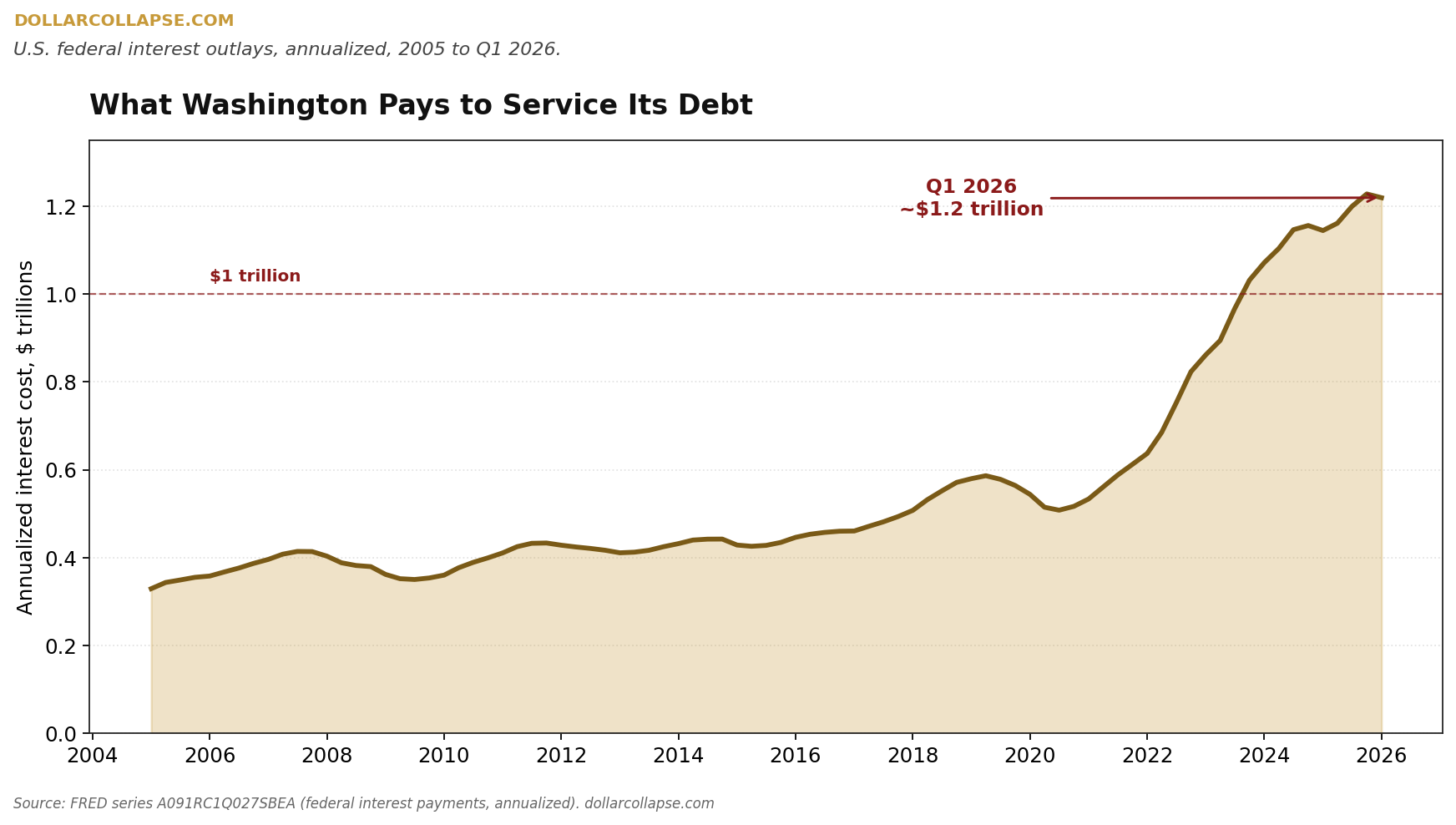
The line sat flat for fifteen years. Then it went vertical.
None of this slows the borrowing, because a State never volunteers to shrink. It taxes what it can, borrows what it can’t tax, and prints what it can’t borrow. That’s the design of the thing, not an American accident.
Which brings us to the part the rankings and the yield charts leave out:
History has read this book before.
France tried it in the 1790s with the assignat, paper “backed” by land seized from the church. The backing was a story. The printing was real. Within a few years the notes bought a fraction of what they promised, and then they bought nothing.
Weimar Germany ran the same experiment on fast-forward. Adam Fergusson called his account of it When Money Dies…
The Weimar Germany government buried in obligations leaned on its central bank to buy them, the currency thinned out, and by 1923 Germans lit stoves with banknotes because paper marks had gotten cheaper than firewood.
Japan is running the slow version right now. Decades of deficits, a central bank that owns much of its own bond market, and long-dated yields grinding up to levels the country hasn’t seen in decades. The wire keeps calling it a death spiral.
Different century, but the same physics nonetheless.
The State overspends, the central bank accommodates, and sooner or later the bond market sets the price the politicians refused to.
So how does a story like this end…
Ludwig von Mises named the ending a century ago: the crack-up boom. In German, katastrophenhausse.
For a long stretch people keep holding the currency out of habit and trust, even as it loses value year after year. Then the trust snaps. Once enough of them understand the money is being devalued on purpose, they stop holding it at all. They trade it for anything real, anything that can’t be run off a printing press, and that stampede out of paper becomes the last, roaring inflation.
Not a market crash, but…
A flight out of money itself.
You can see the early tell in the most boring corner of the market. The thirty-year Treasury yielded barely more than 1% at the 2020 bottom. It sits near 5% today.
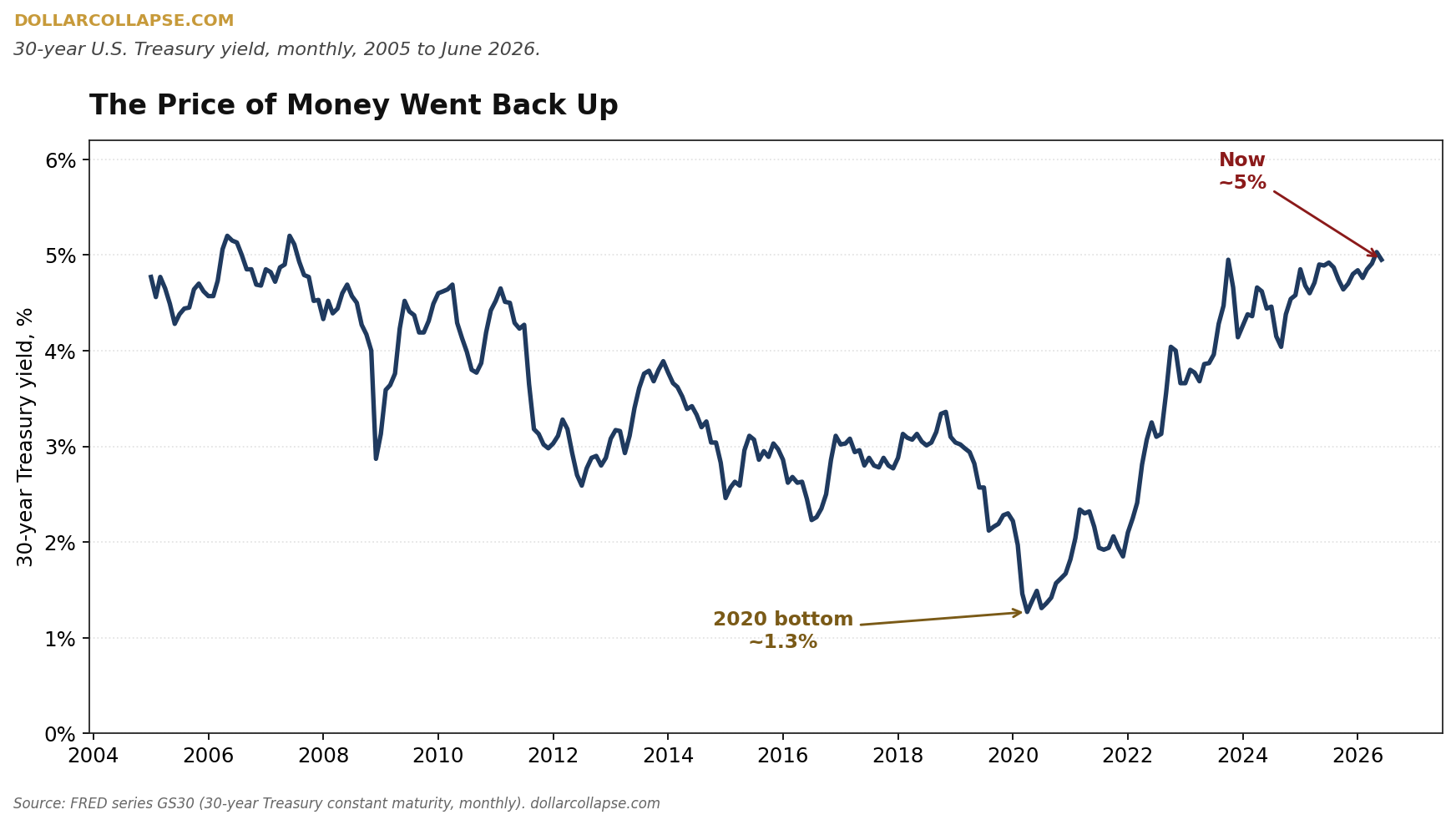
Now the market demanding to be paid for the risk that it won’t get its money back whole.
The crack-up boom isn’t a forecast with a date stapled to it. It’s the final chapter of a book that France, Germany, and now Japan have each read aloud.
And when a currency finally goes, people won’t reach for some other government’s promise.
They will reach for gold.