The Great Recession and its aftermath was actually the best of times for countries with natural resources to sell. The US, Europe and Japan ran record deficits and cut interest rates to zero or thereabouts, sending hot money pouring into mining and energy projects around the world, while China borrowed (as it turned out) $15 trillion for an epic infrastructure build-out.
The result was robust demand and high prices for raw materials like copper, oil and iron ore, and a tsunami of cash pouring into Brazil, Canada, Australia and the other resource producers. Conventional wisdom deemed these countries to be well-run and destined for ever-greater things, which led locals to borrow US dollars at cheap rates and invest in mines, factories and/or domestic government bonds with much higher yields. Good times and fat margins all around.
Then it turned out that the debts accumulated by the resource-consuming economies had created a headwind that they couldn’t overcome. The Chinese build-out abruptly ended and the developed world failed to achieve escape velocity, causing the US dollar to soar and commodity prices to plunge. Oil, for instance, is down 21% in just the last six weeks. while the Bloomberg Commodity Index is 42% below its recent high.
For a sense of what this means, pretend you’re Brazil. During headier times your oil, iron ore and soybean exports created a generation of new millionaires and allowed your government to balance its budget. This in turn led your leaders to ratchet up spending and your entrepreneurs to borrow what now looks like an insane amount of US dollars.
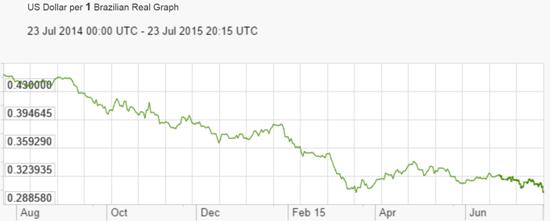
Now your currency, the real, is plunging…
…while your interest rates are surging:
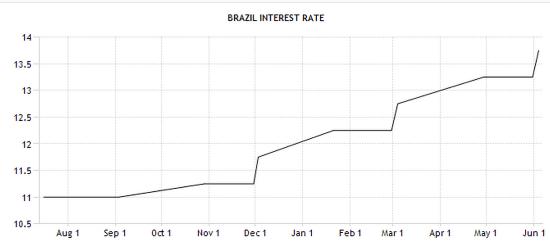
Among other things, this gives you: a ton of dollar-denominated loans that are deeply under water and will be defaulted upon soon; plunging tax revenues necessitating huge cuts in government spending and/or much higher taxes — at exactly the wrong time; and hundreds of mines and factories that aren’t generating enough cash flow to cover their cost of capital and will soon fail.
Variations on this theme are playing out across the resource economy world, so depending on the country, it’s crisis now (Argentina and Venezuela) or crisis in 2016 (nearly everyone else).
And that’s if everything stabilizes around these levels. Let resource prices keep falling and/or the dollar rise further and we can replace “crisis” with “chaos.”
For more, see:
Brazil slashes fiscal savings goals for 2015 and 2016 on plunging tax revenue
The Australian dollar is smashed and poised to fall below US70 cents, analysts warn
8 thoughts on “What Blows Up Next? Part 1: Resource-Based Economies”
We need to move away from money and toward a new form of economics with sustainability and equality at its core.
……..rocking the dollarcollapse > < Make It Easy
……………1=39Now Get this dollarcollapse
bvbvbv
“It’s our dollar, but it’s your problem.”
And that is everything one needs to know about global bubble-nomics and funds flow mismanagement.
That is true, for the most part. But don’t forget that a lot of the hot money went into drilling shale oil projects in the USA that are break even at $95/bbl. So that bubble is unwinding as well.
Look at Norway (currency: NOK) as well. They’re exporting oil & gas and they are suffering under the fallen oil price as well.