
“My father was an amazing man. The older I got, the smarter he got.”
~ Mark Twain
Written by Bryan Lutz, Editor at Dollarcollapse.com:
I decided to return to sending out a few Sunday thoughts. Last year, they seemed to be more popular, and I like writing them. And many people like sharing their two cents too.
Sometimes these thoughts are on the economy, life, or hard assets.
Whatever helps, warns, or is hopeful. That’s what I’m interested in…
So, here we go.
Here are three Sunday morning thoughts for you:
1. The Best Way to Have Some Fun on Father’s Day.
Fatherhood is painful.
Sleepless nights…
Giving young children food you worked hard for only to watch them scream in disgust, eat nothing, and complain the whole meal.
Then there’s the demand for more energy.
I’ve found the best way to make Fatherhood a blessing for yourself and your family is to develop a personal practice of exercise – positive pain.
Exercise shifts your mind, body and brain into a “high emotional state.”
As opposed to watching Fox News, doom-scrolling Twitter, or eating junk food to placate your anxiety over the economy and everything else that’s going wrong in the world.
When you make a practice of some kind of exercise three times a week, you fill yourself up.
You start eating differently.
You start taking care of your body and…
You have energy to enjoy yourself, others and your special day.
If you are a father, Happy Father’s Day to you!
You deserve it.
2. Are We Looking at Tech Bubble 2.0? Or is this a new paradigm?
Back in 2000, tech stocks made up 34% of the S&P 500.
This year, we’re looking at 33%.
Are we looking at Tech Bubble 2.0?
Tavi Costa posted this chart on Twitter the other day:
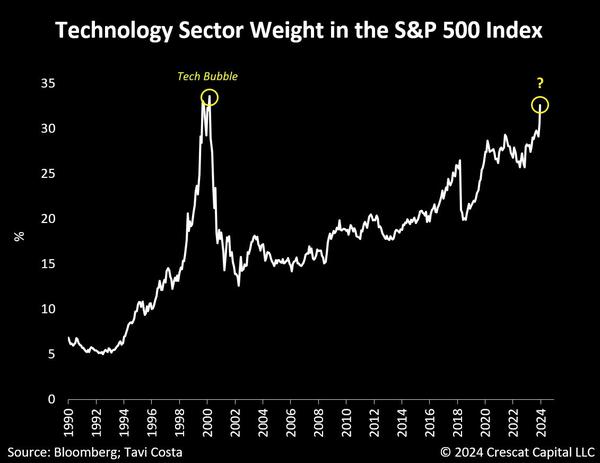 |
It’s even more convincing when you look at the chart.
However, if you compare then and now, there is an important difference.
The tech bubble at the turn of the century was mostly software companies, shell company start ups, and dot.com ideas without any legs.
Today, we have integrated tech stocks with the leader, Nvidia, being a hardware producer.
And, many of the Magnificent Seven are a part of American’s everyday lives.
People aren’t running after “dot com” ideas without traction.
They’re already using their products on their smartphones. Or they’re using their smartphones. And those smartphones are integrating AI technology, chips, supporting data centers to power new AI technology.
So, this is either a tech bubble, or something else.
It may represent some bigger part of the economy shifting towards a new paradigm, one where new hardware is pre-eminent in everyday life.
But I wonder if it’s too much new technology, too fast.
3. US Government Jobs are growing without a “crisis,” but no where near what it’s like in Canada.
The Bureau of Labor Statistics seems to love propping up jobs reports.
Things like jobs created, new jobs, job openings are all propped up by part-time roles and openings.
While part-time jobs are growing in the United States, government jobs are also growing.
In my home country of Canada, this is how much public sector jobs have grown since Trudeau managed lockdowns through the pandemic.
Notice: we are looking at percentage change, not total jobs.
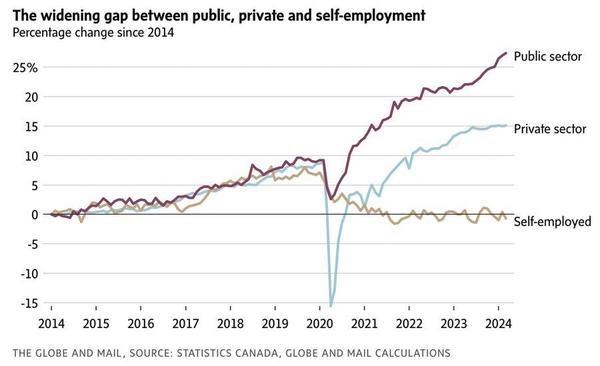 |
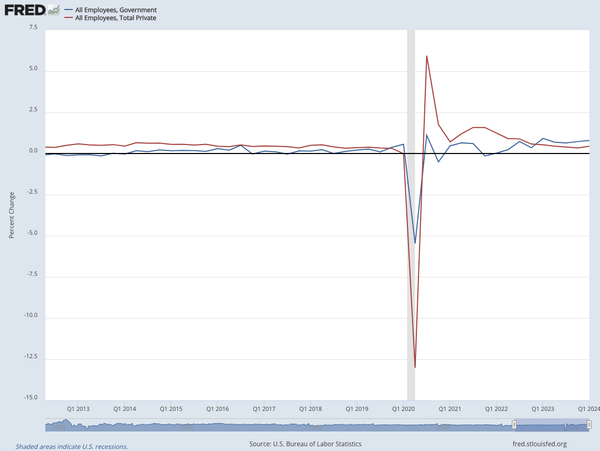
Thankfully, there is not nearly as big of a gap between public and private sector employment in the US than there is in Canada.
Here’s what that looks like in the same time frame:
 |
Capitalism, if you can call it that in the US will always create more productive jobs than socialism can.
Yet, it is interesting to see the growth in government employees starting at about the same time the Fed started raising interest rates in 2022.
It is only natural that corporate employees decline when there’s less revenue available, but percent change in public vs. private only usually happens when there’s a crisis, recession, or the like.
For the last year and half, government job growth has beat the private sector.
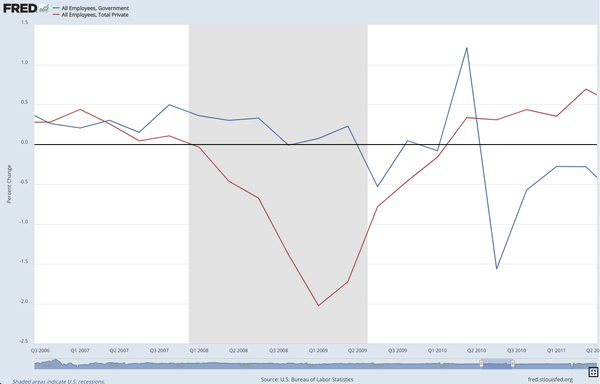
Here’s what public vs. private employee during the past two financial crises…
The Great Financial Crisis(red, private, blue public, percentage change):
 |
Dot Com Bubble(red, private, blue public, percentage change):
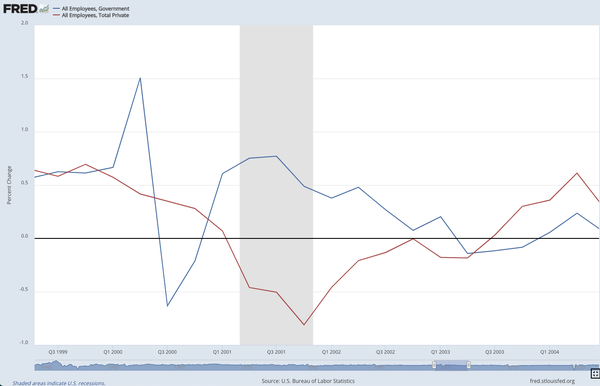 |
Private sector recovery takes about three years, while government hire.
On the other hand, for almost the past two years the US government has been hiring more and more. Take a look above – the blue line is consistently above the red line
But remember, there is “no crisis” right now, say the experts.
Who knows, maybe in a few years capitalism in the US will recover and the private sector will prosper.