
“Another turning point, a fork stuck in the road
Time grabs you by the wrist, directs you where to go
So make the best of this test and don’t ask why
It’s not a question, but a lesson learned in time
It’s something unpredictable, but in the end is right
I hope you had the time of your life”
~ Green Day, Good Riddance (Time of your life)
Written by Bryan Lutz, Editor at Dollarcollapse.com:
We’re at a turning point in our education systems.
Specifically, in higher education.
Unless you are in the market for a profession like doctor, lawyer, or engineer, college or university seem to be an experience less and less American’s would rather say “good riddance” to than accept as a natural progression of life.
Money printing has driven prices far beyond what could ever be expected for a four-year degree…
And the expansion of information through technology has made more young people question if $80,000 and four years of their life is really worth it.
A surprising article from left-leaning Newsweek highlights the fact:
Is College Still Worth It? Many Americans Say No
“College is “overrated,” Abron tells Newsweek. “I don’t see the use of a degree in this day and age. Employers are demanding higher education, and they serve no purpose.”
Reconnu and Abron are among many Americans who have little faith in the value of a college degree, seeing universities as places where political agendas are pushed and where students are not taught the skills they need to succeed in life, but put on a path to a lifetime of oppressive debt.
According to a recent Gallup survey, a growing proportion of Americans are losing confidence in higher education.
The survey, released in July, found that only about a third (36 percent) of Americans said they have a great deal or quite a lot of confidence in higher education, while 32 percent said they had little or no confidence.
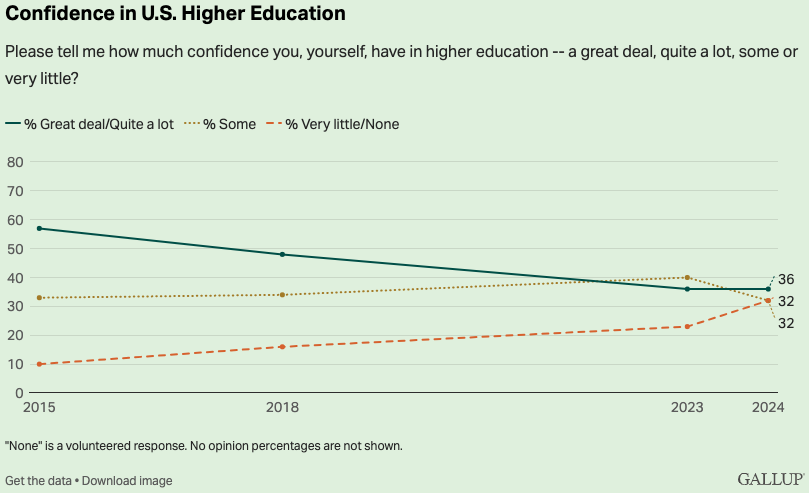
The numbers are significantly down from a decade ago, when 57 percent reported having a great deal or quite a lot of confidence in higher education and only 10 percent said they had little or none.”
Many like the mother / daughter duo mentioned above, would rather rely on what’s not being said – the good ol’ fashion American Dream.
If you work hard…
If you are a self-learner…
If you are an innovator, or know how to accumulate and apply skills.
Then come what may, you have all the opportunity to choose your own direction in life.
This change in direction is not only a sign of the American Dream, it is a sign of something bigger.
It is a sign that our traditional institutions are being re-negotiated.
Like what William Strauss, and Neil Howe outline in their book, ‘The Fourth Turning’.
You might know this, so bare with me. Many do not know this… and should!
A “Turning” is a single part of a four part cycle – where institutions are re-negotiated during a chaotic “Fourth Turning” defined by anxiety/uncertainty, population decline, and even war.
New institutions are then solidified in the “First Turning,” which then breakdown over time.
There. Done.
Let’s move forward.
I’ve already shown this to you, but in order to move on to what’s next let’s solidify the conclusion: there is a re-negotiation happening between prospective students and aging institutions.
There is also a re-negotiation happening between candidates and prospective employers.
Newsweek reports:
“One in three companies in the U.S. say they have eliminated bachelor’s degree requirements from some positions in 2024, according to a survey of 750 U.S, businesses by Intelligent, a college preparation company.
While the majority (59 percent) did so for entry-level positions, 54 percent removed degree requirements for mid-level roles and 18 percent for senior-level roles.
“Eliminating bachelor’s degree requirements from the hiring and recruiting process is becoming increasingly popular across many industries,” says Huy Nguyen, Intelligent’s chief education and career development advisor.
“The trend shift shows a broader recognition that practical skills, real-world work experiences and the ability to self-learn can be more important measures of potential success than four years of formal college education in many job functions.”
We cannot predict all the changes in our world, but we can recognize patterns.
Those are lessons only learned in time, then…
Eventually, one generation “gets it,” and finds alternatives to institutions and systems on the decline.
That’s what we got going on right now.