Graphite is the newest victim of Trump tariffs.
He’s slaying imports with a 93.5% import tariff.
On paper, it’s a win against Chinese “dumping.”
In reality, it’s a gut punch for American EV makers—because the U.S. doesn’t produce the high-purity graphite needed for battery production.
Here’s what this means:
-
U.S. manufacturers will keep buying from China—but at a much higher cost.
-
EV battery and vehicle prices could climb.
-
Domestic graphite production is years away from meeting demand.
Without strategic deals with allies like Canada, or subsidies to kickstart U.S. production, this is a shoot-yourself-in-the-foot policy that punishes consumers and slows EV development.
And if history is any guide?
Graphite prices are likely to rise…
You could look at Northern Graphite in Canada, but then there’s also Graphite One.
Richard Mills at Aheadoftheherd has been following them for awhile.
Worth looking into.
And, here’s the full article on the current graphite from Mish Shedlock, below.
Originally posted by Mish Shedlock at MishTalk.com:
Here’s another shoot yourself in the foot tariff move by Trump.
93.5 Percent Tariff on Graphite
CNN reports Chinese graphite is crucial to electric car batteries. Trump just put a 93.5% tariff on it
The Commerce Department announced a 93.5% tariff on Chinese graphite Thursday, accusing the country of “dumping” the raw material in the United States below the market price. The decision was hailed by domestic graphite producers, who say Chinese producers dominate the market and keep American companies from getting off the ground.
Raw graphite is relatively cheap, costing less than $2 per pound. Chinese imports to the United States more than doubled over two years, hitting $347 million in 2023, according to the most recent Commerce Department data available. But domestic producers haven’t been making graphite of the purity needed to build EV batteries, according to testimony from Tesla during the investigation into the tariffs.
The move not only is an escalation of trade tensions between the United States and China, but another blow to American EV production.
The Trump administration is slashing federal support for electric vehicles. The administration is looking to eliminate or recall federal government loans used to help fund construction of EV factories and battery plants, and the spending and tax bill passed earlier this month that Trump signed into law will eliminate a $7,500 tax credit for EV buyers.
The Biden administration imposed a 25% tariff on graphite last year and started the process that led to the 93.5% tariff announced Thursday. On top of the other duties the Trump administration has imposed on China, Chinese graphite could face tariffs of about 160%.
However, the US industry does not currently produce enough graphite to fill demand. Until it does, American EV battery makers will just have to pay a higher price for the graphite it needs from China.
Numerous auto and EV battery makers did not respond to CNN’s request for comment. But during the hearing process on the potential tariff increase, attorneys for the automakers argued that US producers do not make the high-quality graphite needed for EV batteries.
“Lithium-ion battery producers demand (graphite) with a 99.9 percent carbon purity level, meaning extremely low metallic impurities,” said Matt Nicely, an attorney for Tesla at a hearing in early January. “Not a single US producer is able to produce (graphite) to these exacting specifications. (Domestic producers) cannot blame imports ….when they are not yet able to produce the product the market demands.”
Critical Mineral Assessment
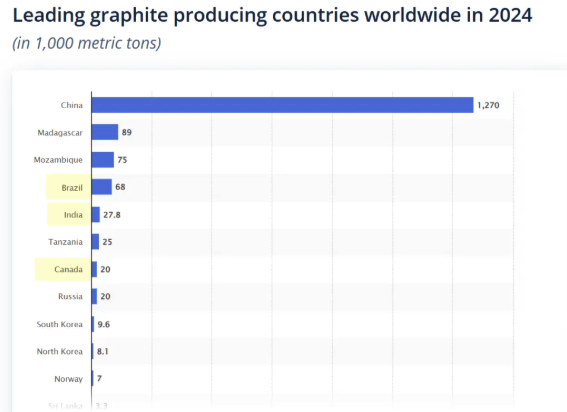
The lead chart from Statista makes a case that graphite is a critical mineral and the US is overly dependent on China.
US and Canada Resources
United States:
- No current production:The US has not mined graphite since the mid-20th century.
- Import reliance:The US relies entirely on imports to meet its graphite needs, primarily from China, Mexico, Canada, and other countries, according to the U.S. Geological Survey.
- Graphite deposits:Graphite deposits do exist in the US, including the Graphite Creek deposit in Alaska, which has substantial resources.
- Exploration:There is renewed interest and exploration for graphite in the US, with projects in Alaska and Alabama, among others.
Canada:
- Significant producer:Canada is a major graphite producer and ranks among the top 10 globally.
- One operating mine:Northern Graphite’s Lac des Iles mine in Quebec is the only operating graphite mine in North America.
- Production capacity:Northern Graphite is working to increase its production capacity at the Lac des Iles mine and has plans for another project in Ontario.
- Graphite resources:Graphite is found primarily in the Grenville Province of Eastern Ontario and in Quebec.
- Government support:Both the US and Canadian governments are taking steps to bolster graphite production and supply chains for electric vehicle batteries.
Shoot Yourself in the Foot Approach
Producing graphite of the required purity will take many years. Meanwhile, Trump’s tariffs punish users of graphite, simply for needing the material.
Making everyone pay more graphite raises costs. And it will do so for years, perhaps a decade or longer.
If instead of tariffs, the administration provided subsidies to get production up in the US, and make an agreement with Canada (and other allies) to buy all of their production, we would be much better off than the Trump approach.
National Security Concerns
Strategically we cannot be beholden to China for rare earth minerals, graphite, magnets, etc.
My answer 10 years ago would have been different than it is today.
I had for years said no subsidies or tariffs no matter what anyone else does. I have changed my time as of a few years ago. I no longer object to subsidies in cases of genuine national security risk.
Steel, copper, and aluminum are not national security threats. Numerous allies produce enough base metals and there is enough competition and supply to eliminate strategic concerns.
The Correct Approach
Tariffs punish manufacturing users and consumers, always, strategic and nonstrategic alike.
But careful subsidies to get production up in the US, and deals with allies don’t. We should be fostering better relationships with allies.
Instead, Trump treats Canada and Mexico like dirt. He makes no distinction between friend and foe, and is clueless at fostering genuine cooperation between allies.