
Written by Bryan Lutz, Editor at Dollarcollapse.com:
The crypto world is not unfamiliar with the relevancy of gold. While most of the crypto world chases Bitcoin, Tether is hoarding more gold than many central banks. In fact, Tether CEO, Paolo Ardoino says, “Gold is nature’s bitcoin.”
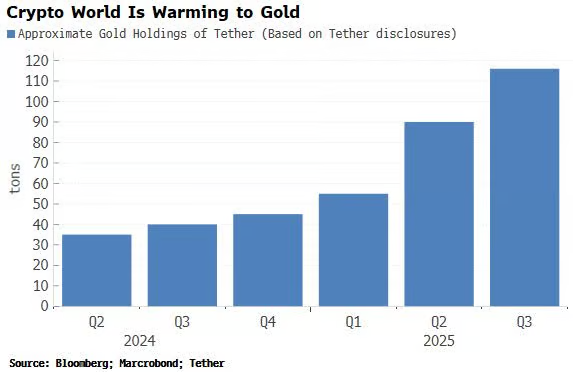
Tether is cryptocurrency company best known for its distribution of the US Dollar stablecoin called USDT. Tether has also been building out a treasury of gold-backed stablecoins(XAUt) and have recently become the world’s largest private holder of gold. As of Q3 2025, the company now holds 116 tons of gold. Over the past several years, the company’s gold holdings have risen along with the price of gold.
The whole sector has grown from zero to $4.42 Billion in market cap, but Tether leads the pack.
The Block reports:
Gold-backed stablecoins near $4 billion as safe-haven demand grows onchain
The growth in gold-backed stablecoins indicates that crypto investors increasingly seek exposure to traditional safe-haven assets while remaining onchain. These tokens allow fractional ownership of physical gold bars stored in secure vaults.
Tether has emerged as a major institutional gold accumulator. The company added 26 tons of gold in the third quarter alone, exceeding the purchases of most individual central banks during the same period. With approximately 116 tons held by end-September, Tether ranks among the top 30 global gold holders according to IMF data, ahead of countries like Greece, Qatar, and Australia.”

Q3 2025 was Tether’s biggest purchasing run yet, outpacing central banks. They also own more gold than many western countries ranking among the top 30 gold holders worldwide. They own more gold than nations like Greece, Qatar and Australia.
🔥 BIG: Tether bought more gold last quarter than any central bank. pic.twitter.com/8BPpJNRA1O
— Cointelegraph (@Cointelegraph) November 29, 2025
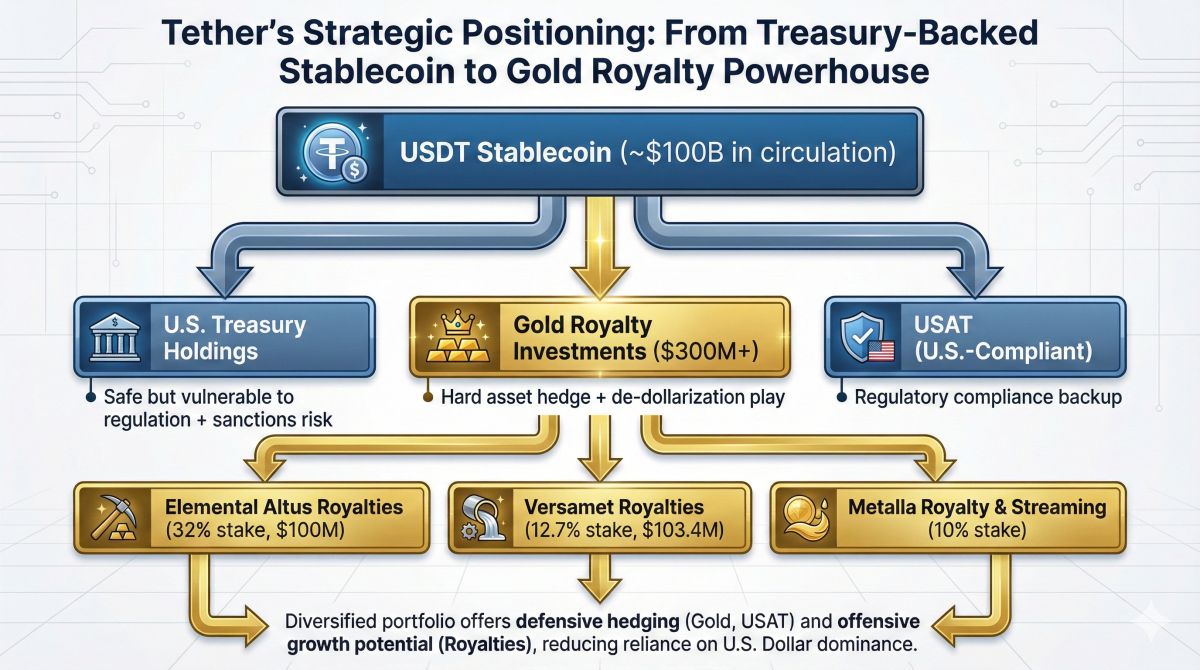
To buy more gold, Tether receives revenue from users paying transaction costs to use their stablecoins, and US Treasury investments. They’ve also heavily invested in gold royalty and streaming companies.
Investing.com reports:
Tether’s Secret Gold Royalty Empire: What It Signals for Stablecoins and Bullion
“The world’s largest stablecoin issuer is no longer just a dollar middleman. As crypto traders focus on the next Bitcoin rally and regulators sharpen their knives for stablecoins, Tether has been building a gold empire that few people were watching.
Since June, the company behind roughly $100 billion in circulating USDT has pushed more than $300 million into gold royalty stocks, the kinds of assets that rarely appear on a fintech balance sheet. It now owns nearly a third of Elemental Altus Royalties, holds significant stakes in Versamet Royalties and Metalla Royalty & Streaming, and controls claims on hundreds of gold mines spanning four continents.
This is more than portfolio tinkering. Tether is making a calculated bet that the future of money will involve gold, and it is building infrastructure that could power the next generation of stablecoins or give the company an escape hatch if regulators shut the door on the traditional dollar-backed model.
Why a Stablecoin Giant Is Betting on Gold Mines
To understand what Tether is doing, you need to appreciate the scale of its profit engine. With more than $100 billion in USDT backed primarily by short-term U.S. Treasuries, Tether rakes in an estimated $5–6 billion a year in interest income. That is more profit than most blue-chip financial institutions and multiple times what the largest listed gold royalty company earns.
But every Treasury bill Tether buys also increases its vulnerability. If the U.S. government decides it does not like offshore stablecoins, it can freeze or restrict access to those assets with a phone call. The 2022 Russian sanctions showed how quickly that can happen. Reserves inside the Western financial system are not as safe as they once seemed, especially for companies operating in regulatory gray zones.
Gold royalties offer a different way to solve that problem. Instead of owning and running mines, royalty companies finance mining projects in exchange for a percentage of future revenue or the right to buy metal at a discount. Once production starts, they collect cash without dealing with labor disputes, equipment failures or environmental lawsuits. The miner takes the risk and the royalty holder gets paid.
Elemental Altus, where Tether now holds about 32 percent of the shares, manages more than 200 royalty and streaming contracts, most of them tied to precious metals. In the current year the company has reported that revenue more than doubled and operating cash flow jumped nearly tenfold as several projects moved from development into full production. Versamet, Tether’s second-largest position at 12.7 percent, is targeting more than 20,000 gold-equivalent ounces of annual production by next year. Metalla brings another 100-plus royalties, including exposure to some of the world’s longest-life gold projects.
For Tether, these investments do more than diversify the portfolio. They convert a chunk of dollar-denominated interest income into inflation-sensitive, gold-linked cash flows that sit outside the reach of U.S. regulators.”

5 thoughts on "While Crypto Chases Bitcoin, this Stablecoin Company Is Hoarding More Gold then Many Central Banks"
This was fascinating. Gold has always been the store of value. I wondered what would happen with the new CBD and crypto currencies
It seems like they are looking to history
Thanks for an excellent article
Yes, I’m curious to see what happens with CBDCs too. Maybe they will get left in the dust for USD and gold stablecoins.
Oh, and sorry for posting in the wrong area… I couldn’t find the right place. 🙁
Bryan,
I love your content and have been following for over 5 years. I don’t normally complain, but this article is rather “weak”.
https://www.msn.com/en-us/money/markets/silver-retreats-from-80-peak-while-gold-softens-on-profit-taking/ar-AA1Td71V
Christmas / New year is always “suspect” as the Big Boys are away so volume is low. As such, the market can become volatile when normal sized orders now look like whales… causing dramatic price moves. I would suspect MSN explanation / commentary means zero to your normal audience. Just saying.
Otherwise, thx for content and keep up the good work.
Regards, Russell
Thanks, Russell. Appreciate the feedback.