Written by Bryan Lutz, Editor at Dollarcollapse.com:
Something is getting attention in the materials world that deserves a closer look. Not because a newsletter told you to buy a stock. Not because some Wall Street desk decided to pump a sector. But because an obscure Canadian company is getting real results making graphene in a controlled explosion in Kansas. Over the past year, their stock has gone up 1921%.
Let’s start at the beginning.
The underlying science is as genuinely remarkable, and the company, Hydrograph, is quickly becoming mainstream in the metals world. One of Adam Taggart’s recent posts about the company went close to viral on X last week.
Do you know what graphene is?
It has the promise to be a near-miracle material, making many of the things we use stronger, more efficient & cheaper
I'll be releasing an interview next week w/ the CEO of a graphene company
Take a look at its stock performance over the past year pic.twitter.com/j0tSSe9zRW
— Adam Taggart (@adamtaggart) February 28, 2026
And the stock chart Taggart references tells its own story. Shares of HydroGraph Clean Power (CSE: HG / OTCQB: HGRAF) have gone from a stock most people had never heard of to a market cap of around $1.3–1.6 billion.
That’s a big number for a company with almost no revenue yet. Which either means the market is getting way ahead of itself, or something real is happening underneath. Let’s find out which.
We’ve Heard This Before
Graphene has been the “next big thing” since 2004, when British researchers at the University of Manchester isolated a single layer of carbon atoms using Scotch tape and a pencil. They won a Nobel Prize in 2010. The press called it a wonder material so often the phrase became background noise.
And then, for about twenty years… not much happened in the real world.
The problem was never the material. It was making it at industrial scale without either destroying its properties or going broke in the process.
Graphene’s theoretical properties are genuinely extraordinary. A single atom thick. Two hundred times stronger than steel at a fraction of the weight. Conducts electricity better than copper. Conducts heat ten times better than copper. And when exposed to different types of gases, it is nearly impermeable.
But the two main methods for producing it commercially each came with serious baggage. One manufacturer produces high-quality graphene but requires expensive metal substrates, runs at extremely high temperatures, and takes minutes to hours per batch. Another cheaper method involves soaking and shaking graphite in liquid until it breaks apart, but that produces graphene full of flaws and leftover chemicals. It’s so low quality that it’s hard to tell apart from ordinary pencil graphite. Many producers have been selling exactly that, labeling it “graphene,” and collecting the premium.
The result has been a market full of products that don’t perform as advertised, frustrated industrial buyers, and two decades of legitimate graphene applications stuck in the lab waiting for a production method that actually works.
It appears that that production method now exists.
The Interesting Part About Graphene
A physicist named Chris Sorensen at Kansas State University discovered, somewhat serendipitously, that detonating a precise mixture of acetylene gas and oxygen inside a sealed steel chamber produces pristine graphene nanosheets.
Reliably.
Batch after batch.
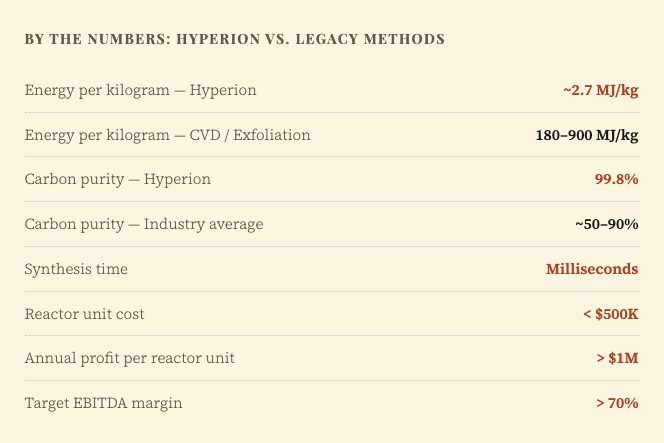
At 99.8% purity compared to an industry standard closer to 50%.
The company commercializing this is HydroGraph Clean Power. Their proprietary system is called the Hyperion reactor, and it works like this:
A measured mix of hydrocarbon gas and oxygen is ignited by a single electric spark. The resulting shockwave reaches temperatures above 2,550 Kelvin and pressures up to 300 psi within milliseconds. Under those extreme conditions, the hydrocarbon molecules dissociate and the carbon crystallizes into graphene nanosheets. The whole thing happens faster than you can blink.
The economics are almost embarrassing compared to legacy methods. Traditional graphene production consumes somewhere between 180 and 900 megajoules of energy per kilogram. The Hyperion system uses approximately 2.7 MJ/kg. The reaction is self-sustaining once ignited. And the byproducts, hydrogen and carbon monoxide, form what are called… syngas, another valuable commodity in the clean energy market. So you get high-purity graphene and a saleable clean energy byproduct from the same process, with no toxic solvents and no hazardous waste.
The revenue trajectory they describe is striking: from roughly $500K this year to over $10 million in contracted revenue next year, a 20x increase, as the company moves from pilot-scale into commercial production. They’re targeting applications in biosensors, plastics, defense, and automotive. The Texas facility, built in partnership with a major gas supplier for pipeline acetylene access, is expected to push annual capacity to hundreds of tons.
But here’s the thing — none of this is entirely new information. Someone was talking about this company and making exactly these arguments more than a year ago. Most people ignored him.
When Jay Taylor Was Calling It Early (And People Called Him Crazy)
Jay Taylor has been covering junior mining, hard money, and critical materials for longer than most financial journalists have been alive. He’s the kind of analyst who gets dismissed as a permabear crank until the thing he’s been warning about actually happens — at which point everyone pretends they knew all along.
More than a year ago, Taylor sat down to discuss HydroGraph when the stock was trading around $0.22. At that price, the company was producing 10 tons per year of pristine turbostratic graphene, had 6 to 7 customers requiring 1,000+ tons annually — a massive demand gap against existing supply — and was in discussions with the U.S. military on ballistic protection and aerospace components. A major automotive contract was expected by end of 2023 or 2024. The first large contract announcement was targeted for 2025.
Taylor and his guest Bob Moriarty also situated HydroGraph within a broader macro argument that regular readers of this newsletter will find familiar: a Western financial system that is mathematically bankrupt, a Fourth Turning cycle that demands hard assets and critical materials, and a window of opportunity for companies producing the physical building blocks of the next economy before the old one finishes coming apart.
Whether or not you subscribe to every piece of that macro framing — and I think there’s substantial truth to it — the point about critical materials independence is hard to argue with. HydroGraph is the only Verified Graphene Producer in the Americas. In a world where supply chains are being re-examined and domestic production of advanced materials is becoming a national security issue, that is not a trivial distinction.
The early believers who were paying attention a year ago when Taylor made this case were right. The question now is whether the story still has room to run from here.
Why This Matters Beyond the Lab
At this point you may be thinking…
Interesting chemistry, but who actually needs this stuff?
The answer turns out to be:
Everyone who makes anything physical. Here are the applications:
Concrete and cement.
Cement production is responsible for roughly 8% of global CO₂ emissions. It’s one of the hardest industrial sectors to decarbonize because the carbon comes from the chemistry itself, not just the energy source. Research conducted at Arizona State University found that adding HydroGraph’s graphene to concrete at just 0.02% to 0.04% by weight (very small amount) increased compressive strength by 15–21% after 28 days of curing and enabled a 16.7% reduction in total cement content while maintaining structural performance. Life cycle assessments show a 10–15% reduction in Global Warming Potential per cubic meter of concrete. If 1% of global annual concrete production incorporated graphene, the CO₂ savings would equal removing 2.7 million cars from the road every year.
Electric vehicles and lightweighting.
Every gram matters in an EV. Adding 0.05% of HydroGraph’s graphene to polypropylene increases impact toughness by 50%. The same dose in polyethylene delivers a 30%+ strength gain. For automotive engineers trying to extend range by replacing heavy metal components with reinforced plastics. Graphene-enhanced polymers also provide electromagnetic interference shielding for high-voltage EV electronics at a fraction of the weight of traditional metal shielding.
Energy storage.
In lead-acid batteries, HydroGraph’s graphene improves charge acceptance by 47%, which is relevant for micro-hybrid vehicles and grid storage. In lithium-sulfur and silicon-anode lithium-ion batteries, graphene acts as a conductive scaffold that absorbs volumetric changes and extends cycle life. This matters enormously for next-generation EV batteries.
Defense and subsea.
The U.S. Army Research Laboratory has engaged with HydroGraph through the University of Manchester on ballistic materials, aerospace stealth coatings, and domestic supply chain security. A September 2025 partnership with SEADAR Technologies targets subsea radar and sensing platforms. The application here is that graphene’s corrosion resistance, thermal conductivity, and structural reinforcement properties are uniquely suited to the extreme conditions of deep-sea deployment.
Regulatory green light.
In February 2026, HydroGraph received commercial-scale clearances from the US EPA (TSCA Section 5(e)), UK REACH, and EU REACH. For a company selling a nano-material into industrial applications, that triple clearance removes the legal uncertainty that has kept most industrial buyers on the sideline. It’s the equivalent of getting your product approved for three major markets in one month. The pipeline of potential customers just got a lot shorter.
The Business Model Is Worth Understanding
HydroGraph is not trying to make cars, pour concrete, or build batteries. They’re the ingredient company. The “Intel Inside” of graphene. They produce ultra-pure material and supply it to manufacturers who already have the customers, the distribution, and the industrial processing infrastructure.
The commercial template is their partnership with Hubron International, a global compounder that exports 85% of its production to automotive, construction, and electronics OEMs worldwide. Hubron takes HydroGraph’s graphene and turns it into ready-to-use masterbatch compounds that slot directly into existing factory equipment. So, no re-tooling required. That’s the key to shortening the adoption cycle in industries that are notoriously conservative about changing their recipes.
Their January 2026 upgrade to Tier 1 membership at the Graphene Engineering Innovation Centre at the University of Manchester, gives them a dedicated laboratory, access to world-class characterization equipment, and a seat on the Technology Advisory Board alongside Tier 1 aerospace and automotive manufacturers. The annual fee is over £225,000. It is not a vanity move. It puts HydroGraph at the center of a 75+ project commercial pipeline with the world’s most credible graphene institution as a co-validator.
HydroGraph is one of only three companies globally, and the only one in the Americas, to receive the Graphene Council’s Verified Graphene Producer certification. In a market saturated with “fake graphene” that is really just fine graphite, that matters.
— Graphene Council Certification Standards
The production footprint is designed for modularity. Each Hyperion reactor is about 6 feet by 6 feet by 18 feet. You can add production capacity in months, not years, and tie capital expenditure directly to signed customer demand. The Manhattan, Kansas facility started at 10 tons per year in 2022. Two additional reactors are now under construction. The Texas facility is targeting over 350 tons of annual capacity in the 2026–2027 period. The math on that, at $250K–$1M per ton and 70%+ margins, is the kind of math that explains a $1.5 billion market cap on near-zero current revenue.
Let me be direct about the risk here, because you don’t need to be talked into things…
The Honest Caveats
The stock has run hard. A market cap of $1.3–1.6 billion on trailing twelve-month revenue of roughly $43,000 is pricing in an enormous amount of future success. That is not automatically wrong. Early-stage materials companies often get valued on potential, but it means the margin for execution error is slim.
The construction and automotive industries move slowly. Commercial adoption typically requires multi-year validation cycles. The Texas facility needs to deliver on schedule. The 75+ pipeline projects need to convert into revenue. None of that is guaranteed.
And anyone who has watched the junior mining and cleantech space for more than a few years knows this pattern:
Transformative technology –> credible science –> real partnerships –> stock that got ahead of itself
Sometimes those stories end in heartbreak. Sometimes they end in life-changing returns. The difference usually comes down to whether production economics hold up at scale and whether management can execute through the commercial adoption valley.
With all of that said:
The science here is peer-reviewed and published. The regulatory clearances are real and hard-won. The certifications are independently verified. The university partnerships are substantive, not ornamental. And two credible analysts, Jay Taylor, who was early and largely ignored, and Adam Taggart, who is now amplifying the story to a much larger audience have independently done their homework and arrived at the same place.
Graphene has been promised to us before and underdelivered. But the detonation synthesis process is genuinely different, and that makes it more than an incremental improvement on existing methods, but a fundamentally different approach that sidesteps most of the cost and purity problems that killed previous commercial attempts. When you can produce a material at 99.8% purity using 100 times less energy than your competitors, while generating a valuable clean energy byproduct and leaving no hazardous waste, you don’t have a marginal advantage. You have a structural one.
Graphene may finally be arriving twenty years late, but it’s here.
Also, here’s the most recent interview with HydroGraph CEO, Kjirstin Breure by Adam Taggart:
References
Technology & Production
- Sorensen, C.M. et al. — Synthesis of turbostratic nanoscale graphene via chamber detonation of oxygen/acetylene mixtures — ResearchGate
- Chamber explosion synthesis of fractal aggregate graphene — ResearchGate
- HydroGraph — FGA-1 Fractal Graphene Technical Datasheet (Version 8) — hydrograph.com
- Detonation technique to mass-produce graphene patented — ChemEurope
Company & Commercial
- HydroGraph Clean Power — Investors Overview — hydrograph.com
- HydroGraph — Hyperion Detonation Technology — hydrograph.com
- Kansas State University — A big bang: K-State graphene research leads to new company HydroGraph — k-state.edu
- HydroGraph — Graphene Production Technology Delivers Lowest Environmental Impact — hydrograph.com
Cement & Construction
- HydroGraph — ACS Journal Validates HydroGraph Cement Performance — hydrograph.com
- HydroGraph — New Study Reveals HydroGraph’s Fractal Graphene Enhances Cement Performance — hydrograph.com
Polymers & Lightweighting
- HydroGraph — Revolutionizing Material Efficiency: Fractal Graphene-enhanced polymers — hydrograph.com
- Hubron International — Graphene in HDPE Blow Molding Study — hubron.com
- HydroGraph Partners with Hubron for Graphene — Plastics Today
Regulatory & Certifications
- HydroGraph — Receives US EPA, UK REACH, and EU REACH Regulatory Clearances — Nasdaq / advancedcarbonscouncil.org
- HydroGraph — Achieves ISO 9001:2015 Certification — hydrograph.com
- HydroGraph — First Company in Americas to Receive Graphene Council’s Verified Graphene Producer Certification — hydrograph.com
Partnerships & Expansion
- University of Manchester — HydroGraph and GEIC Expand Collaboration to Drive the Graphene Age — manchester.ac.uk
- GlobeNewswire — HydroGraph and GEIC Expand Collaboration through Tier 1 Membership — globenewswire.com
- HydroGraph & SEADAR Technologies — Agreement to Advance Subsea Radar Platforms — Investing News Network
Market Research
- IDTechEx — Graphene & 2D Materials 2026–2036: Technologies, Markets, Players — idtechex.com
- IDTechEx — The graphene market to reach 3,800 tonnes per year in 2026 — idtechex.com