
Written by Bryan Lutz, Editor at Dollarcollapse.com:
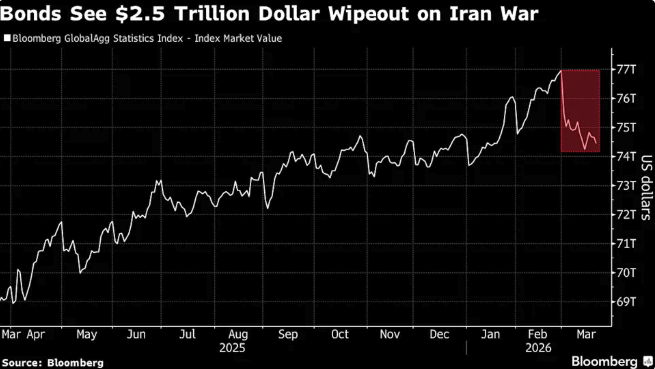
The global bond market is cracking.
Since the start of March, the Iran war has torched more than $2.5 trillion in bond value worldwide. That puts this month on pace for the biggest monthly loss since 2022, when the Fed was mid-rampage through one of its most aggressive rate-hike cycles in history. Government debt is leading the carnage, down 3.3% in a single month. Corporate bonds aren’t far behind.
Nowhere is this more alarming than Japan.
Since the massive money printing scheme of 2020, Japan has been unable to cure rising inflation, and government bond yields.
Bloomberg reports:
Japan Bond Yields Near Multi-Decade Highs as War Fuels Inflation.
“Japan’s government bonds fell on Monday morning, pushing yields back toward multi-decade highs, as concerns mount that the widening conflict in the Middle East will stoke inflation.
Futures dropped as much as 59 ticks to 130.62, while the 10-year bond yield rose six basis points to 2.32%, near its highest level since 1999 that it hit in January. The five-year yield jumped 5 basis points to 1.72%, taking it to within a whisker of its highest since its debut.”

Meanwhile, the oil shock is hitting Japan particularly hard. The country just launched its largest-ever strategic oil reserve release (80 million barrels) as the Strait of Hormuz remains effectively closed and Brent crude sits at $104 a barrel. Roughly 70% of Japan’s naphtha supply comes from the Middle East. As a result, plastics manufacturers have already started cutting output. Car exports to the region, which account for 15% of Japan’s total vehicle exports, are also seizing up. This latest release of oil is the last gasps of a economy being pushed into a an inflationary death spiral by global events.
The Japan Times reports:
Japan begins its largest-ever oil release from strategic reserves
“Japan started the largest-ever release of oil from its strategic reserves on Monday, an 80 million-barrel effort as the Strait of Hormuz stays effectively closed amid the U.S.-Israeli war with Iran and crude oil prices continue to soar.
The release — 15 days’ worth of domestic demand from mandatory private reserves and one month from national reserves — was the seventh ever conducted in the nation.
The private reserve release is being carried out by lowering the required stockpile amount, from 70 days to 55 days, initially for one month. The government has also decided to transfer one month’s worth of national petroleum reserves for the time being, the Economy, Trade and Industry Ministry announced Monday…
…Japan holds stockpiled oil equivalent to about 254 days of domestic demand — including 146 days worth of oil in national reserves, 101 days in mandatory private stockpiles and seven days under a reserve program with oil-producing countries. Monday’s release is roughly 17.7% of the total amount.”
Japan is simultaneously facing an energy supply shock, a currency in freefall, and bond yields spiraling toward levels unseen in a generation.
One of the biggest “boots-on-the-ground” symptoms of Japan’s inflationary death spiral are rapidly increasing wages. Japanese companies just announced the biggest wage hikes in 35 years, a 5.26% average increase, slightly topping last year’s record. On the surface, this sounds like a win. Workers finally getting a raise after decades of stagnation.
But here’s the problem. Those wage gains are feeding directly into prices. Companies pass higher labor costs onto consumers. Higher prices force workers to demand even higher wages. The Bank of Japan, which spent 30 years desperately trying to create inflation — has now lost control of the dial. Rate hikes are coming, possibly as early as April, with markets pricing a 60% chance. And every rate hike piles more pain onto a government carrying the world’s largest debt-to-GDP ratio.
This is not a Japanese growth story. It is an inflationary death spiral with another big symptom: a wage-price spiral.