
The House of Saud is done with the West.
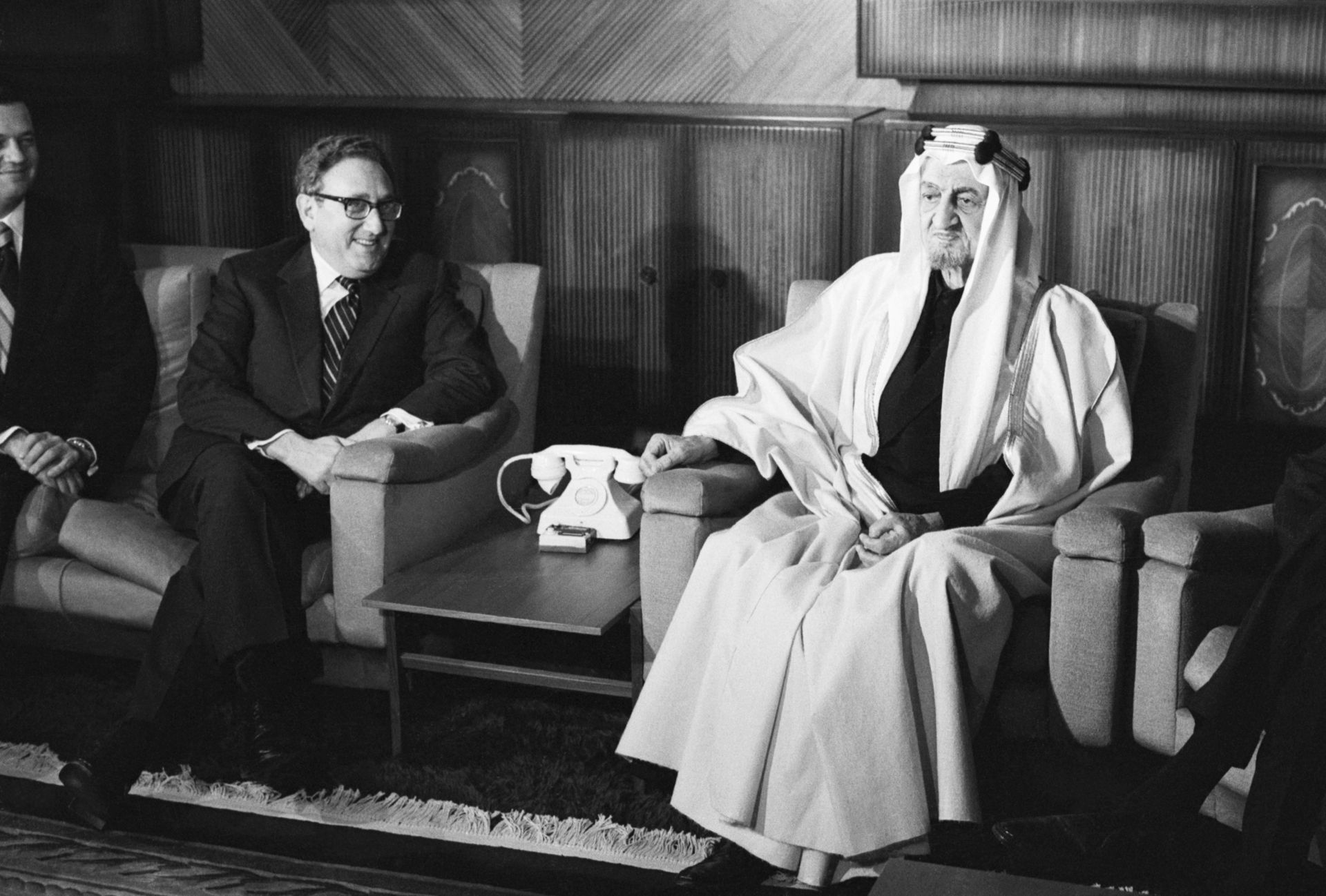
Not in the dramatic, burn-the-bridges sense. In the quieter, more consequential sense of a business partner who lets a contract lapse, stops returning calls as promptly, and starts taking meetings with your competitors. The fifty-year petrodollar agreement that Henry Kissinger brokered with King Faisal in 1974 expired in June 2024. The Saudis chose not to renew it. Washington chose not to make a public fuss, because making a public fuss would have forced everyone to acknowledge what happened.
Two years later, the consequences are no longer deniable. The UAE is shopping for currency swap alternatives. The Gulf is pivoting toward Beijing. Hong Kong is rewiring dollar plumbing. The Strait of Hormuz has become a chokepoint on the dollar itself.
But to understand where this ends, you have to understand where it started. And “started” does not mean 1974. It means 1944.
source: https://newlinesmag.com/argument/how-henry-kissinger-bungled-the-arab-oil-embargo/
The Pattern Repeats Because the Problem Never Changes
Every monetary order in modern history has followed the same arc. A system is built on a credible anchor. The anchor is gradually abandoned because political convenience demands it. A substitute anchor is improvised to paper over the abandonment. The substitute works for a while, then fails. Crisis follows. A new system is built.
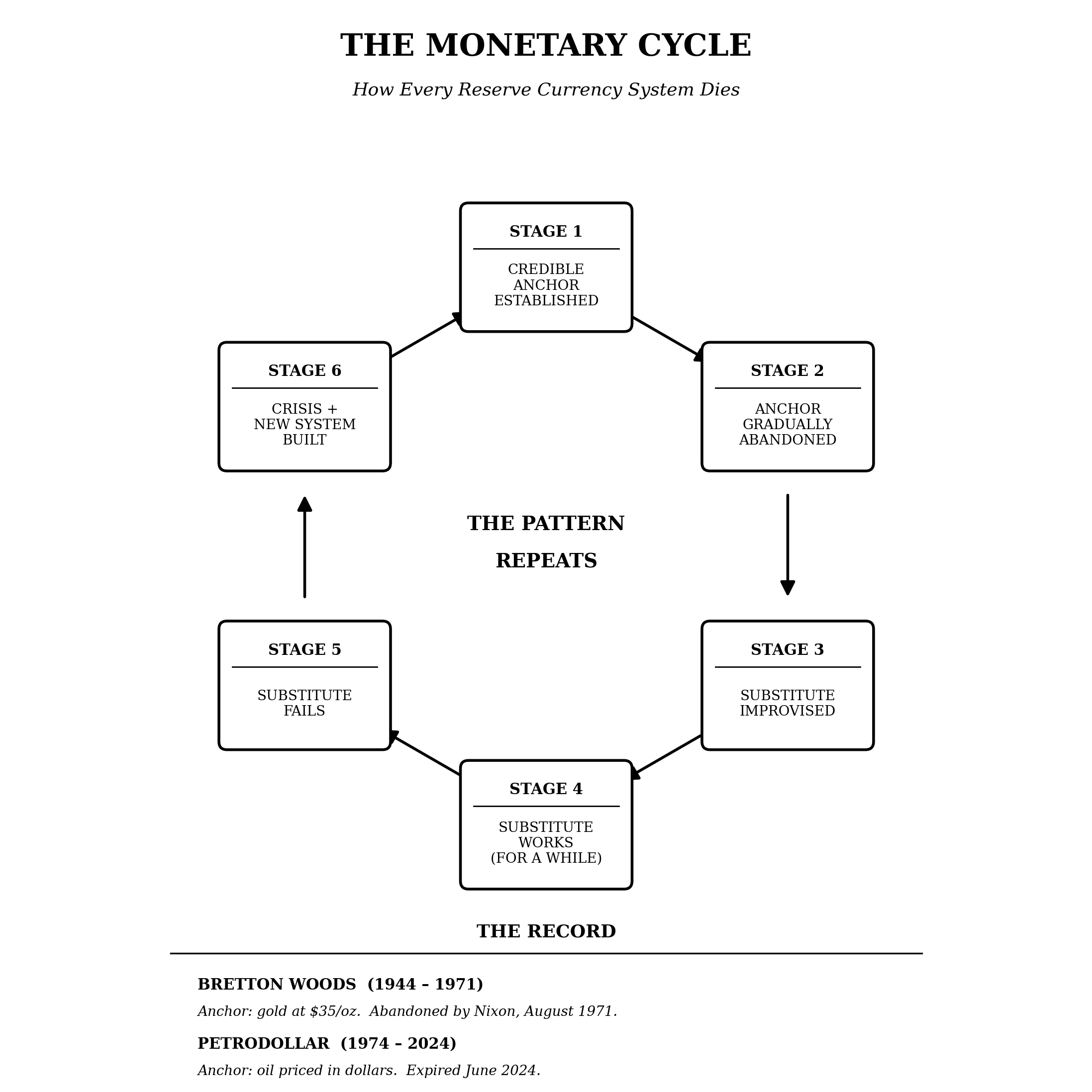
The United States has run this playbook twice in eighty years. We are now watching it fail for a third time.
Act One: Bretton Woods, 1944 to 1971
In July 1944, delegates from forty-four nations gathered at the Mount Washington Hotel in New Hampshire and agreed to a new global monetary system. The dollar would be convertible to gold at $35 per ounce. Other currencies would peg to the dollar. This made the dollar the world’s reserve currency, but with a catch…
Any nation holding dollars could, in theory, exchange them for physical gold.
The system worked. For roughly twenty-five years, global trade expanded, inflation stayed manageable, and America’s creditors had real recourse if Washington misbehaved.
Then Washington misbehaved.
Lyndon Johnson wanted to fund both the Vietnam War and the Great Society without raising taxes. The printing press filled the gap. By the late 1960s, foreign central banks were doing the math: there were vastly more dollars in circulation than there was gold in Fort Knox to redeem them. France’s Charles de Gaulle was first to call the bluff, shipping dollars back and demanding gold in exchange. Others followed.
On August 15, 1971, Richard Nixon went on television and unilaterally closed the gold window. He called it “temporary.” It has now been temporary for fifty-five years.
The lesson of Bretton Woods is the lesson every gold-backed system eventually teaches:
Politicians will not tolerate the limitations of gold when those limitations (a budget) becomes politically inconvenient. They will always find a reason to break the link.
Act Two: The Petrodollar, 1974 to 2024
By 1973, the dollar was backed by nothing. Confidence was collapsing. The Arab oil embargo had quadrupled crude prices. The global monetary order was staring into an abyss.
Kissinger and Treasury Secretary William Simon improvised the fix. The Saudis would price oil exclusively in dollars and recycle their surpluses into US Treasuries. In return, America would provide security guarantees and weapons. Within a year, the rest of OPEC followed. Every country that needed oil now needed dollars. Every oil exporter became a captive Treasury buyer.
This was the substitute anchor. Not gold, but oil. Not physical redemption, but structural demand.
It worked, mostly. For fifty years, the petrodollar loop subsidized American borrowing costs, propped up the dollar’s reserve status, and allowed Washington to run deficits that would have been unthinkable under Bretton Woods. The discipline that gold had imposed was replaced by the demand that oil created.
But substitute anchors are not real anchors. They depend on the willingness of foreign nations to continue participating. That willingness is not a commodity. It is a relationship.
Over time, three things happened that the architects of the petrodollar did not plan for. The United States became a net oil exporter, eliminating its direct need for Gulf supply. Washington began weaponizing the dollar system, first against Iran, then Russia, then anyone who stepped out of line. And the Saudis noticed, particularly after watching Russia’s reserves get frozen in 2022, that the dollar system had become a liability rather than a utility.
In June 2024, the Saudis let the arrangement expire.
Act Three: Whatever This Is
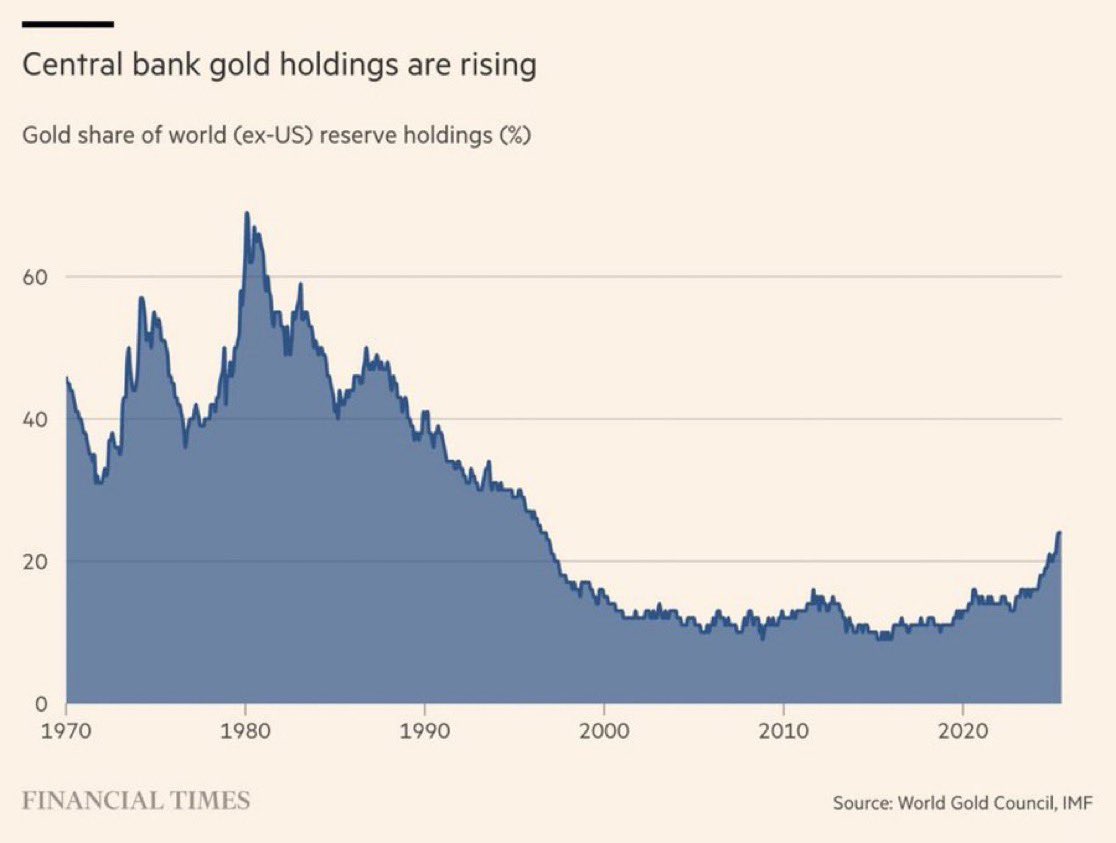
Which brings us to now. The petrodollar substitute is dead. The UAE is exploring currency swaps. Hong Kong is building yuan settlement infrastructure that bypasses SWIFT. Central banks are buying gold at the fastest pace in history, with purchases since 2022 running at more than twice the 2015-2019 average. Foreign central banks have been net sellers of Treasuries for months, with holdings at the New York Fed dropping to the lowest level since 2012.
Washington’s response to all of this has been to reach for another substitute. Stablecoin legislation to manufacture synthetic dollar demand through crypto rails. Aggressive sanctions enforcement to force compliance. Military action at Hormuz to remind everyone who polices the shipping lanes.
These are more of the same improvisations that produced the petrodollar, repeated with less credibility and more desperation. The pattern is same: the anchor has been abandoned, so Washington looks for something, anything, that can generate structural demand for dollars without imposing discipline on the issuer. Meanwhile, Central Banks keep accumulating the gold.
What History Actually Teaches
Two generations of monetary architecture have now failed for the same underlying reason. You cannot run a global reserve currency on political promises alone. You need something the issuer cannot conjure into existence by typing numbers into a spreadsheet.
Bretton Woods failed because Washington found gold inconvenient. The petrodollar failed because Washington found trust inconvenient. Any successor system built on another improvised substitute, whether that is stablecoins, CBDCs, a new basket currency, or a digital SDR, will fail for the same reason. Constraints on the money supply have to come from something outside the political process, or they will not come at all.
We are not creating some kind of goldbug fantasy. The cycle we’re referring to is the actual record of what has happened every time a monetary system tried to escape the gravity of a hard anchor. The Romans learned it with their silver coinage. The French learned it with John Law’s paper experiment. The Weimar Republic learned it. Zimbabwe learned it. Argentina learns it every decade.
The next global monetary order, whenever and however it arrives, will have to be built on something with three properties. It has to be scarce, meaning its supply cannot be expanded by decree. It has to be neutral, meaning no single government can weaponize it. And it has to be verifiable, meaning participants can confirm the anchor exists without trusting the issuer.
There is exactly one asset in human history that has consistently met all three tests. Central banks, led by the non-Western world, have spent three years accumulating it at the fastest pace on record. And they are doing this because they have done the math and reached the same conclusion that every previous generation of central bankers eventually reached.
The petrodollar is dying because the petrodollar was always a workaround. Commodity-exchange schemes, debt-based reserves, and political guarantees have had their run. A system built on gold imposes costs on its issuer (which is something we actually want). It was the feature that made Bretton Woods work for twenty-five years, and the feature whose absence has made every system since a slow-motion failure.
They will reach once again for an improvised substitute and set the clock ticking on Act Four.

4 thoughts on "The Lesson Washington Refuses to Learn: From 1944 to 2026, Every Dollar System Dies the Same Way"
Excellent presentation Bryan. I’m sending it to my children and grandchildren, so when they ask why are things so expensive and out reach, they’ll be able to see why.
Thank You,
Bill Anderson
Much appreciated, Bill.
Thanks for this excellent article… re affirming my memory of our history of the dollar’s issues and manipulations since Bretton Woods… and one great article for the general public that has found your site and reads it daily as I have for quite some time now… appreciate you… be safe, stay safe…
Ciao,
J Daniel
Thanks, Daniel. Take care.