
Written by Bryan Lutz, Editor at Dollarcollapse.com:
April 5, 1933.
Franklin Roosevelt signed Executive Order 6102 from the White House. The order was titled “Forbidding the Hoarding of Gold Coin, Gold Bullion, and Gold Certificates Within the Continental United States.”
Every American had until May 1 to hand over their gold to a Federal Reserve bank at the official price of $20.67 per ounce.
The penalty for non-compliance was a $10,000 fine, ten years in prison, or both…
Nine months later, on January 30, 1934, Congress passed the Gold Reserve Act and revalued gold to $35 an ounce.
Anyone who obeyed FDR’s order in April 1933 lost a third of their purchasing power on the spot.
The government made $14.33 of profit on every ounce it had just bought from its own citizens.
That is what Stage 5 of Currency Grief looks like. And it did not arrive out of nowhere.
The United States ran every previous stage in the four years leading up to that signature. Denial. Suppression. Rationing. Controls. Then the metal was taken.
Forty-seven months. That is how long the sequence took to run on American soil…
Stage 1: Denial, 1929 to 1930
Denial is the public stance that the system is fine.
October 1929: the Dow lost 13% in a single session, then another 12% the next day. By the end of the month, it had lost half its value.
Hoover’s response, that same month: “Any lack of confidence in the economic future or the strength of business in the United States is foolish.”
1930: “The worst is behind us.”
December 1931, Hoover’s annual message to Congress, after two years of accelerating bank failures: “Our currency and bank deposits are protected by the greatest gold reserve in history. No external drain on our resources can threaten our position.”
That sentence aged as well as Powell’s “transitory.”
Within nine months of Hoover saying that everything was fine, the Federal Reserve Bank of New York had fallen below the legal gold reserve requirement.
Stage 2: Suppression, 1931
Suppression is the active attempt to stop the gold drain by using official tools.
September 21, 1931. Britain abandoned the gold standard.
Within weeks, foreign investors started converting their dollar holdings to gold at the U.S. Treasury, fearing the dollar would be next.
The Federal Reserve had a structural problem under the Federal Reserve Act of 1913. Every Federal Reserve Note in circulation required 40% gold backing. Every ounce of gold that walked out of the Treasury reduced the amount of currency the Fed could legally issue.
So the Fed did what suppression always does. It used policy to defend the gold reserves. It raised interest rates in the middle of a deflationary depression. Then bank failures more than tripled, which resulted in 2,293 banks suspending operations in 1931 alone…
The Fed launched a billion-dollar open-market purchase program in April 1932 to try to offset the drain. It was an early version of QE, conducted under a gold standard. Yet, it failed to stop the bleeding.
Stage 3: Rationing, 1932
Rationing is when the government stops fighting the price and starts asking citizens to behave differently.
In February 1932, Hoover issued a public statement titled “On the Hoarding of Currency.”
The text could be Modi’s speech from this past weekend with the proper nouns swapped.
Hoover said:
“Every dollar hoarded means a destruction of from $5 to $10 of credit. Every dollar returned from hoarding to circulation means putting men to work. Everyone hoarding currency injures not only his own prospects and those of his family, but is acting contrary to the common good.”
He called it “patriotic service.” He invoked World War I. He asked Americans to put their money back into the banks.
In a radio address shortly after, Hoover called hoarders “traitorous.”
Murray Rothbard observed that Hoover’s anti-hoarding campaign worked, briefly. Currency hoarding peaked in July 1932 and stayed below that peak until February 1933.
The voluntary phase bought the government seven months…
Then it stopped working.
Stage 4: Controls, Late 1932 to March 1933
Controls are when the asking ends and the regulation begins.
October 31, 1932. Nevada declared the first state banking holiday in U.S. history. It was supposed to be temporary.
January 1933: Iowa, then Louisiana, declared their own.
February 14, 1933: Michigan, the home of the auto industry, declared an eight-day bank holiday after the RFC refused to bail out two large Detroit banks. Then Michigan holiday triggered a national run.
Americans withdrew $1.8 billion in gold and currency in February and early March. Two-thirds of it was gold.
By Inauguration Day on March 4, nearly every bank in America had either closed or was operating under emergency state rules.
The New York Fed had fallen below its legal gold cover ratio.
George Harrison, Governor of the New York Fed, sent a communique to Washington. He wrote that he would “no longer take responsibility” for running the bank “with deficient reserves.”
March 6, 1933. At 1:00 a.m., Roosevelt issued Proclamation 2039. Every bank in the United States was ordered closed. Gold export was prohibited. The 1917 Trading with the Enemy Act, a wartime statute, was the legal authority.
March 9, 1933. Congress passed the Emergency Banking Act in a single evening. The Act retroactively legalized everything Roosevelt had done over the weekend and amended the Trading with the Enemy Act to apply to any future national emergency declared by the President.
The controls were now permanent…
Stage 5: Confiscation, April 5, 1933
Stage 5 is when the government takes the metal.
April 5, 1933. Executive Order 6102. Every individual, partnership, association, and corporation in the continental United States was ordered to surrender their gold coin, gold bullion, and gold certificates to the Federal Reserve by May 1.
Surrender price: $20.67 per ounce.
Penalty for non-compliance: $10,000 and ten years.
The exemptions were narrow. A personal allowance of $100 in gold coin. Gold required for “legitimate and customary use in industry, profession or art.” Rare collector coins. Gold held in trust for foreign central banks.
That was it.
The Reconstruction Finance Corporation began buying gold on the open market at progressively higher prices throughout the summer and fall of 1933. The dollar was being deliberately devalued in real time.
January 30, 1934. The Gold Reserve Act was signed. It transferred all Federal Reserve gold to the U.S. Treasury, prohibited the redemption of dollars into gold, and authorized Roosevelt to set the official gold price.
Roosevelt set it at $35.
The Federal Reserve’s gold holdings, valued on its books at $20.67, were instantly worth 69% more. The Treasury used the paper profit to capitalize the Exchange Stabilization Fund.
The math worked. The gold cover ratio was restored. And the Fed could expand the money supply again.
The cost was paid by every American who had handed in their gold nine months earlier.
Here is the sequence on a single chart:
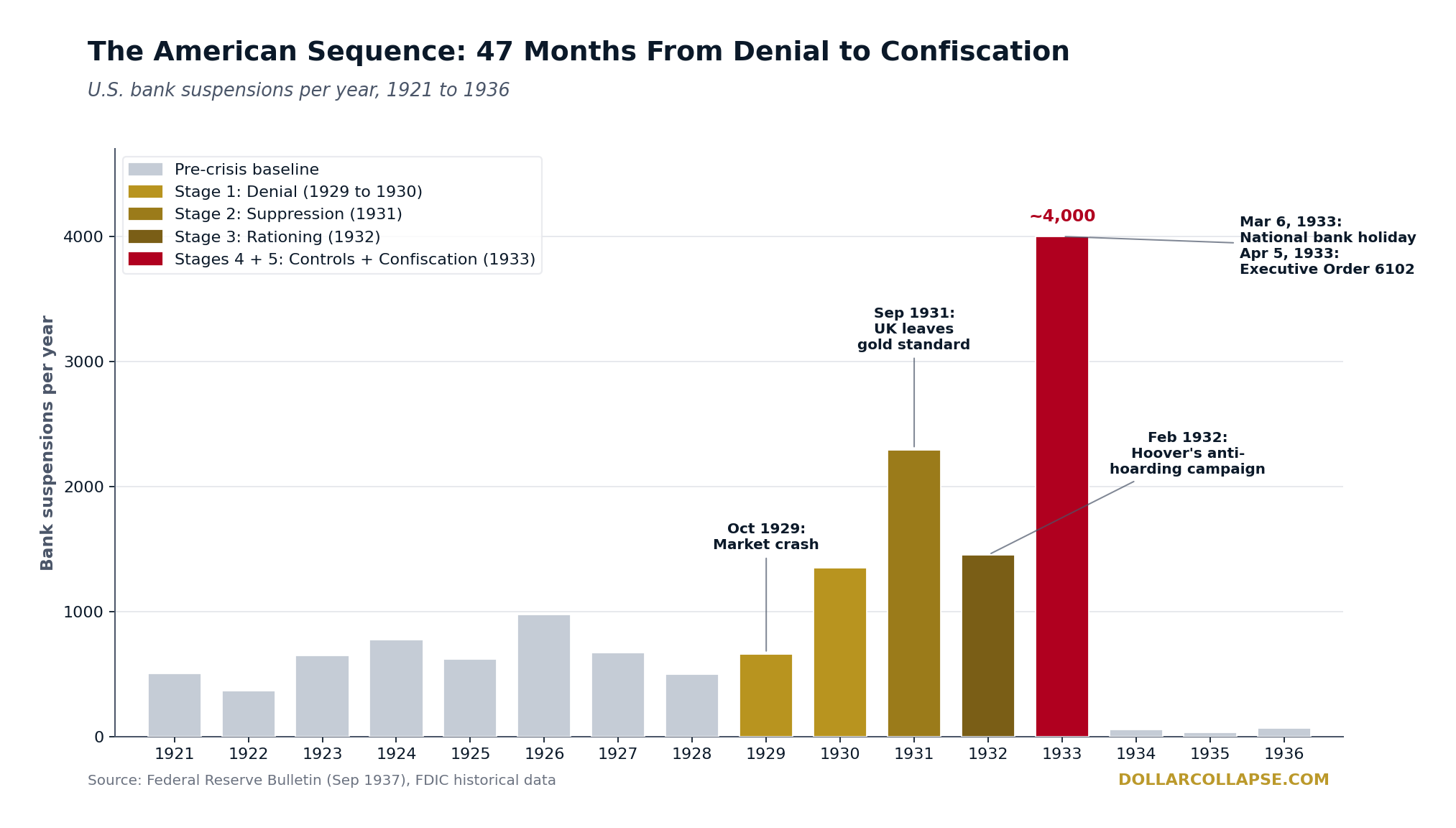
Bank failures ran at roughly 500 per year through the 1920s. They tripled in 1930. They peaked at 4,000 in 1933. They dropped to near zero immediately after Stage 5.
That last detail matters. The government’s intervention worked. Confiscation stabilized the banking system…
It also cost American citizens a third of their wealth, ended forty-one years of legal private gold ownership, and stripped the Federal Reserve of its independent monetary policy until the 1951 Fed-Treasury Accord.
The bill is always paid by the people holding the metal at the wrong moment.
Where We Are Now
The American sequence ran from October 1929 to April 1933.
Roughly four years from crash to confiscation.
The 2026 sequence is already underway. Stages 1 through 4 are running in plain sight, and the pattern is the same as it was in the lead-up to FDR.
Stage 1, Denial, is the current official position of every G7 finance ministry. The dollar’s reserve role is “structurally durable.” The inflation is “moderating.” The fiscal trajectory is “sustainable.”
Stage 2, Suppression, is the modern paper-gold market. COMEX futures trade roughly 100 ounces of paper for every ounce of physical metal. The mechanism is different from the 1961 London Gold Pool. The function is identical.
Stage 3, Rationing, ran this past weekend. Narendra Modi asked 1.4 billion Indians to stop buying gold jewelry for a year and to cut fuel use and overseas travel. Modi quoted the rupee shortage. Hoover quoted the credit shortage. The vocabulary changed. That’s all.
Stage 4, Controls, is already running. The OFAC desk in Washington has spent the last four years rehearsing the playbook on Russian central bank reserves, which has inspired many other central banks to turn to gold buying.
So Stage 5 may be an alternate ending this time. Here’s where 2026 stops rhyming with 1933…
Stage 5 Will Most Likely Be Different This Time (Not Confiscation)
In 1933, the U.S. government took gold because it needed gold.
The Federal Reserve Act required 40% gold backing on every Federal Reserve Note. The Fed was up against the legal limit. Foreign investors were draining the Treasury at $20.67 an ounce. The math was broken. The only way to restore the gold cover ratio was to take the citizens’ metal and revalue it.
That same structural problem does not exist in 2026.
The Federal Reserve abandoned the gold cover requirement in 1968. Then Nixon closed the gold window in 1971. Then Congress set the statutory gold price at $42.22 in 1973 and never touched it again.
The Federal Government doesn’t need to come for your gold this time. It already has roughly 261.5 million ounces of it…
The Treasury sits on roughly 8,133 tonnes of gold, currently carried on the federal balance sheet at $42.22 per ounce.
Total book value: $11 billion.
Total market value at $5,000 gold: roughly $1.3 trillion.
The time between $11 billion and $1.3 trillion is the Stage 5 of 2026.
Here is the mechanism:.
It is described on page 12 of the Federal Reserve’s Financial Accounting Manual for Federal Reserve Banks. Congress, or the President by executive order, raises the statutory price of gold. The Treasury issues new gold certificates to the Fed at the new price. The Fed credits the Treasury General Account for the difference.
No new debt is issued. No physical gold changes hands. No citizen surrenders an ounce.
So, gold revaluation isn’t a fringe idea anymore. Quite a few experts have been making their guesses over the past few years.
Luke Gromen has sketched out a $20,000 revaluation that would create $5 trillion in TGA capacity and drop debt-to-GDP from 122% to 70% overnight.
Tavi Costa has shown that a $55,000 revaluation would back 40% of outstanding Treasuries, the same ratio as World War II.
Judy Shelton has proposed a 50-year gold-convertible Treasury bond targeted at a July 4, 2026 launch date.
And, the Federal Reserve’s own staff published an academic note in August 2025 titled “Official Reserve Revaluations: The International Experience.”
Treasury Secretary Bessent said it on camera in February 2025 with Trump standing next to him. To paraphrase, he said something like, “We’re going to monetize the asset side of the U.S. balance sheet.”
The 1933 playbook took the citizens’ gold and revalued it. The 2026 playbook leaves the citizens’ gold alone and revalues only the government’s stack…
The math works better, actually.
Because the government is no longer constrained by the gold cover ratio, it can revalue to any price it wants. The political cost is lower because no one has to surrender a coin. The benefit is the same. The dollar gets devalued against gold. The debt gets cheaper to service. The system gets recapitalized.
There are a few different versions of a new monetary system.
The quiet version is a series of revaluations spaced over a few years, dressed up as accounting reforms.
The loud version is a gold-backed Treasury issue with a published convertibility ratio.
The hard version is a new international agreement with the dollar reanchored to something tangible after a managed crisis.
All three end at the same place. Gold is repriced higher. The dollar is repriced lower.
And the Federal government recapitalizes its balance sheet without coming through your front door.
What This Means for You
In 1933, the people who lost were the people who held physical gold and obeyed the order to surrender it. The people who won were the foreigners and the banks who got paid in dollars and re-bought gold after the revaluation.
In 2026, the math inverts.
The people who lose are the people who hold dollars and dollar-denominated debt and watch them get marked down against gold by government decree. The people who win are the people who already own the metal when the revaluation prints. Because no one is being asked to surrender it.
Your gold is not at risk of confiscation. Your gold is at risk of being repriced for you, by a government that needs the gap between $42.22 and $5,000 to close a fiscal hole it cannot close any other way.
The American sequence ran in 47 months from crash to confiscation in 1933.
This sequence has been running for fifteen years already. It does not need a final executive order. It needs an accounting entry.
When that accounting entry happens, the ounces you hold will be worth what the government decides they should have been worth all along…
Governments do not announce Stage 5. Confiscation, or re-valuation… They run Stages 1 through 4, and then they run out of room.
The order is always the same.
Denial. Suppression. Rationing. Controls. Revaluation (this time).