
***Obligatory forward-looking statement: This is not investment advice. Anyone considering what is said in this email or from the author should consult a licensed financial advisor before taking action or making any purchases.
—
“You cannot expect the people who sell you umbrellas to tell you when it’s going to stop raining.”
~ The Dollar Collapse Playbook
Written by Bryan Lutz, Editor at Dollarcollapse.com:
The 30-year Treasury pays 5.08% today.
Sounds respectable… until you ask what a fixed-dollar promise from a $39.5 trillion debtor is worth over three decades.
Wall Street desks had a nickname for this trade back when it paid 2%:
“Return-free risk.”
At 5%, the name still fits.
The latest headlines from mainstream media tell you where we are.
CNBC reports, May 19:
30-year Treasury yield tops 5.19%, highest since before the financial crisis
“Yields on U.S. Treasurys advanced Tuesday as investors continued to dump bonds on fears inflation is reigniting. The 30-year Treasury yield hit the highest level in nearly 19 years…
The longer-dated 30-year Treasury bond yield was last trading more than 3 basis points higher at 5.183%. It briefly hit 5.197% during the session, marking its highest level since July 2007.”
And Bloomberg reports, July 9:
US 30-Year Bond Auction Set to Draw Highest Yield in 20 Years
“An auction of 30-year Treasury bonds Thursday drew the highest yield in nearly 20 years, underscoring how swelling bond supply is driving investors to demand higher returns from government debt.
The bonds were awarded at 5.058%. While the auction result was the highest since 2007, it was lower than anticipated, suggesting that demand exceeded expectations. In pre-auction trading just before 1 p.m. New York time, the bidding deadline, the yield was 5.061%. Existing 30-year bonds have traded at yields as high as 5.20% this year.
Unlike shorter-maturity Treasury yields, which are more sensitive to changes in the Federal Reserve’s target for overnight lending rates, the 30-year bond’s yield tends to rise and fall with expectations for economic growth, inflation and the US government’s borrowing needs. There’s been upward pressure on all of those over the past year.
Long-maturity Treasury yields are likely to continue to climb particularly because of increased borrowing, not only by governments around the world but also by companies to finance artificial intelligence infrastructure, Gregory Peters, co-chief investment officer at PGIM Credit, said on Bloomberg Television.”
The bond market has spent six years marking up the price of a 30-year loan to Washington.
Here’s the story in one chart:
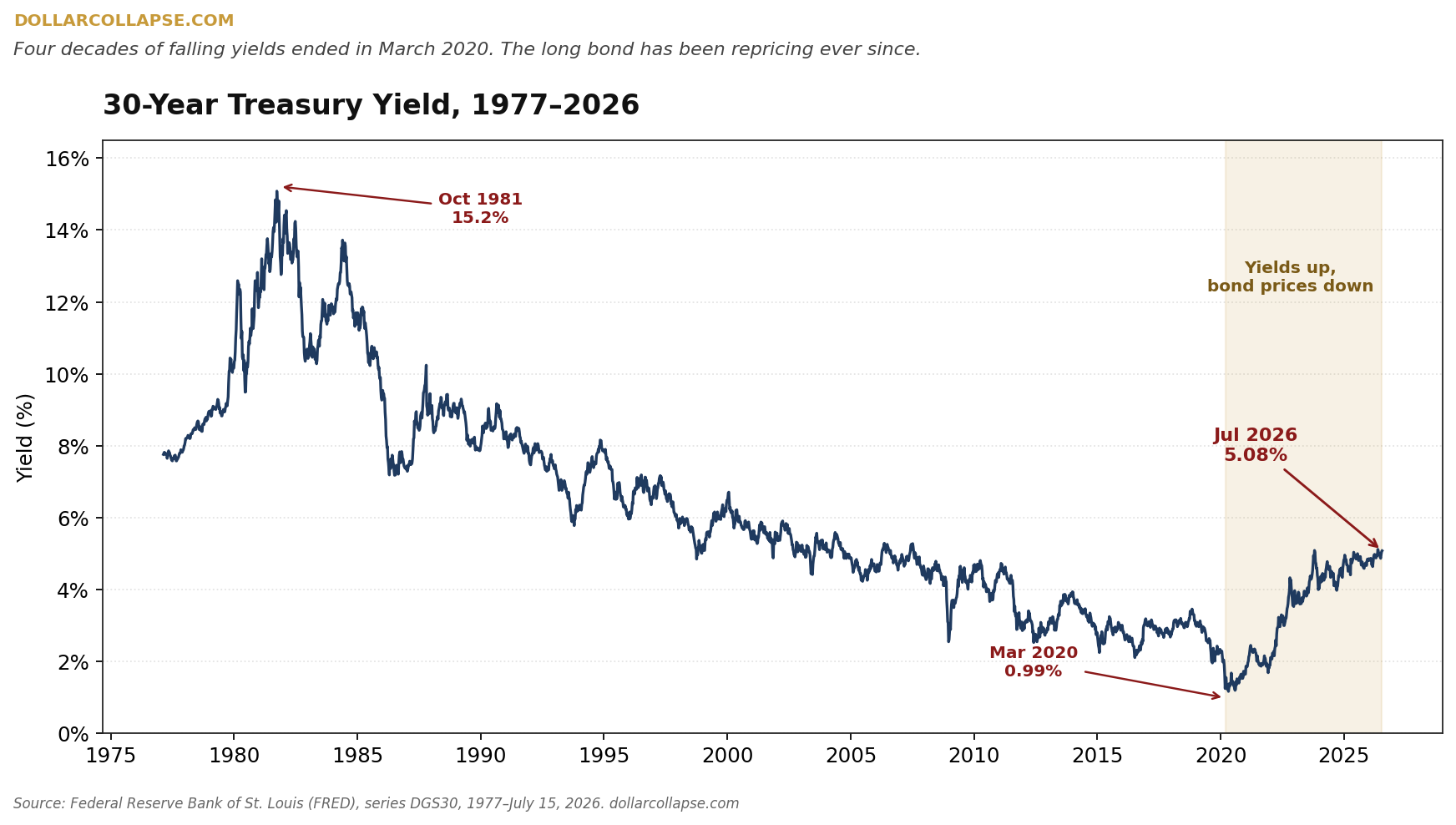
Four decades of falling yields ended in March 2020. Since then, bondholders have been paying for what they initially bought.
Now, the part the fund companies leave out of the brochure.
If you own a target-date fund, the one in your 401(k) with a retirement year in its name, a “balanced” fund, or anything with “total return” in the name, the Dollarcollapse Playbook pegs the long-bond share buried inside at 30 to 50%. You never picked that position. Most likely it was formula picked for you by a banker the day you chose your retirement year.
And duration math is mechanical. No committee meets or forecast are required:
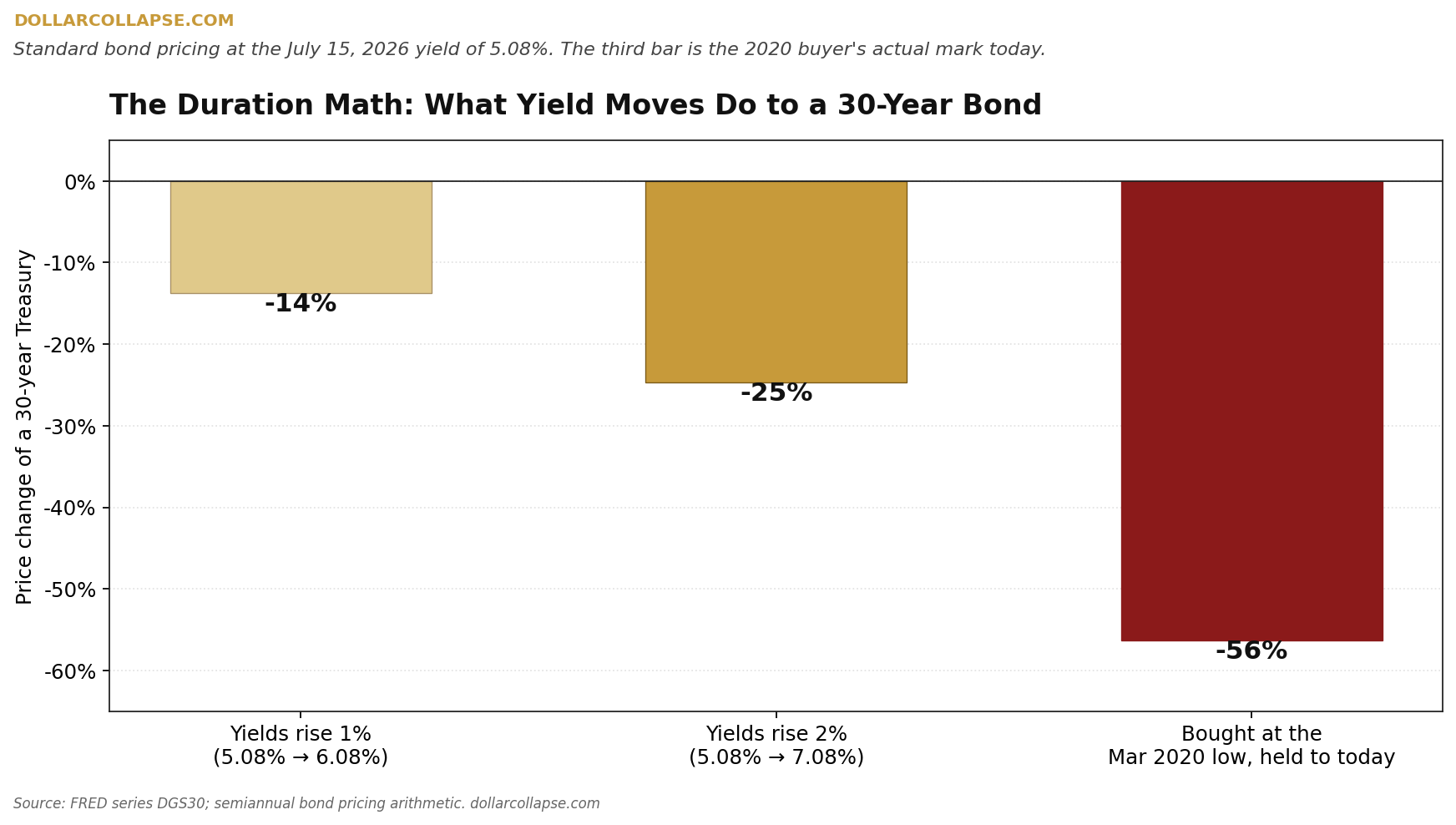
A 1% rise in long yields takes about 14% off a 30-year Treasury. A 2% rise takes about 25%. And whoever bought the March 2020 low sits on a 56% loss today… in the world’s “safest” asset.
So, Move 3 of the Dollarcollapse Playbook: audit every 401(k), IRA, and brokerage account for long-duration funds (TLT, VGLT, EDV) and for the long bonds hidden inside target-date and balanced funds. Swap that sleeve into short-duration Treasuries: SHY, SHV, or BIL. In a 401(k) with a thin menu, the stable value fund does the job.
Also, here’s two things to avoid:
1. Leveraged inverse bond ETFs like TBT bleed value through derivatives decay; they are trading tools, not holdings.
2. And don’t dump everything in one afternoon… exit over several weeks.
To be clear, this is not a default call. Uncle Sam will pay every coupon. He’ll pay it in dollars that buy less each year, which is the entire problem…
Lend short if you must lend at all, and keep your long-term trust for our favourite safe haven, the one that promises no dollars because it doesn’t need to.
The long bond had one great job: return-free risk. Somewhere along the way, your retirement fund made it a core position.
—
***Obligatory forward-looking statement: This is not investment advice. Anyone considering what is said in this email or from the author should consult a licensed financial advisor before taking action or making any purchases.