Written by Bryan Lutz, Editor at Dollarcollapse.com:
The national debt hit $39.9 trillion last week.
It will cross $40 trillion soon. In weeks… maybe days, while everyone argues about spending.
Social Security.
Medicare.
The Pentagon new proposed budget of $1.5 Trillion. Each of those programs have voters, lobbyists, and logos.
Yet, one of the fastest-growing item in the budget has none of those things, and it keeps growing anyway.
It’s the bill for interest on federal debt. Readers ask me one question about it more than any other:
How long until interest is the biggest line item in the whole federal budget?
The Treasury publishes the starting point every month. Here’s the ladder as of July…
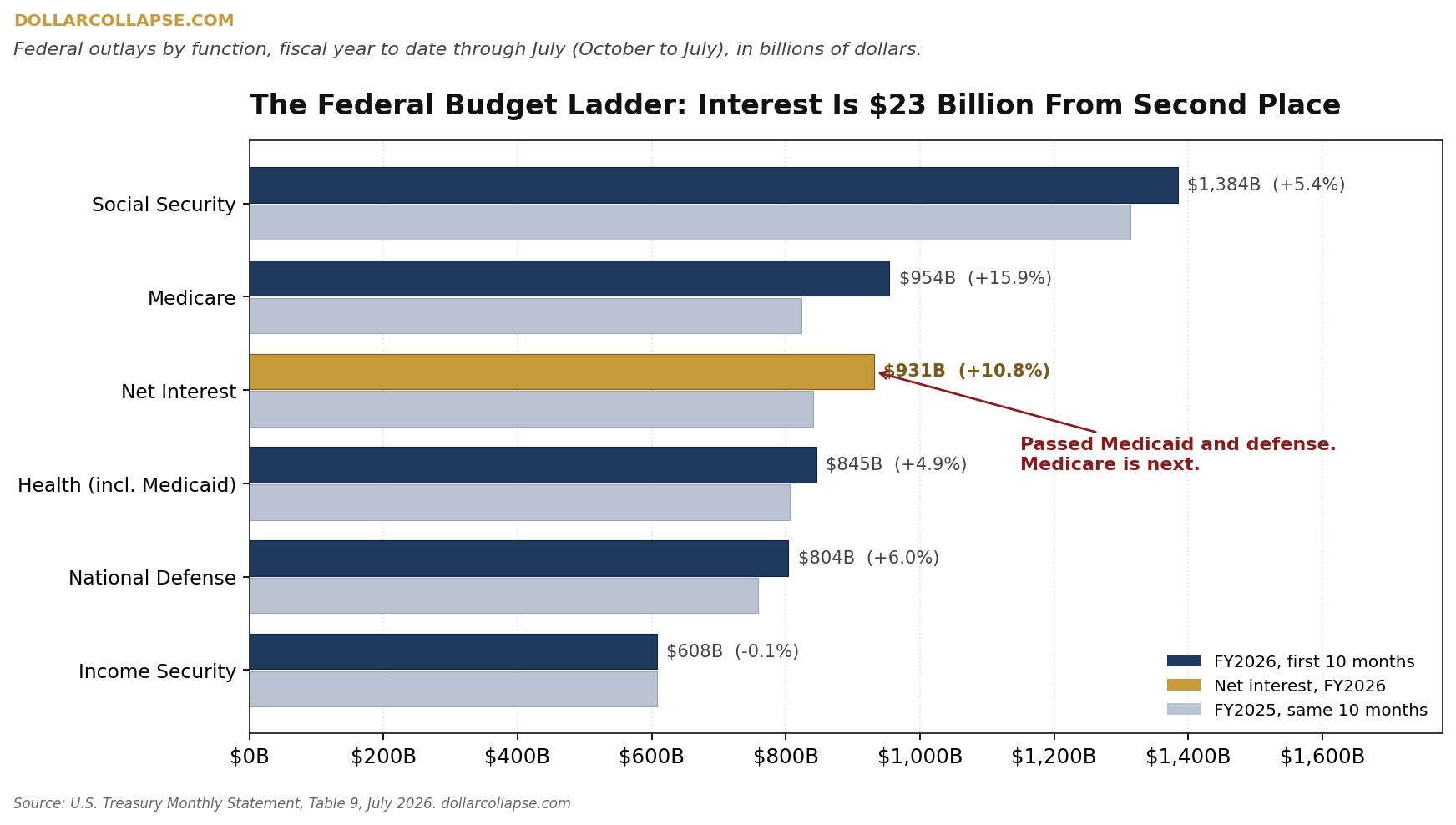
Ten months into fiscal 2026, Social Security leads at $1,384 billion. Medicare holds second at $954 billion. Then Net interest sits third at $931 billion.
Interest now outranks Medicaid and the Pentagon, and it trails Medicare by $23 billion.
The money supply side explains the increasing speed of debt.
Wolf Richter at Wolf Street writes:
US Government Sold $742 Billion of Treasury Securities this Week. 30-Year Treasury Auction Yield Highest since 2001
“The US government sold $742 billion of Treasury securities during the week, spread over nine auctions… The 30-year Treasury bonds sold at auction on Thursday with a yield of 5.216%, the highest auction yield since the 30-year auction in August 2001.”
The US Government sold three quarters of a trillion dollars of debt in one week. Most of it rolls over old debt, but every roll happens at today’s prices, which is the point most coverage misses: the interest bill climbs even if Washington stops adding new debt.
The government pays an average rate of 3.45% across all its debt. The market now charges 5.2% for 30-year money and 4.7% for 10-year money.
Think of a family with a 3% mortgage from 2020. Now imagine the bank makes them refinance a slice of it every month at today’s rates. The payment never jumps, but it does ratchet up.
That’s the Treasury’s position. The average rate on the debt has climbed every single month this year: 3.32% in January, 3.45% in July. Each auction retires cheap old paper and replaces it with expensive new paper. The dial is only turning one way.
So when does interest reach first place? The honest answer has two parts.
Second place looks close to a lock. On current growth rates, interest passes Medicare around fiscal 2027 or 2028.
First place depends on where the interest dial stops…
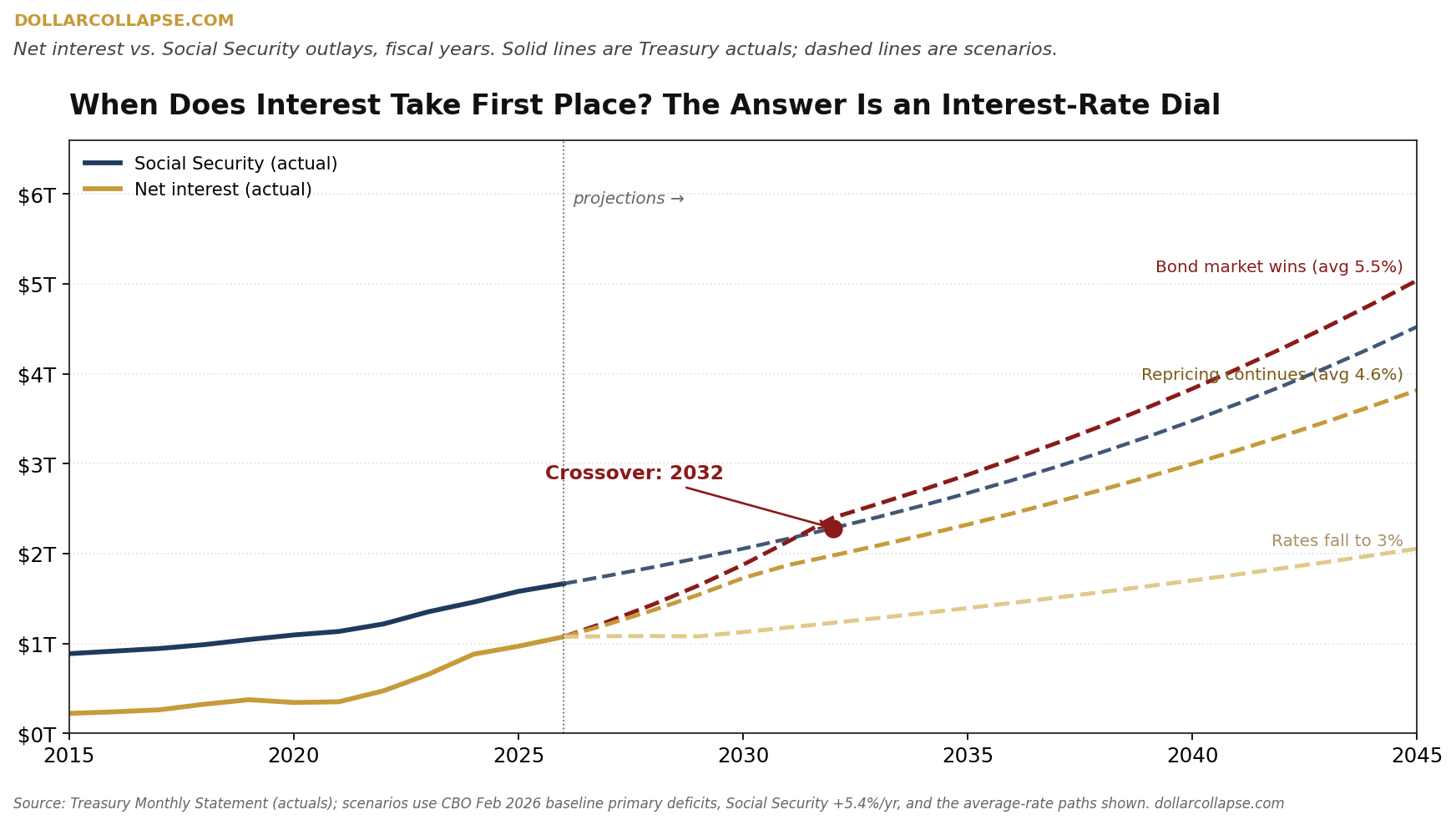
If rates fall back toward 3%, the interest bill flattens near a trillion dollars a year and never threatens the top.
If the average rate stops near 4.6%, interest never catches Social Security in the next twenty years. But look at the price of that “good” outcome: roughly $2.5 trillion a year by 2036, every year, with nothing to show for it.
And if the bond market keeps pushing with the average rate grinding up to 5.5%, interest passes Social Security around 2032.
Six years.
The CBO’s own baseline points the same direction:
Congressional Budget Office, The Budget and Economic Outlook: 2026 to 2036
“In CBO’s projections, the federal budget deficit in fiscal year 2026 is $1.9 trillion and grows to $3.1 trillion by 2036. Rising net interest costs drive much of that increase. Federal debt held by the public rises from 101 percent of GDP this year to 120 percent in 2036, surpassing its previous high of 106 percent of GDP in 1946.”
To be clear, this is a repricing, not a detonation. Nothing breaks on a schedule, but every scenario on the chart above agrees on one thing:
Within about two years, the second-biggest program in America is interest on money already spent. Then the bond market decides only whether to hand it the crown.
Under current law, Social Security hits its own trust-fund wall in the early 2030s. The strongest force keeping interest out of first place is the other program’s need to be funded. No politician wants to deny voters what they believe is rightfully theirs.
The biggest line item in the federal budget used to be a promise to retirees. Based on the current trajectory of the US Treasury bonds, it becomes a promise to bondholders.