Years of cheap money inflated financial assets while the physical economy was neglected. That imbalance may now be reversing.
Written by Bryan Lutz, Editor at Dollarcollapse.com:
Commodity prices are rising again.
Energy, fertilizer, metals and agricultural goods are all feeling renewed pressure. The World Bank now expects its broad commodity price index to rise 16 percent in 2026, led by a 24 percent increase in energy prices. The S&P GSCI, a major commodity benchmark, has also climbed sharply over the past year.
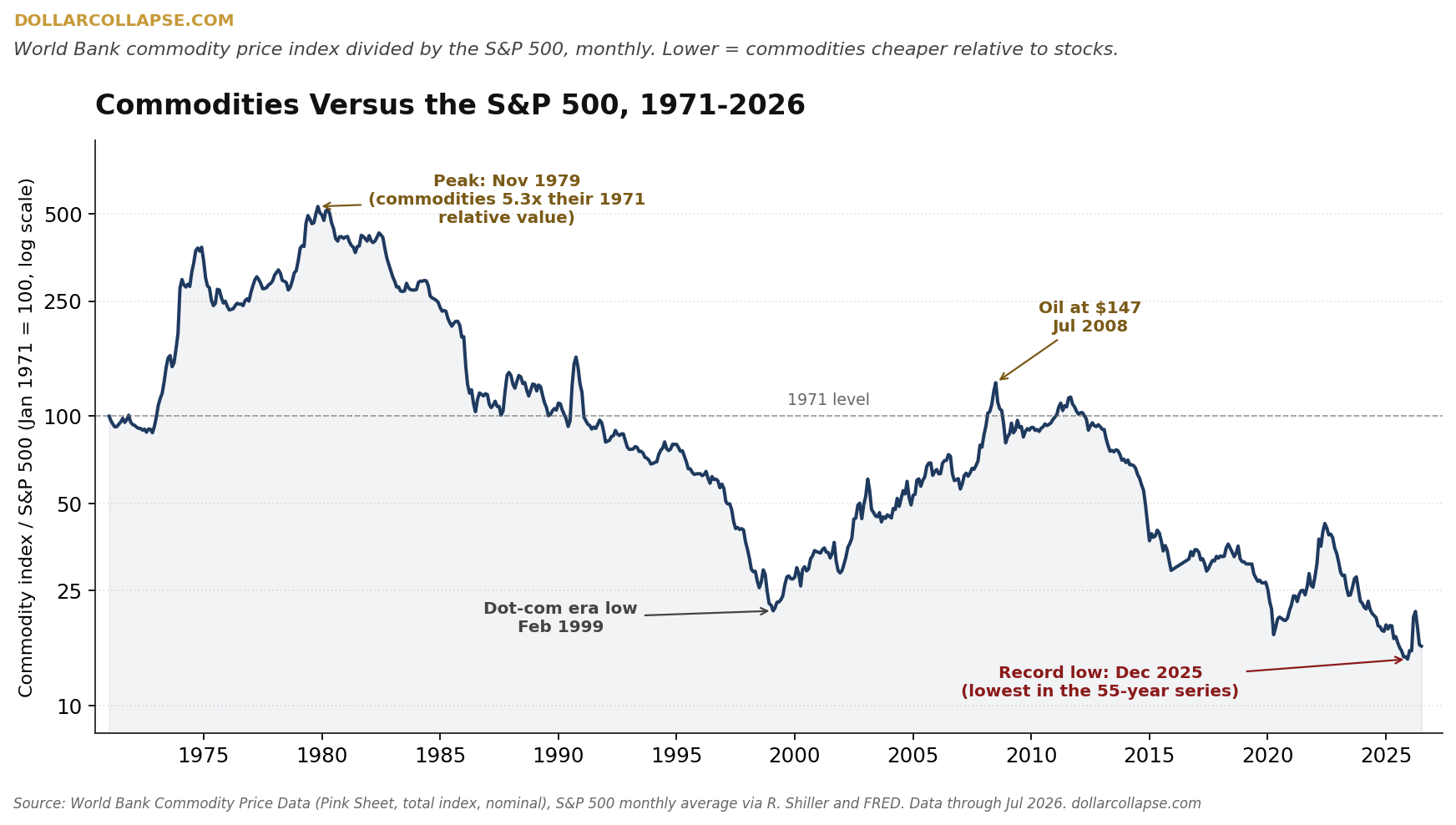
That might make commodities sound expensive, but relative to stocks, however, they remain close to historic lows. The gap between equities and stocks is so wide because the last economic cycle rewarded ownership of financial assets while discouraging investment in the physical systems that produce energy, food and raw materials.
So, you might already be able to guess what happens when one of history’s cheapest asset classes meets a world that suddenly needs far more physical supply.
How Financial Assets Became So Expensive
For more than a decade, near-zero interest rates and central-bank asset purchases pushed investors toward stocks, bonds, real estate and private equity. Technology and software companies attracted capital because they could grow quickly without building mines, refineries, pipelines or factories.
On the other hand, physical industries faced the opposite conditions. Mining projects required years of permitting and construction. Energy producers faced political pressure, price crashes and demands to return cash to shareholders. Agriculture and manufacturing offered slower, less predictable returns. Capital moved toward financial claims and away from productive capacity.
That created a strange form of abundance. Money was plentiful, market valuations rose and borrowing remained cheap. Yet the capacity to produce many essential goods did not grow at the same pace.
Low Prices Created the Next Shortage
Commodity supply cannot respond quickly when prices rise. A software company can release a new product in months. However, a major copper mine may require more than a decade to discover, permit, finance and build. Even after construction begins, falling ore grades and higher operating costs can limit output.
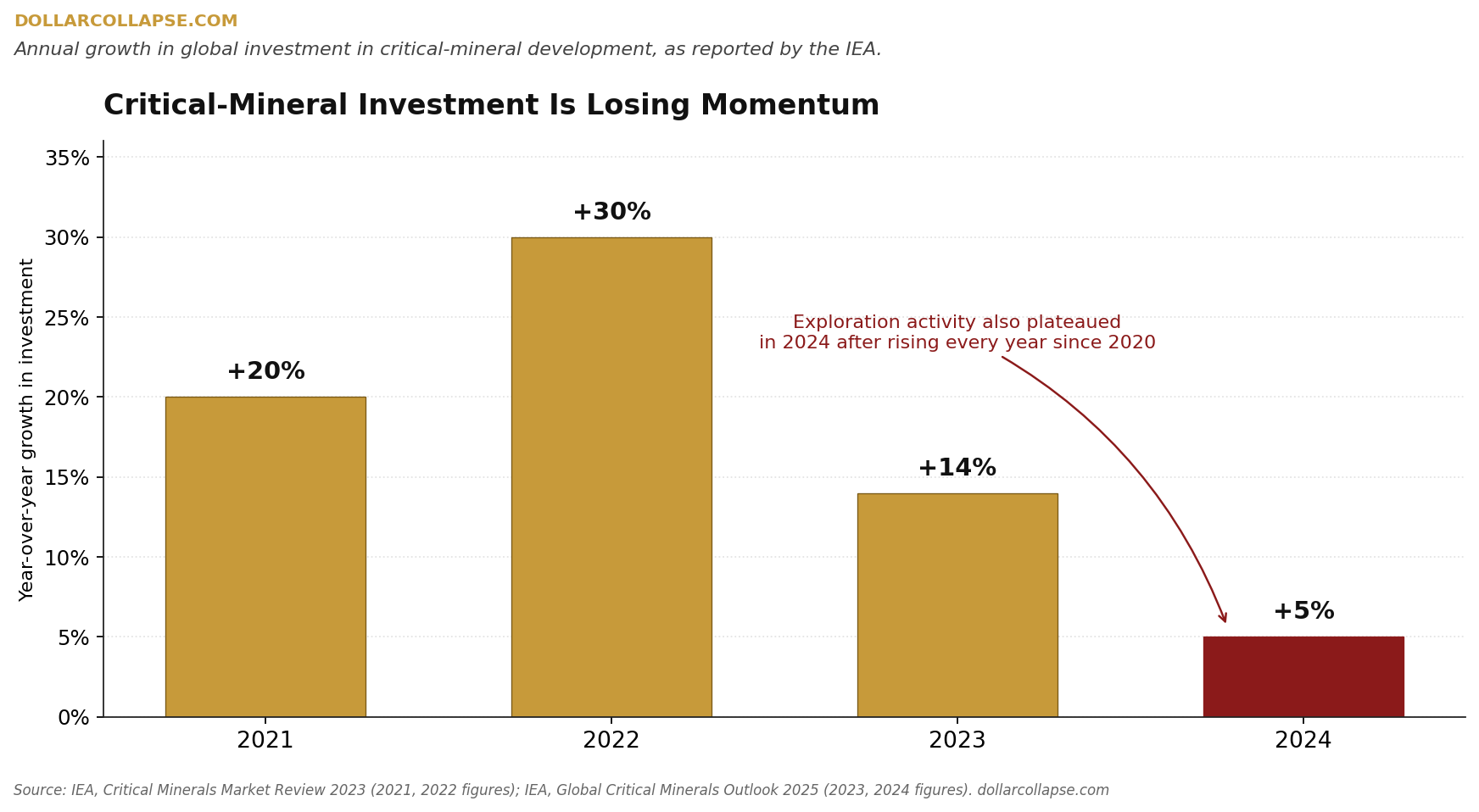
Investment momentum is already weakening. The International Energy Agency reported that critical-mineral investment grew only 5 percent in 2024, down from 14 percent in 2023. Exploration activity also stopped growing. Producers were responding rationally to weak prices, uncertain rules and high development costs. That’s why yesterdays limited investment becomes tomorrow’s limited supply.
Why Relative Value Matters
Relative valuation does not provide a precise market-timing signal, but it does show where expectations are concentrated. Today, investors are paying premium prices for future earnings from a narrow group of financial assets. Many commodity producers, by contrast, are priced as if weak demand and easy supply will continue. That leaves room for a large adjustment if either assumption proves wrong.
Hard assets also have a feature that financial claims do not: they are costly to replace. When labor, steel, energy, financing and permitting costs rise, the price required to justify a new mine, power plant or processing facility rises with them. Existing productive assets can therefore become more valuable before new supply arrives.
The Physical Economy Wants More
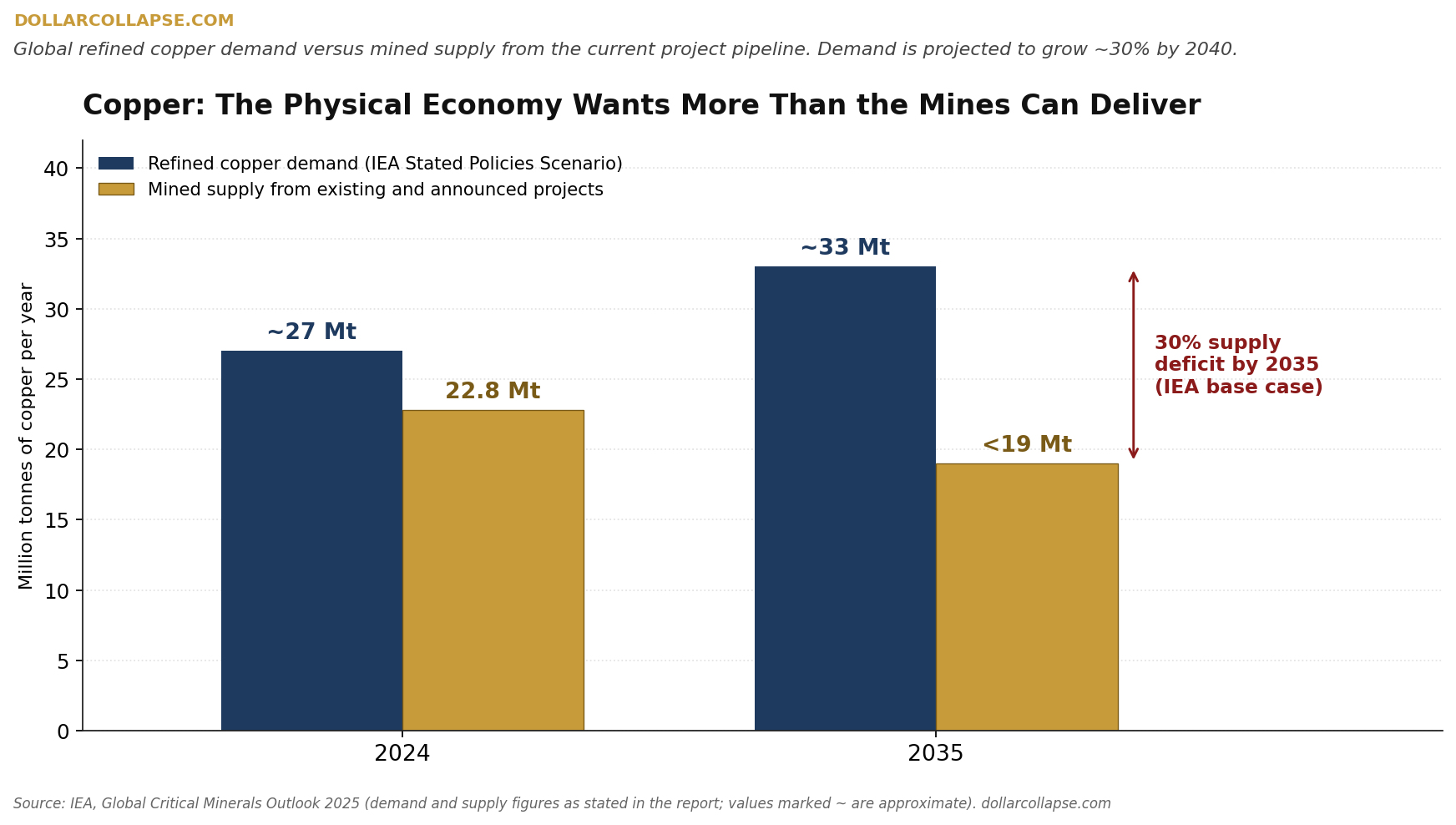
At the same time, demand is broadening. AI data centers require electricity, copper, grid equipment, cooling systems and backup power. Governments are raising defense budgets and rebuilding depleted weapons inventories. Electrification requires more transmission lines, batteries, transformers and critical minerals. For example, the IEA projects copper demand to grow about 30 percent by 2040.
Geopolitical fragmentation adds another layer. Countries are duplicating supply chains, subsidizing domestic factories and stockpiling strategic materials. These systems may be safer, but they are rarely cheaper. Efficiency is being exchanged for security, raising the amount of physical capital needed to produce the same economic output.
Cheap Does Not Mean Easy
None of this means every commodity will rise immediately. Commodities are cyclical. A recession, stronger dollar, tighter credit or temporary surplus could produce sharp declines. Oil, copper, uranium, fertilizer, gold, silver and agricultural goods also have different supply-and-demand conditions.
I’m not saying that the entire complex must move together. It is that commodities begin this period from an unusually favorable relative valuation while the physical economy faces structural investment needs. Volatility is part of that story, not evidence against it.
A Rotation Back to the Real World
For years, investors placed rising values on stocks, bonds and digital businesses while treating energy, mining, agriculture and industrial capacity as yesterday’s economy. But AI cannot run without electricity. Electrification cannot proceed without metals. Armies cannot rearm without factories. Food cannot reach consumers without fuel, fertilizer and working supply chains.
The world is rediscovering that financial capital cannot replace physical capacity.
Commodities have already begun to move, but compared with the financial assets that dominated the last cycle, the great revaluation of the physical world is still in its early stages
4 thoughts on “The World Is Running Short of What Money Can’t Create”
Oh, sounds like rotating the tires, but the car is still going in the wrong direction toward the cliff. I will stick with gold, silver, toilet paper, and keep growing my garden. The elites heavily invested in the narrative for the Mag 7, AI, and crypto will continue to push it. Can you say $40 trillion that can’t (won’t) be addressed?
Exactly, commodities are needed not only for tech, but defense, autos, and robots on the way..
You are absolutely right. And it won’t change a thing.
Appreciate your comments, Lenn.