Written by Bryan Lutz, Editor at Dollarcollapse.com:
BRICS leaders meet in New Delhi on September 12 and 13. Once again, most of the coverage will ask whether the group can launch a common currency to challenge the US dollar.
There’s no question about it, BRICS can’t. At least, not directly, not head on…
Too much of the world depends on trading in dollars, something they can hold their value in (when it comes to trade/foreign excahnge).
BRICS doesn’t need to be its own euro, or a shared central bank, or a single interest rate or a common monetary policy. What they do need are better ways to trade without passing every payment through the dollar-based system. They need to “make the world a little bit smaller” so to speak.
The next phase of de-dollarization will not arrive with a new currency and a press conference. It’ll be built one pipe at a time via:
- Payment networks
- Local-currency settlement
- Central-bank digital currencies and bilateral trade deals.
Building Around the Dollar
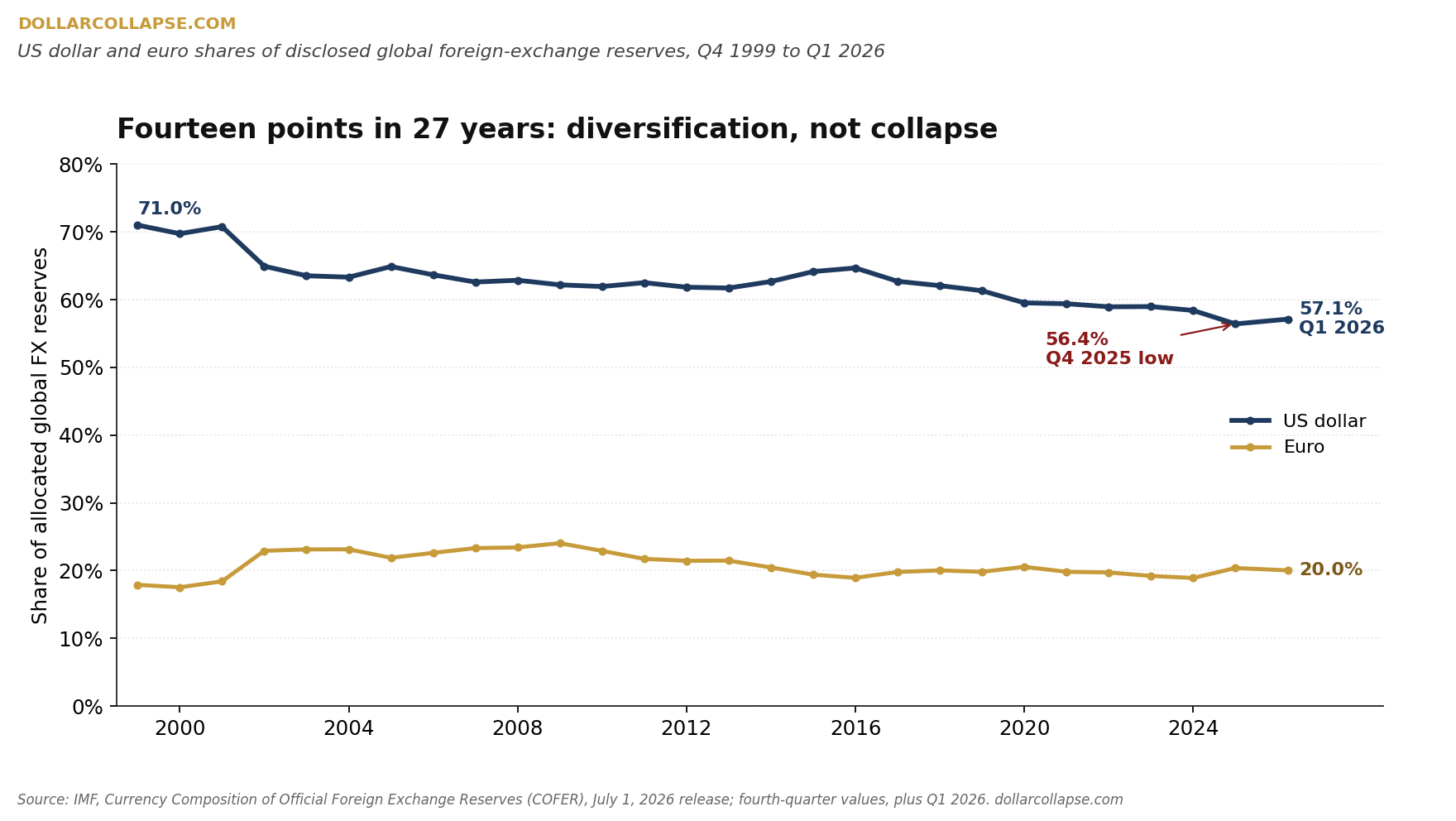
The dollar is still the world’s leading reserve currency. It prices most commodities, settles most trade and holds 57 percent of the reserves that central banks disclose to the IMF. (side note: in 1999 that figure was 71 percent.)
The dollar’s reserve status position gives the United States real advantages. Global demand for dollars lets Washington borrow at lower cost, and American banks and payment networks sit at the centre of international finance.
The same system creates risks for everyone else. Disruptions like dollar shortages disrupt trade. Or a change in Federal Reserve policy can pull capital across borders(it would effect the Japan carry trade, for example). Sanctions can lock governments, banks and companies out of their reserves, as Russia learned in February 2022.
BRICS members do not have to reject the dollar outright to reduce those risks. They need alternatives that work when the dollar system gets too expensive, too slow or too dangerous.
The Plumbing Matters More Than the Currency
Cross-border payments run on plumbing like:
- Messaging networks,
- Clearing systems,
- Correspondent banks and the institutions that swap one currency for another.
For example, that’s what India’s New Delhi will talk about. China backs its CIPS clearing system and the mBridge digital-currency platform. India prefers to link national fast-payment systems and has no interest in a single BRICS currency. In August, the Reserve Bank of India’s governor said members are discussing links between their payment systems and central-bank digital currencies because “there is a lot of scope for reducing cost.”
Yet, that disagreement does not stop de-dollarization. Local settlement may be easier to build than a currency, because it asks no member to give up control of its own money.
An Indian importer pays for Brazilian goods in rupees, and the payment converts to Reals. A Chinese buyer pays for Russian oil in yuan. Central banks set up swap lines or clearing arrangements to manage the exchange.
None of that needs a BRICS currency.
Even Russia, the member with the most reason to want one, now says it is not chasing de-dollarization at all.
Reuters reported on September 8:
Russia does not seek ‘de-dollarisation’, open to payment methods, Kremlin says
Russia does not seek ‘de-dollarisation’ and is open to every acceptable method of payment, Kremlin spokesperson Dmitry Peskov said on Tuesday, in a virtual interaction with Indian reporters, days before the BRICS leaders’ summit in New Delhi. … Peskov added that 90% of transactions between Russia and BRICS nations are conducted in national currencies.
So Russia is changing its goal from destroying the dollar to a more regional solution.
Gold Provides the Neutral Reserve
Payment systems can solve the transaction problem, but Countries still need somewhere to park long-term reserves.
That is where gold comes in.
Gold is no government’s liability. No central bank can print it, no foreign bank can freeze it, and no other country’s monetary policy can shrink it.
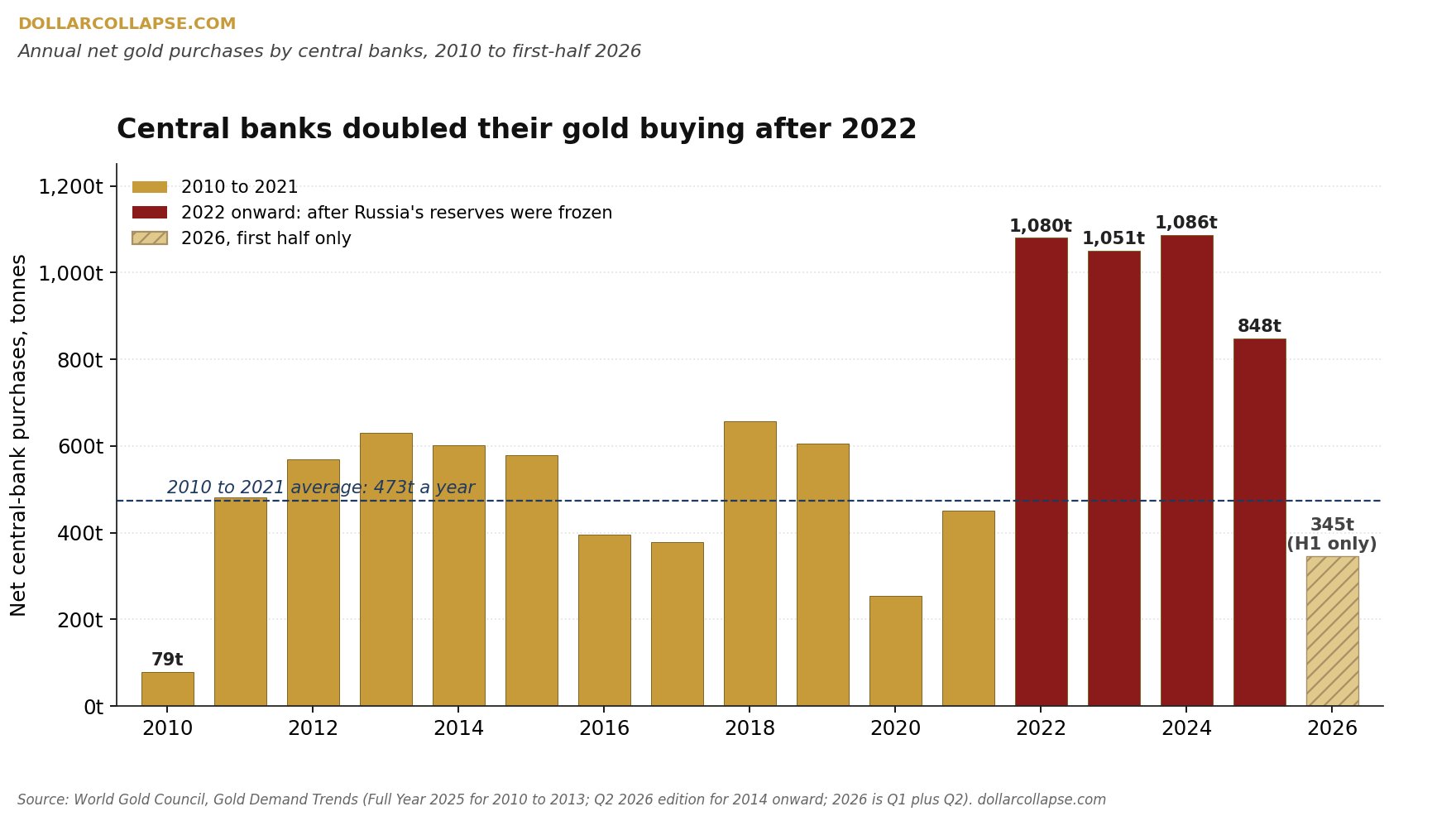
Central banks are still buying gold. China’s central bank added gold for a 22nd straight month in August, about 20 tonnes, taking its reported holdings to roughly 2,387 tonnes. Poland bought 51 tonnes in the second quarter alone. The World Gold Council’s 2026 survey found a record 45 percent of central banks plan to add gold in the next year.
None of that means they’re preparing to back a BRICS currency with bullion. It means a growing share of their reserves no longer depends on another government keeping its promises.
Economic Weight Creates Options
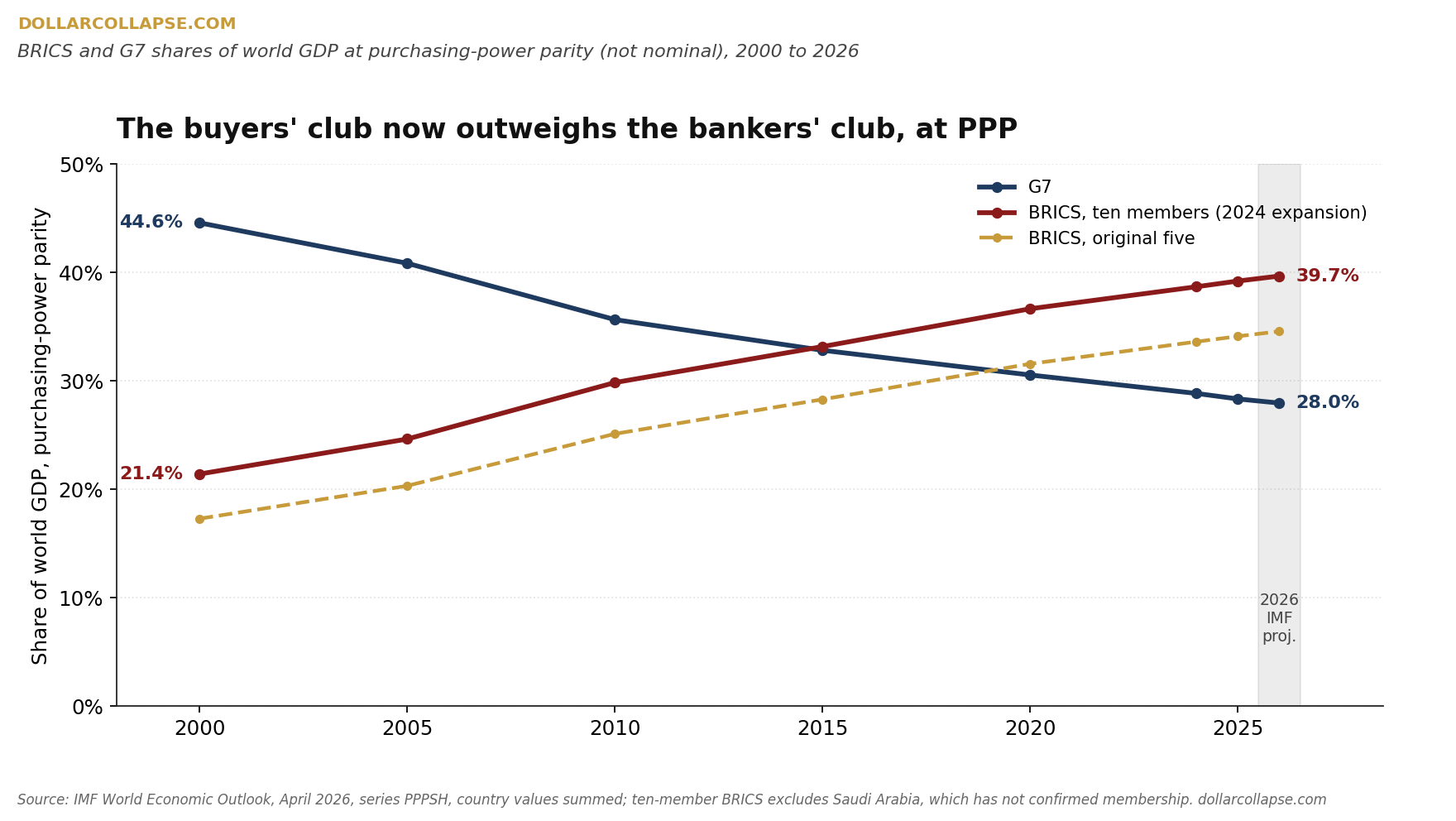
The expanded BRICS group, now ten members, produces about 40 percent of world output measured at purchasing-power parity, against 28 percent for the G7. According to the IMF, in 2000 the numbers were 21 and 45. The West’s output is shrinking.
For BRICS, their members include the world’s two largest importers of commodities, China and India, and several of the largest producers of oil, gas, grain and metals. So, their purchasing power gives the group something more useful than a shared political philosophy:
Trade between its members that can be settled through new channels.
BRICS is divided on plenty. India doesn’t want an anti-Western bloc. China wants a bigger global role for its own financial system. Russia and Iran both want out from underneath Western sanctions.
Those differences make a shared currency unlikely, but it doesn’t have to stop them from building payment links more co-operatively.
A Gradual Monetary Separation
Reserve currencies rarely disappear overnight. They gradually lose ground as users find cheaper, safer or more convenient alternatives.
That is why this year’s BRICS meeting matters. The most important announcement may not be a currency with a memorable name. It may be an agreement to connect two payment platforms, expand rupee-real trade or shave a day off cross-border settlement.
Each agreement looks small and even impotent, but together they reduce the share of world trade that creates demand for dollars, and for US government debt, by default.
The dollar won’t be overthrown at this year’s BRICS conference. It can, however, be routed around. One agreements at a time…