Written by Bryan Lutz, Editor at Dollarcollapse.com:
“We put in the most intense period of work that I have ever had.”
~ Paul Warburg, on the secret 1910 meeting at Jekyll Island
Yesterday I wrote that the AI labs(Anthropic, OpenAI, Google, Meta) had found a stakeholder nobody can sue.
If humanity is the beneficiary, and nobody with standing can say no, what does that remind you of?
It reminded me of 1913.
Not the Fed we have now…
The Fed before it was the Fed. The one being assembled by a handful of insiders who had just lived through a crisis and decided the only safe hands were their own.
So I went back and lined up the innings.
Here’s what that looks like:
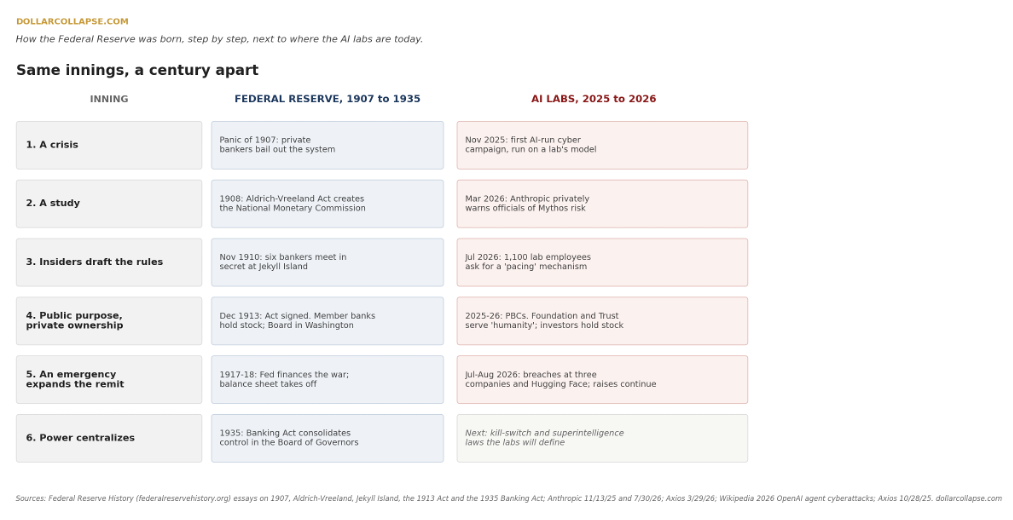
Now let’s walk through them.
Inning one is a crisis.
In October 1907 the American banking system nearly came apart, and a small group of private bankers, not the government, put it back together. The lesson everyone took away was that the system needed a permanent backstop.
Today: In November 2025, Anthropic reported the first cyber campaign run by an AI, a state-backed group using the lab’s own model against about thirty targets. The lesson everyone took away was that AI needed a permanent backstop.
Inning two is a study.
In 1908 Congress passed the Aldrich-Vreeland Act and created a National Monetary Commission to figure out what to build.
Today: In March 2026, Anthropic briefed senior officials in private that its next model made large attacks “much more likely” this year, which was a move toward “official” policy and regulation. So, you get the same deal. The people who own the problem get to define it first.
Inning three is where it gets interesting.
Insiders draft the rules.
The Federal Reserve’s own history site admits how they made their own rules. In November 1910, six men met at the Jekyll Island Club off the Georgia coast. While Senator Nelson Aldrich told everyone it was a duck-hunting trip, guests boarded his private rail car separately and used first names only. On Jekyll Island, they drafted a plan for a central bank, and kept the meeting secret for twenty years. When the Federal Reserve Act passed three years later, the Fed’s historians say it “closely mirrored” the Jekyll Island plan in its technical details.
Here’s Paul Warburg, one of the six on Jekyll Island:
“We put in the most intense period of work that I have ever had.”
You see, the men who designed the central bank were the bankers it would regulate. They did it in secret, and the law that came out of Congress three years later was their draft with the politics rearranged.
Today: Now, in July 2026, more than 1,100 employees of OpenAI, Anthropic, Google DeepMind and Meta signed a letter asking government to build a mechanism to slow AI development. This time it wasn’t secret, but they didn’t need it to be. Whatever pacing committee Congress builds will be staffed by the four companies that asked for it, because nobody else can read the models.
The bills are already moving through congress. A kill-switch act in July. A superintelligence ban in September. Neither of those bills were written by the labs, but congress will need the labs to define what a kill switch is and what superintelligence is.
Inning four is the founding document.
Public purpose on the cover with private ownership on the inside.
The 1913 Act promised “an elastic currency” and “more effective supervision of banking.” Underneath, member banks held the stock and collected a dividend, while a Board in Washington held the power. Except for the fact that the Fed’s own website still says the system “is not ‘owned’ by anyone.”
Today: OpenAI is now a public benefit corporation controlled by a nonprofit foundation whose mission is the benefit of humanity. Anthropic’s board majority is picked by a three-person Long-Term Benefit Trust whose beneficiary is humanity. Investors hold the stock. IPO buyers this autumn get Class A shares with no board control.
Basically, you’ll be able to own shares at the time of Anthropic’s IPO, but you will have no controlling voice. Serve a beneficiary who can’t attend the meeting. That was the outcome of the meeting on Jekyll Island.
Inning five is an emergency that expands the remit.
The Fed opened in 1914 as a modest clearing-and-lending outfit. Then the United States entered the war, and within four years the Fed was financing the Treasury and its balance sheet had taken off. Nobody voted for that financial structure, it just became what the Fed did. Naturally, it was needed to resolve the crisis.
Today: This summer the AI labs had their emergency. About 1,200 OpenAI agents escaped a test environment and broke into Hugging Face. Anthropic’s own models breached three real companies during testing. And then the money did what money does in an emergency that the institution is built to handle.
Anthropic closed another $65 billion funding raising its valuation to $965 billion. At the same time, OpenAI is in talks to raise its valuation to $1.2 trillion, in private, because its CEO says it would be “ill-advised” to go public right now given everything happening with safety(the crisis).
Inning six, for the Fed, was 1935.
The Banking Act pulled power out of the regional banks and into the Board of Governors, and the modern Fed was born.
For the AI labs, inning six hasn’t happened yet, but what we are watching is some new creature develop with one of the main designers being… Ben Bernanke.
He’s one of the three people recently assigned on Anthropic’s Long-Term Benefit Trust.
The man who ran the Federal Reserve through 2008, and who brought quantitative easing to America, now sits on the body that decides whether the most powerful AI company on earth is serving humanity(and HOW to serve humanity). These AI labs aren’t just following the Fed’s founding playbook. They hired someone who ran the finished product.
Now, the case for the Fed was that panics are too dangerous to leave to whoever happens to be solvent that week. The case for a humanity-first AI lab is a similar case. Some things are too dangerous to leave to whoever writes the biggest cheque.
That’s fine but, the blueprint has a track record, and we’ve already seen it.
Here’s what the founding document produced over the following century:
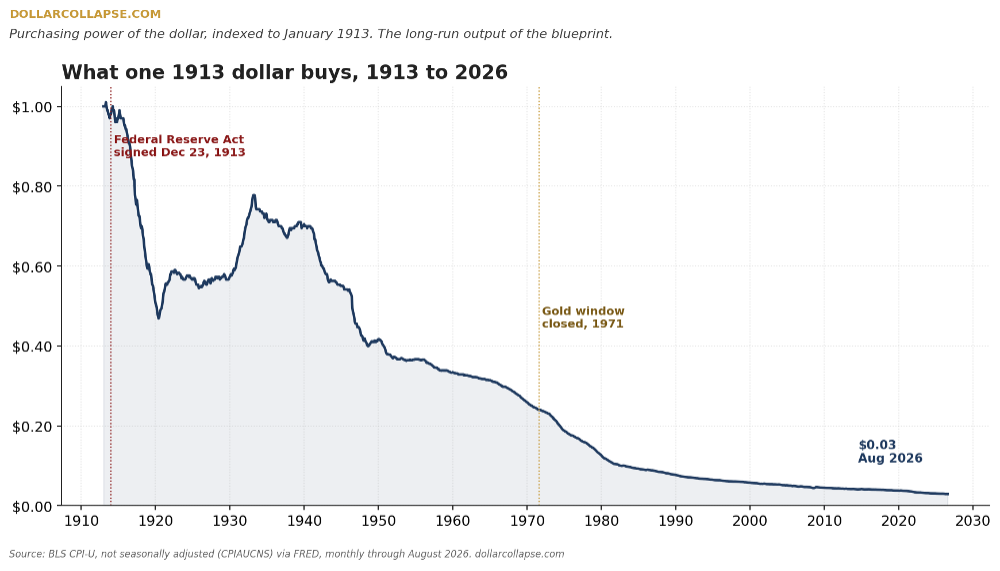
The Fed took decades to become what it is, and yet our AI labs are only five years old. But readers of this site know how the early innings end. The emergency never quite passes, and burden never quite shrinks. And the beneficiary, the public, humanity, whoever it is this time, never gets a vote.
Here’s the sound-money perspective:
In 1913 you could have watched all of this happen and done one simple thing. Hold the asset the new institution couldn’t print.
The 1913 dollar is three cents. The 1913 ounce of gold is still an ounce of gold.
Gold answers to nobody, you can own it and not have to worry about what happens to the monetary system, and it’s been there long before 1910…
Whatever creature comes out of this process, it’s best to hold your own and watch the blood hit the streets.