If the market feels nuts to you lately, you are not imagining it. A 2% drop on a Monday for no obvious reason. Half a trillion dollars gone from one company in a day. The VIX up 19% in a session when nothing actually happened. It feels like the whole thing trades on nerves.
There is a reason for that, and it is simpler than most of the explanations you have heard.
Nearly every one of the ten largest companies in the S&P 500 is a technology company. Technology and the tech-adjacent giants make up roughly 40% of the index. And technology, as of this year, is no longer a sector of mature, cash-generating businesses. It is effectively a venture capital fund. Which means your index fund is one too.
Here is the strangest thing about this market. The most profitable companies in the history of capitalism are being traded like a Series B round.
Alphabet earned more than $100 billion last year. Microsoft, Amazon and Meta are the same story: businesses with margins, moats and cash flows that no company in history has matched. These are not speculative enterprises. And yet their stocks now move on exactly the questions that move a startup: Will the spending ever pay off? When does the revenue show up? How much more cash do they need? Who is funding it?
Look at the headlines from the past two weeks and ask yourself whether they sound like headlines about the five largest companies in the world.
Alphabet lost half a trillion dollars in a day because search revenue grew 12% instead of 15%. Amazon spent $77 billion on capital expenditure in a single quarter, more than double a year ago, and its long-term debt went from $66 billion at the start of the year to $173 billion by September. Meta’s free cash flow turned negative, and it launched $35 billion of stock offerings, with a $60 billion at-the-market program to follow next year. Microsoft, the one that held up, still had to sell $25 billion of bonds. Together, the four will spend more than $720 billion on AI infrastructure this year, triple what they spent in 2024. The five largest AI borrowers have raised $326 billion in debt in 2026, three times last year’s total.
Look closely at the Meta deal, because it is the clearest picture of what has happened.
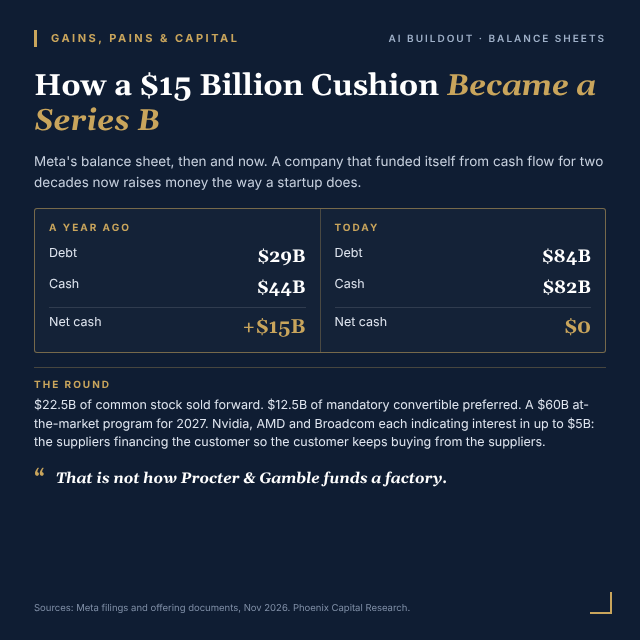
A year ago, Meta had $29 billion of debt and $44 billion of cash. Today it has $84 billion of debt and $82 billion of cash. In twelve months, a company with $15 billion of net cash spent its way to zero, created a new class of non-voting stock that its filings describe as “usable for capital raising,” and then used it: $22.5 billion of common stock sold forward, $12.5 billion of mandatory convertible preferred, and a $60 billion at-the-market program on deck for 2027.
And look at who stepped up to buy.
Nvidia, AMD and Broadcom each indicated interest in taking up to $5 billion of the common stock. The suppliers are financing the customer’s buildout so the customer can keep buying from the suppliers. That is not how Procter & Gamble funds a factory. It is how a startup closes a round, with the strategic investors who need it to succeed sitting at the table.
Those are startup headlines. Raise money, build capacity, hope the revenue arrives, repeat. Amazon’s CEO Andy Jassy said it plainly on the earnings call: data center capital is spent two years before the servers can be monetized. That is the economics of a venture-backed company, and it is now the economics of the companies at the top of the S&P 500.
Here’s why that matters to you personally.
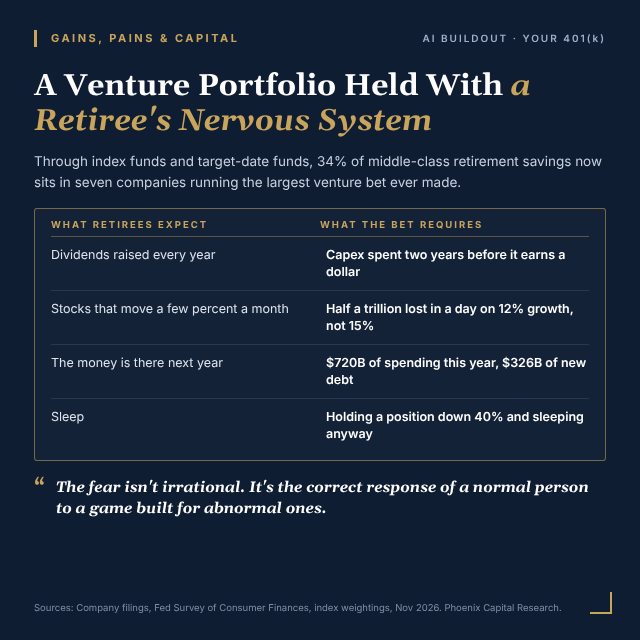
Through index funds, 401(k)s and target-date funds, the retirement savings of the American middle class are now 34% invested in seven companies. Fifteen years ago, the core of a retirement portfolio was Exxon, Johnson & Johnson, Procter & Gamble and Coca-Cola, companies that raised their dividends every year and whose stocks rarely moved more than a few percent in a month. Today the core of every retirement account in the country is tied at the hip to the largest venture bet ever made.
Most people are not built for that.
Venture investors expect to lose years, wait a decade, and watch most of their bets go to zero on the way to the one that pays for everything. Retirees expect dividends and sleep. The panic you felt two weeks ago, and again yesterday when the Nasdaq dropped 2.5% and the VIX jumped 19%, is the gap between those two sets of expectations. And it isn’t going to close, because the bet isn’t going to get smaller.
It’s worth being honest about who is built for it.
The people who run this game, the founders who raise a Series B, the executives who sign off on $300 billion of capex two years before it earns a dollar, the investors who fund them, are not normal people. They are a specific breed, wired a specific way. They can hold a position that is down 40% and sleep. They can watch nine bets go to zero because the tenth is going to return fifty times. They can spend money they don’t have yet on a future nobody can prove.
That wiring is rare. It is also the only wiring that has ever built anything new at scale, which is why the sliver of companies that produce all the returns are run by people like that and not by people like the rest of us.
Most of society is wired the other way, and for good reason. Most people need predictability. They need the money to be there next year. They cannot watch a quarter of their savings disappear in a month and treat it as a rounding error on a decade-long bet, because it isn’t a rounding error to them. It’s the roof.
The reason there is so much doom and gloom around AI and technology, the reason every pullback gets called a crisis and every capex number gets called a bubble, is that the whole country has been handed a venture capitalist’s portfolio and asked to hold it with a retiree’s nervous system. The fear isn’t irrational. It’s the correct response of a normal person to being made to play a game built for abnormal ones.
Think about how different this is from the last two bubbles. In 1999, nobody at a dinner party was telling you the internet was a bubble. They were telling you about the stock they’d just tripled their money in. In 2006, nobody was warning you about housing. They were buying a second condo. Bubbles are made of belief. The people inside them are not scared. They are certain. The AI buildout is the opposite. It has had more doom, more warnings and more panic attached to it than any major investment cycle I have seen in 25 years.
Every week someone announces AI is a bubble, that it’s going to end horribly, that this is the most dangerous market of our lifetimes. That has been the constant background noise for three years, through a tripling of the sector.
I have never seen a bubble that everyone agreed was a bubble while it was happening. That’s not what bubbles look like. That’s what it looks like when a technology that only a specific kind of person is wired to bet on gets forced into everyone’s retirement account at once. The volume of the fear is a measure of how many people are holding something they were never built to hold, and that is a very different thing from a measure of how much risk is actually in the asset.
Understanding this doesn’t make the volatility go away. But it should change how you read it. When the headlines say crisis, ask who is talking. If it’s someone who isn’t wired for this, and most commentators aren’t, the panic is telling you about them, not about the companies.
It should also change how you hold it. Nvidia reports tomorrow night. The Fed decides on December 9. Between now and then the largest venture fund in history is going to be marked to market every day, in your retirement account, by people who will treat a 2% move as a verdict. You cannot change the wiring you were born with. You can decide in advance what you will do when the next 2% day comes, so that you are not deciding it at 3:55 in the afternoon with the rest of the country.
If you find yourself worried about another crash, or bear market hitting, we have a proprietary signal that you can use to insure you get out of the markets well before a collapse hits.
This signal has accurately predicted every major market collapse in the last 40 years. And we detail it, how it works and what it’s saying about the markets today in a Special Investment Report How to Predict a Crash.
Normally we’d sell this report for $499, but in light of what’s happening with the Fed today, we’re making just 99 copies available to the investing public.
To pick one up…
Graham Summers, MBA
Chief Market Strategist
Phoenix Capital Research