Written by Bryan Lutz, Editor at Dollarcollapse.com:
So, every Sunday morning I sit down to write a few thoughts.
Sometimes these thoughts end up being about life, other times they are on gold, geopolitical issues affecting the markets, or the economy.
Here are three thoughts for this morning:
1. Bitcoin is crashing hard. But the big picture says its fate is somewhere other than zero.
Bitcoin is crashing so hard even HODLers are feeling it in the butt.
For about a month there, Bitcoin went down and sideways not moving below $74k. Now it’s down around $64k with many fearing it will move further to $58k. However, if we “Zoom Out,” I’m dovetailing off our Publisher’s (Mark Jeftovic) latest thoughts, we see that Bitcoin’s fate is probably somewhere other than zero.
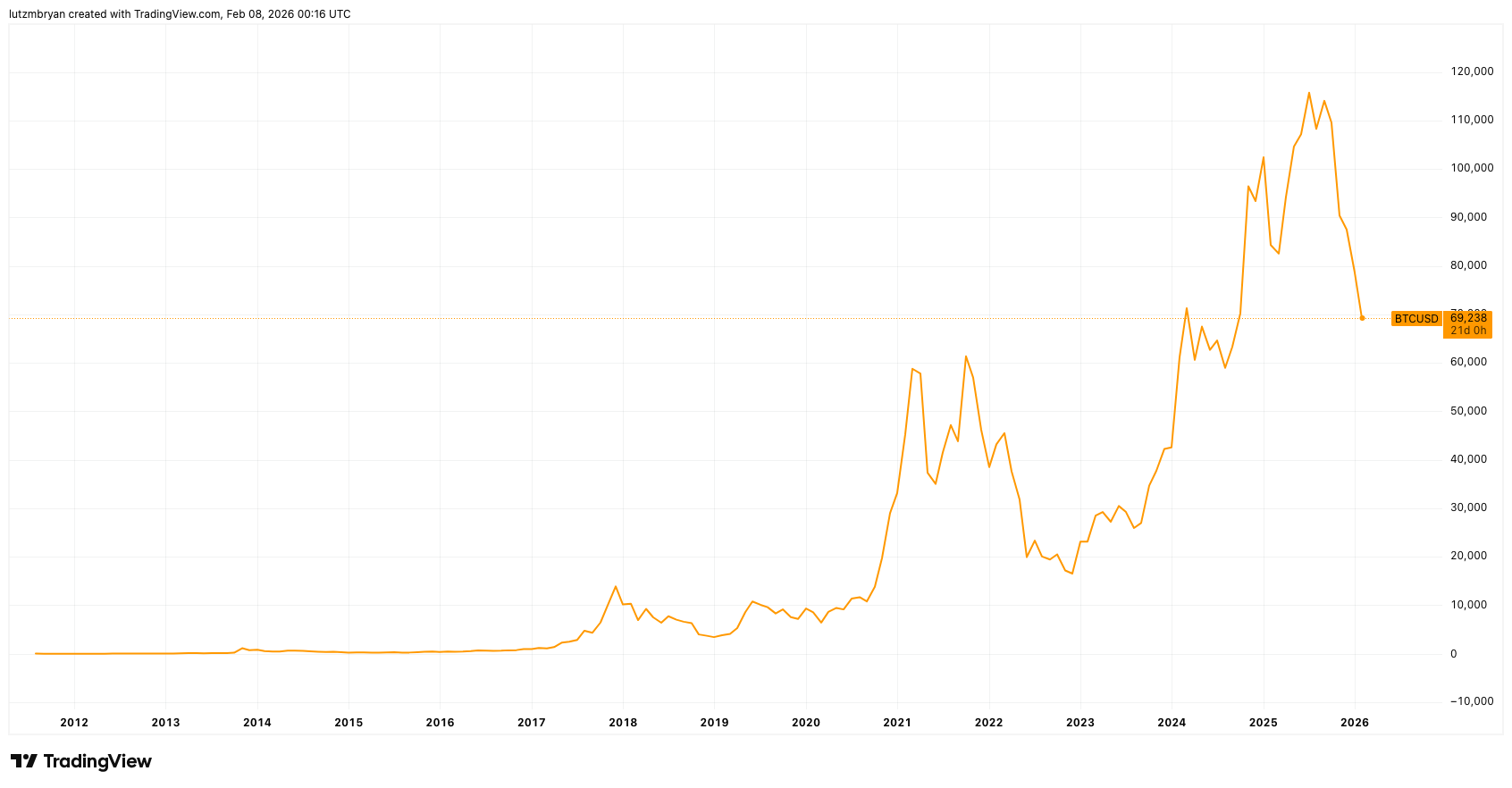
Take a look at Bitcoin the chart below.
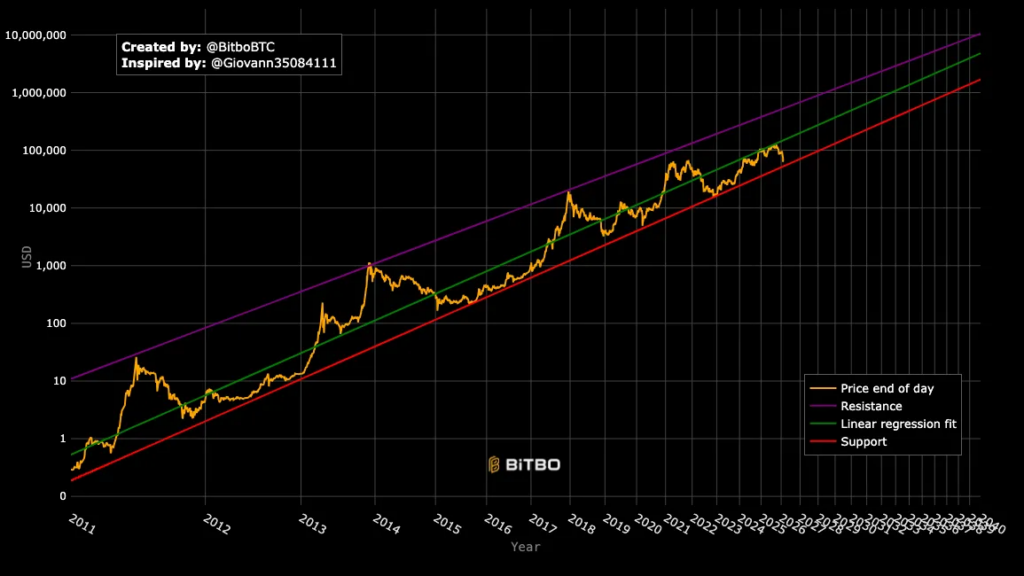
It shows Bitcoin’s long-term power law.
A power law describes systems where growth is driven by network effects, scarcity, and adoption, not linear inputs. Bitcoin seems to fit this dynamic because:
-
Absolute scarcity (hard-capped supply)
-
Global permissionless adoption
-
Network effects (more users → more value)
-
Time-based issuance (halvings create step-changes)
-
Survivorship under stress (each cycle removes weak hands)
Here’s what that looks like a log-log chart:
-
Time is on the x-axis
-
Price is on the y-axis
-
Bitcoin’s historical price clusters tightly around a straight line
That straight line is the middle is the power-law behavior with support lines on the top and bottom. This suggests that is only a matter of time before Bitcoin rises back up to the mid-line again.
You can play around with this chart, here.
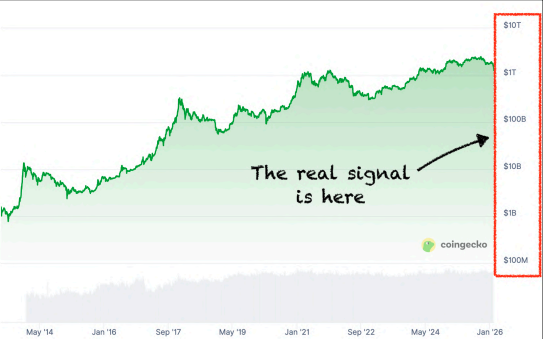
Then when you look at Bitcoin’s market cap over the past several cycles it seems to add a zero every for years. With more institutions adopting Bitcoin, stablecoin regulation incoming, and accessibility via ETFs I’m beginning to question what all the fear is about.
2. Did Central Banking reduce the number of recessions after World War 2?
The chart below indicates that after the 1933, even 1945, the United States suffered less recessions.
For many economists, and mainstream retail investors this is a sign that Central Banking and the debt-based fiat system is doing what it is supposed to do – reduce investment risk for all by creating a large reserve on the back end of the banking system. Thus, the Federal “Reserve.” If some keen acolyte of market manipulation did manage to place bets in their favor with enough force to bankrupt the reserves held at whatever bank was backing the system… then the Feds could step in, bail out the bank, and provide what they marketed to congress and the public as a much needed safety net.
So when many look at the chart, they see it as proof that the system is doing what it is supposed to do.
When in reality, the Federal Reserve Act was signed into law on December 23, 1913. Then the Federal Reserve Banks officially opened for business on November 16, 1914. After implementation, the frequency of recessions didn’t actually change.
It wasn’t until after the Great Depression, and the following gold confiscation that the Federal Reserve was able to stabilize the system. How were they able to do that?

After the gold confiscation, in 1934, the government raised the official gold price from $20.67 to $35/oz, which effectively devalued the dollar and increased the dollar value of U.S. gold reserves. The result was a beefed up Federal Reserve, and US Treasury that now had the ability to back the banks with the help of FDIC insurance. It made bank runs much rarer.
The key point here is the devaluation of the dollar.
Shortly thereafter the United States entered into World War 2 producing the highest Debt-to-GDP ratio in history. Second, to the pandemic skyscraper of 132% of Debt-to-GDP. At the conclusion of WWII, the United States Dollar gained reserve currency status at Bretton Woods, which made US Treasury bonds that much more popular.
The purchase of US Treasury bonds globally made it possible for the United States to continually beef up the Fed / Treasury. The same way they did 1933. The result was again the devaluation of the dollar behind-the-scenes. Behind-the-scenes, US trade partners began demand trade in gold instead of US dollars. The US banking solution was implemented in 1971 when President Nixon suspended the convertibility of the US Dollar for gold. And that meant, the US Dollar was no longer backed by gold. Bankers could then go on increasing the money supply, devaluing the dollar, and exporting inflation overseas.
Thus began the seeming endless supply of money to regulate, intervene, and inject liquidity into markets where and whenever the nation’s top bankers wanted. Poof…
No more recession, and…
No, it was not Central Banking that solved the recession problem.
It was the devaluation of the US dollar driven by its advantage as the global reserve currency in a globalizing world.
3. We’ve reached a point in Western culture where Kanye West looks more sane than the majority of our elites.
The more we learn about our elites from the Epstein files, the more Kanye looks sane. And maybe, he’s known a lot of the Epstein truth this whole time…just not the details.
The video should start just a few seconds before our pals(Trump, Diddy, Jay-Z, Bill Gates etc.) life-size cut outs pop up to say “hi” to the kiddies.
Just how much Ye knew back then goes deeper than the Diddy sex trafficking crimes. He outed Diddy as a Fed years ago.
Kanye "Ye" West told us years ago that Diddy was a Fed.https://t.co/RuYs4eUa8n
— Amazing Video (@amazingvideo01) September 22, 2024
Somehow he also knows the bigger picture. Many of those mentioned in the Epstein files are controlled.
Kanye West says he can't be controlled because he hasn't killed anyone..
"They can control Shaq, Charles Barkley, LeBron James, Jay-Z & Beyoncé but they can’t control me. […] My mama was sacrificed. […] In Hollywood, a lot of people come up missing. They wanna monetize &… pic.twitter.com/EWCR3trROy
— illuminatibot (@iluminatibot) December 23, 2025
The world is so upside-down that even Kanye West is looking sane.