Written by Bryan Lutz, Editor at Dollarcollapse.com:
It’s Sunday.
Alright, here’s what we do.
Every Sunday I share a few thoughts with you and other subscribers at Dollar Collapse.
Sometimes we’ll talk about economics, sometimes recent events, and other times, life.
Here are three thoughts for this morning:
1. America’s biggest banks are bleeding at both ends.
Bank of America, Goldman Sachs, and Morgan Stanley each dropped 13 to 14% in the month before earnings while the S&P 500 rose. So, what’s happening?
America’s largest banks are rolling over. Bank of America: -24% Wells Fargo: -20% Goldman Sachs: -24% Morgan Stanley: -24% Capital One: -25% Historically, bank stocks peak before recessions, and if this decline continues, it’ll signal serious trouble ahead for the US economy.
— Casey Donaldson (@caseyjdonaldson) October 15, 2026
The Fed hiked in September for the first time in three years, and the 10-year Treasury is above 5%. Every bond those banks bought at 1 or 2% is now worth less. If US Treasury bond yields stay high, many of those bonds are maturing at a negative rate of return. Bank of America alone sits on more than $90 billion in paper losses.
That’s one end. The other end is the people who owe the banks money.
For example, JPMorgan has written off 3.2% of its credit card loans as unpaid. JPMorgan will absorb the rising cost…
Then there’s private credit, the lenders that make loans banks won’t touch. Their default rate could reach 10%. The catch is that banks lent those same lenders nearly $300 billion. When the borrower stops paying, the fund stops paying, and the bill lands back on the bank.
2. The AI industry’s CoreWeave is no one-off event. It’s part of a bigger trend in the AI story.
One of the big AI stories out there right now is CoreWeave. It borrowed their way to 51 data centers. This week its bonds dropped below 80 cents on the dollar, while the market priced in a 60% chance it defaults within five years. Shares then fell 16% in a day.
CoreWeave is the loudest case, but not the only one. It is part of a bigger trend in the AI story.
The AI gold rush just hit a wall. Investors are DUMPING the debt that bankrolled it. Bonds financing massive U.S. data centers for the likes of Meta, Nvidia, Oracle and Microsoft are trading well below face value, just months after investors were happy to pay full price. Meta’s “Hyperion” bonds dropped to 92 cents on the dollar, Microsoft’s “Project Excalibur” fell below 88, and CoreWeave’s plunged under 80. CoreWeave is in distressed territory, with investors now demanding yields near 15%. Meanwhile, Nvidia lost roughly $270B in market value in a single week. But the AI math gets more uncomfortable. Gartner estimates data center owners need $8.5 TRILLION in revenue by 2030 to cover costs and earn a decent return. Expected AI services spending? Just $3.6 trillion. That’s a $4.9 TRILLION GAP, and Gartner reckons 80% of neoclouds like CoreWeave will be gone or absorbed by 2030. Nvidia CEO Jensen Huang insists he’s “optimistic” and says CoreWeave’s borrowing costs are actually falling. Someone should tell the bond market. It’s charging nearly 15% for the privilege. Source: Financial Times / Writer: Julie
— Mario Nawfal (@MarioNawfal) October 16, 2026
Every line on that chart is a bond backed by a Meta, Microsoft, Nvidia or Oracle lease… and every one trades below what it sold for.
The landlords are next in line. Here are two examples:
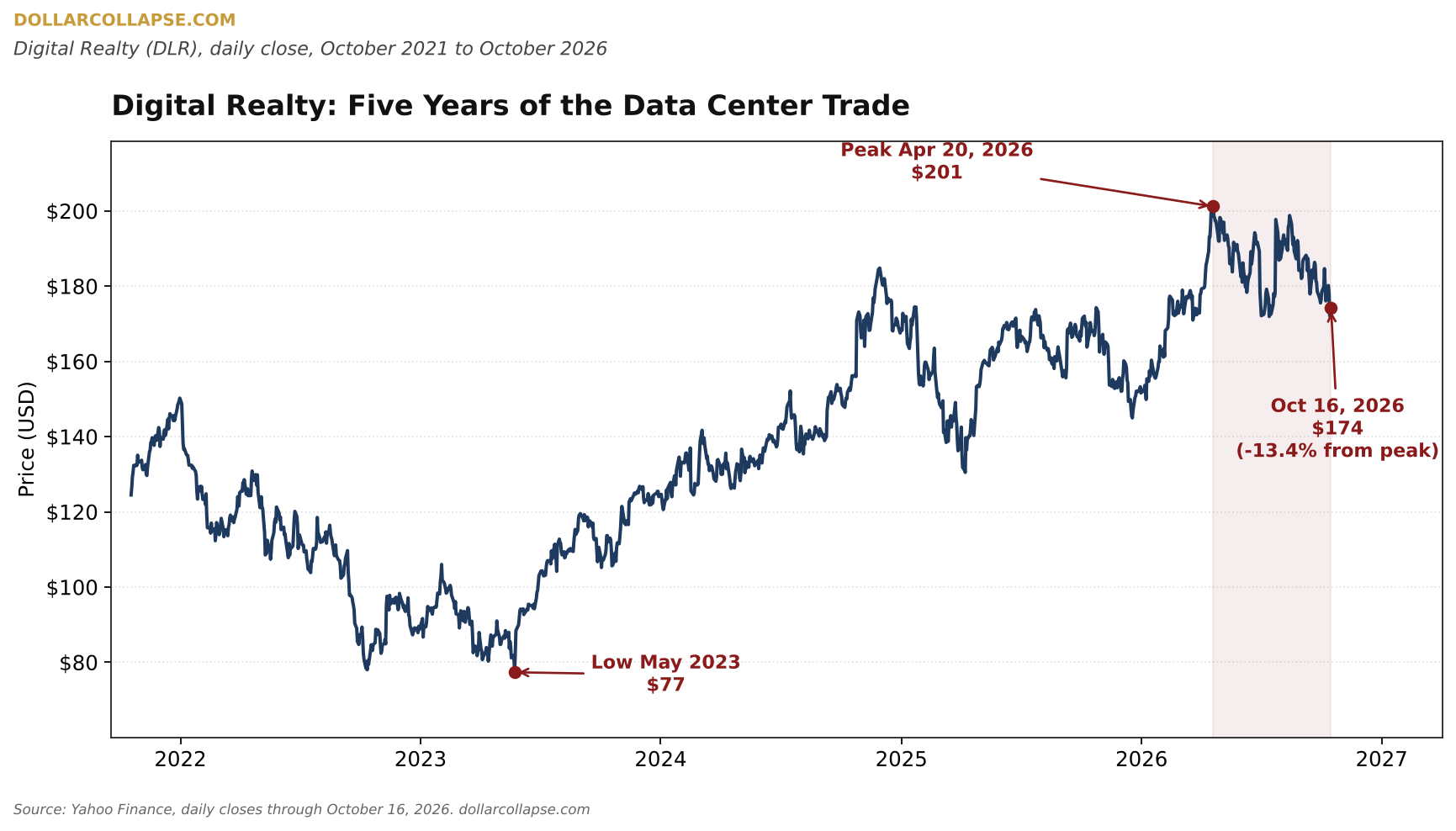
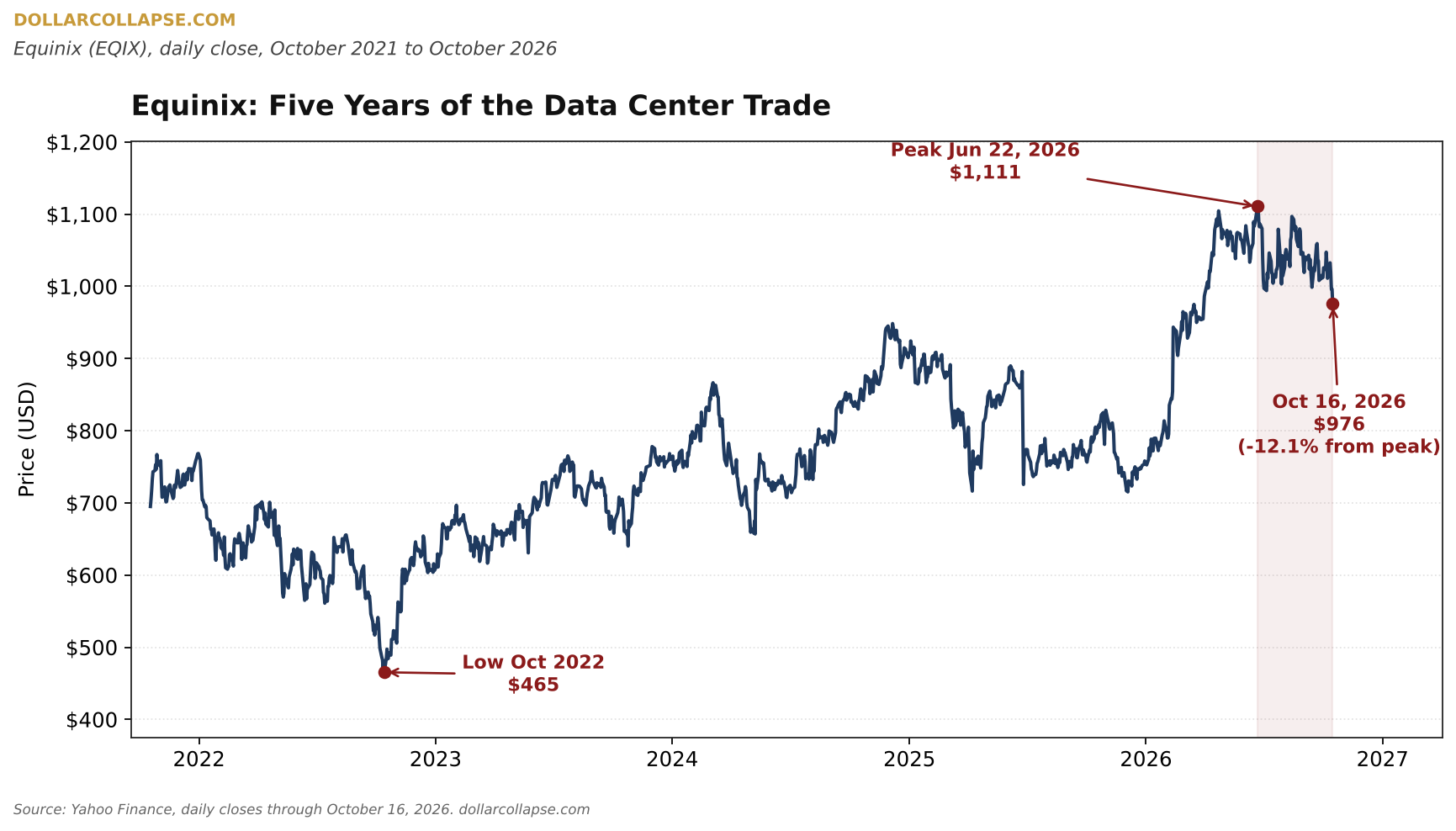
Equinix and Digital Realty own the buildings and they’re following the bond value trend… Equinix topped out at $1,111 on June 22 and closed Friday at $976, down 12%, and Digital Realty peaked in April at $201 and sits at $174, down 13%.
Data center bonds are already the first movers. Stocks are following, then the proxies like these guys. When lenders mark the debt down, the equity underneath is worth less too, and the stocks keep falling until the weakest borrowers are gone and the survivors can refinance at a price that works. That’s where the bottom is. What comes after is a smaller, slower industry (like these stocks) that pays its bills.
Watch the bonds as they continue on their trend. They’ll say when.
3. Silver is the contrarian trade in the AI energy story.
Copper is at $6.72 a pound and climbing, while silver is at $59 and sinking.
About a year ago the two moved together, and since March they’ve gone separate ways. There really is no reason for this other than silver’s relationship to gold, and the price suppression we’ve witnessed for years. Silver is still very much a part of the data center, robotics, and AI infrastructure buildout. Yes, copper is a contrarian trade in the mainstream markets, but silver is the even deeper, more valuable contrarian trade.
What is happening between copper and silver is remarkable.
Copper’s resilience while other metals sell off is too important to ignore.
There is plenty of skepticism around metals right now, and I think this is a very important window of opportunity.
https://t.co/dbja65kklr https://t.co/y23Fr2SrGh
— Otavio (Tavi) Costa (@TaviCosta) October 14, 2026
Both metals wire the same buildout… data centers, grid upgrades, solar, and the transformers nobody ordered in time. Right now, copper is getting the credit in the market and silver is getting ignored. Here’s what the relationship looks like over the next decade…
AI data centres, electrification and renewable energy are creating a structural demand wave for copper. But the bigger opportunity may not be the metal. It may be the companies that help produce it.
Consider the numbers:
A thread… https://t.co/hm5UR50wNm
— Vivek Mashrani, CFA (@MashraniVivek) October 16, 2026
The chart above shows the copper deficit opening in 2027 and widening to 13 million tonnes by 2040. So demand is steadily growing.
The thing about silver is that it sits on the same circuits, with a smaller market, a thinner supply pipeline, and faster price action. The market has priced copper, but forgotten silver. Do with that what you will.
Have a great Sunday!