A two-year high in yuan swap drawdowns, a quiet Fed line, and a Powell handoff.
Written by Bryan Lutz, Editor at Dollarcollapse.com:
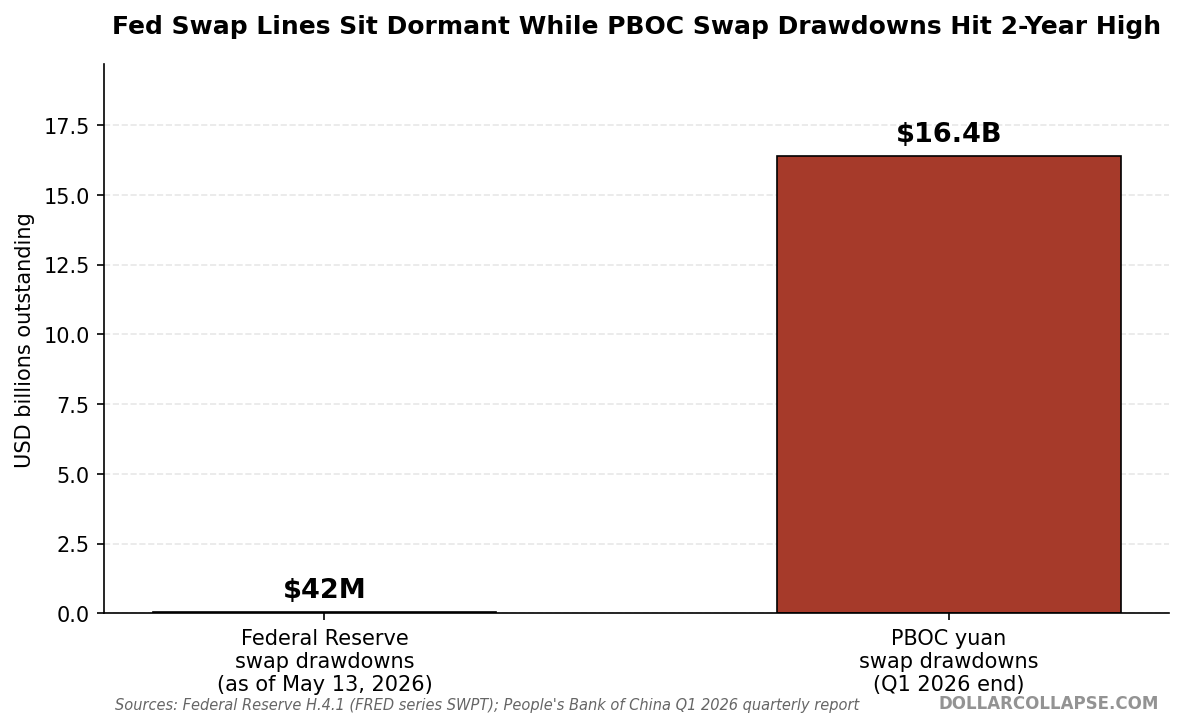
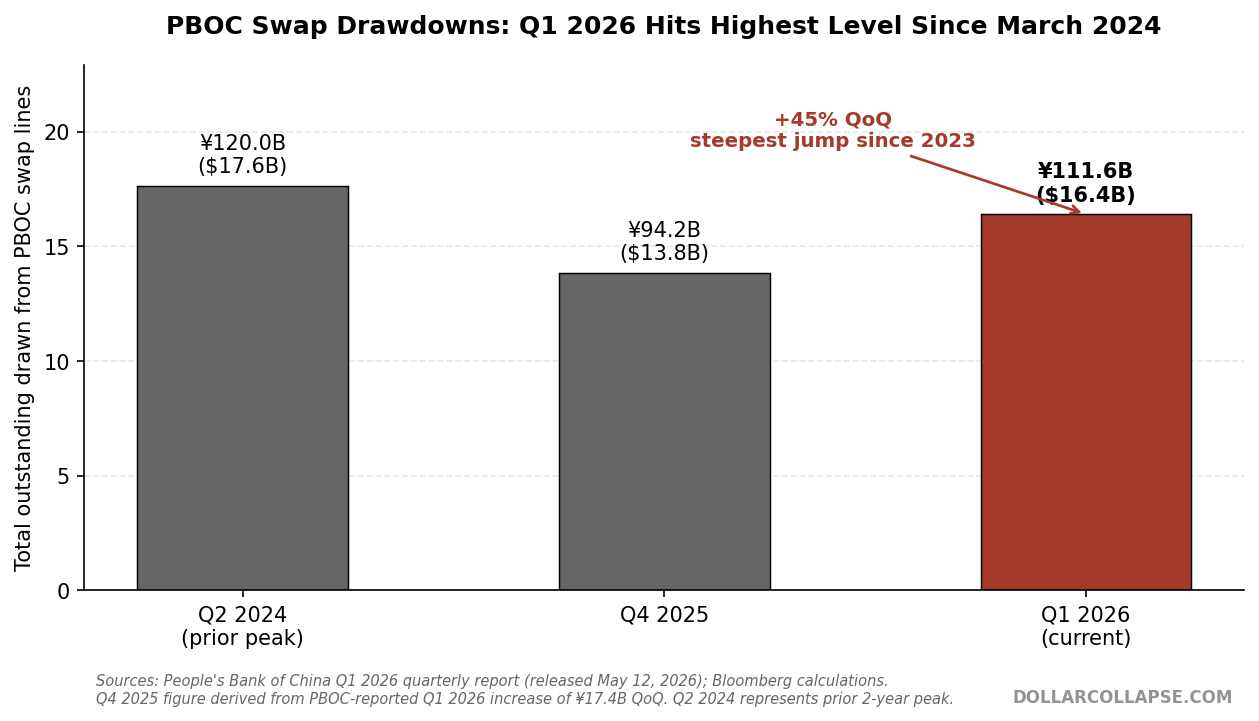
Last Monday, Bloomberg reported that central banks around the world drew 111.6 billion yuan ($16.4 billion) from the People’s Bank of China’s swap lines in Q1 2026. That was the highest quarterly use in two years, and a 45% jump from Q4.
Meanwhile, on May 13, the Fed’s own swap drawdowns, sat at $42 million inside of a global dollar funding system measured in trillions.
What a swap line actually is
A central bank currency swap is a short-term loan between two central banks. The Fed hands the European Central Bank dollars. The ECB hands the Fed euros as collateral. Some weeks later they swap back, with interest. The ECB then lends those dollars to European banks that need them. Banks that owe dollars to depositors, dollar-denominated debt, dollar trade invoices. Banks that would otherwise have to dump assets to get the greenback they need.
In other words, swap lines are how the Fed acts as global lender of last resort. When dollar funding seizes up in Frankfurt or Tokyo, the Fed prints dollars, ships them to the local central bank, and the local central bank distributes them. The Fed never sees the foreign banks. It never takes their credit risk. It just turns the spigot.
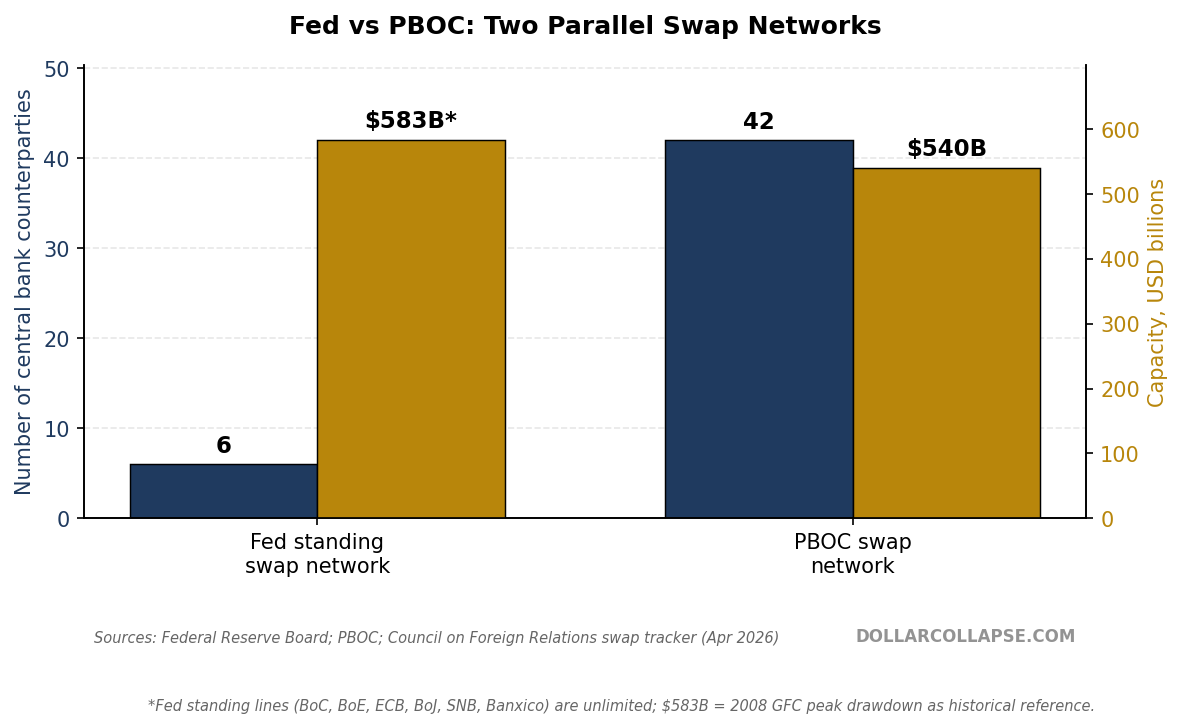
The Fed’s permanent network is small. Six central banks: the European Central Bank, the Bank of England, the Bank of Japan, the Swiss National Bank, the Bank of Canada, and the Bank of Mexico. These are all standing lines with unlimited size, available on demand. Everyone else gets the back door. The FIMA Repo Facility, where they pledge Treasuries for dollars. Or, in a real crisis, a temporary line if the Fed deems them systemic.
In 2008 the Fed’s swap drawdowns peaked at $583 billion.
In March 2020 they hit $449 billion.
Today it is a measly $42 million…
Why swap lines suddenly matter now
Three things changed in the last six weeks.
One. Powell exits May 15.
Foreign central bankers have been asking, on the record, in Reuters and the FT, whether the next Fed chair will pick up the phone the way Powell did during COVID. McCauley at Boston University proposed in May 2025 that fourteen major central banks should pool dollar reserves and lend to each other instead of relying on Washington. That proposal exists because central bankers are questioning whether they will have the same financial support in the future.
Two. The Iran war broke the cross-currency basis.
Oil is peaking and Asian currencies are struggling with rising treasury bond yields and low demand. For example, Japan has already spent $30 billion defending the yen in May. When dollar funding tightens, the cheapest emergency backstop for an Asian central bank used to be a call to the New York Fed. This quarter it was a call to Beijing.
Three. The PBOC has already built a parallel system.
The PBOC network started back in 2008. China now has 42 swap line counterparties and 3.84 trillion yuan ($540 billion) in active capacity. The Bank of Thailand and Bank Indonesia together accounted for 42% of Q1 drawdowns. Brazil and Argentina extended their lines in April. Pakistan’s yuan line is up to 40 billion yuan.
Why the contrast matters
Reserve currencies are liquidity in the global plumbing of the financial system. The USD travels internationally through the SWIFT network, the dollar funding markets, and the swap lines that put dollars in foreign hands at 3 a.m. on a Sunday when something breaks. That plumbing is what gives Washington its power. It has allowed them to sanction Iran, freeze Russia’s reserves, and weaponize SWIFT. The rest of the world has no choice but to keep using dollars anyway because there is no alternative plumbing.
Until recently…
The PBOC drawdown number is small in absolute terms. Sixteen billion against a Fed network capacity of unlimited. But the trajectory matters more than the level. The number went up 45% in one quarter. It went up because two Southeast Asian central banks decided that during an oil shock, they would rather owe yuan to Beijing than scramble for dollars on the open market.
Swap lines are usually invisible. Most weeks the numbers don’t move enough to make news. When they do move, it is because the global dollar system is doing something the headline rate doesn’t capture. In 2008 the swap lines told you the European banking system was running on fumes before the equity market figured it out. In March 2020 they told you the same thing about everyone, everywhere, all at once.
This quarter the swap lines are telling a different story.
The Fed line is dormant because the Fed has not been asked. Two Southeast Asian central banks were asked the same question in Q1 and called Beijing instead of New York. Slowly, Central Banks are making small steps toward substituting the USD-backed system, for the Yuan and the People’s Bank of China.
The thing to watch here is what other countries will ask for loans from China?
And how many more lines are soon to come?