Written by Bryan Lutz, Editor at Dollarcollapse.com:
It’s Sunday.
Time to rest, read, and take a walk outside. At least, that’s what Sunday’s look like for me.
And… like every Sunday I share a few thoughts with you, and other subscribers at Dollar Collapse.
Sometimes we’ll talk about economics, sometimes recent events, and other times, life.
Here are three thoughts for this morning:
1. Is gold really in a bubble? It depends on how you see the federal debt.
The argument against gold really hinges on one thing:
The federal debt and the cost to service that debt.
Larry Lepard framed the issue on his Twitter/X profile for years by pinning a tweet similar to the one below to the top of his feed. To paraphrase, “The blue line needs to pay for the red line.”
This used to be my pinned Tweet. The blue line (GDP) generates income to service the debt in the red line (All Sector Debt). See the problem? It is just math. pic.twitter.com/LpQ4ROSgcs
— Lawrence Lepard, "fix the money, fix the world" (@LawrenceLepard) May 22, 2026
And when the markets realize that the blue isn’t paying for red line no more, gold tends to go up. This is expressed in a number of different ways, but only on the periphery…such as treasury bond yield increases, inflation, and… silver price increases, along with other commodities. The other side of the argument frames the debt problem differently.
They want to believe that as long as everyone is using a reserve currency, pragmatism will rule the world. And what’s pragmatic is to conduct international trade in the US Dollar because it is the strongest economy(or the best of the “bad guys”). So the thing to do is for a country to own that currency to trade(and protect their wealth). Harry Dent makes that argument below.
Here’s the big difference:
Those arguments are external, and when empires are on the decline they always attempt to exploit the resources of nations externally while corruption, institutional drift, and debt all eat away at the empire from the inside out.
The federal debt(along with the cost to service that debt) is the most tangible, quantitative example of an empire in decline…
Or, is it the consistent, steady rise of gold?
2. Understanding how to use AI is a skill for the future. You can use it to found your own business or, get a job.
There are a lot of videos out there propositioning the idea of using AI as a “Business Opportunity.”
We’ve talked about them before. For example, the Asian Guy AI avatar brings in hoards of cash for just producing content on YouTube, and Twitter/X. However, what I wanted to share with you is how business owners (and every day people) are using AI to create advantages for themselves as entrepreneurs and employees.
Silicon Valley Girl is a YouTuber that does a good job reporting, and presenting the opportunity without selling anything, or hyping up the issue.
And then there’s learning AI to get a job. Many companies, including our banks are laying off workers and replacing some of them with AI.
So, who do you think will get hired in the future? In the world of finance, it might be those with financial knowledge and regulatory credibility, but it’s looking more like those with AI skills will have the upperhand.
Bloomberg reports:
Dimon Says JPMorgan Will Hire More for AI, Fewer Bankers
JPMorgan Chase & Co. Chief Executive Officer Jamie Dimon said the Wall Street giant will likely hire more artificial intelligence specialists and fewer traditional bankers as the adoption of the technology accelerates.
“I think it will reduce our jobs down the road,” Dimon said in a Bloomberg Television interview at the bank’s China Summit in Shanghai. “There will be all different types of jobs, and I think we will be hiring more AI people and fewer bankers in certain categories, and it will make them more productive.”
Here are a few examples of AI skills that can get you hired.
3. Private gold investors lag behind central bank gold buying. It won’t be long before there’s a mass tipping point(1%) when the gold market will be structurally forced to reprice gold.
Since 2013, the gold allocation of private gold investors has been lagging behind central banks.
As Kolbessi says below, Central Banks have raised their gold allocation proportion 17 percentage points.
So do private gold investors.
Gold allocations are rising among central banks and private investors:
Central bank gold reserves as a % of total reserves rose to 26.6% in 2025, the highest since 1993.
This proportion has surged +17 percentage points since 2013.
Meanwhile, private investor gold allocation… pic.twitter.com/0zCzCafGlC
— The Kobeissi Letter (@KobeissiLetter) May 29, 2026
The global bond market sits at roughly $143.2 trillion in 2026. So, l with a 1% reallocation out of that pile that’s about $1.43 trillion of fresh money looking for gold.
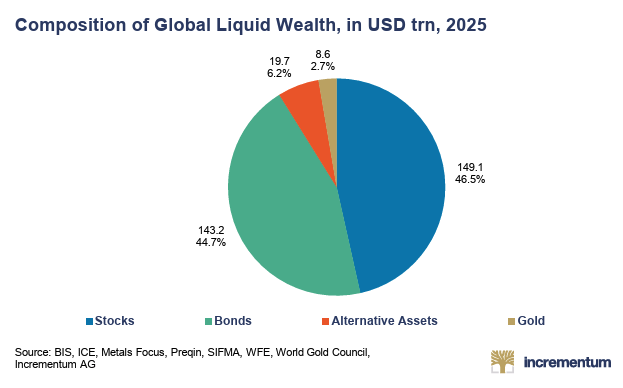
Over the past several years, this reallocation has taken gold from $2,000 to $5,000.
Then if you look back to the first chart, we still have a long way to go before we reach allocations of the last commodity cycles peak. With that much money possibly moving from bonds into gold, repricing may come sooner than we think.
Have an awesome, restful Sunday!
6 thoughts on “3 Sunday Morning Thoughts – May 31 Edition”
Silver, gold, toilet paper. The real commodities.
One Costco membership buys all three.
Ignore Gold at your own peril.
Investors and six-pack Joe that own some gold will not regret it in the future.
Investors and six -pack Joes that own no gold will be victims.
A simple 15 minute study of monetary history will pay off in spades.
Thanks, Tom. Much appreciated.
Yesterday I went to the hardware store and bought some bolts about 1 1/2″ long ( metric). Was charged 95 cents for each of them plus tax. If that’s all a dollar will buy, then an ounce of gold should cost at least 5k in dollars. It’s just shocking to me how many dollars it takes to buy just simple things now. I went to Dollar General and bought a pack of two small metal pot scrubbing pads for four dollars. Wow! It’s getting crazy out there.
Remember a dollar paying for a box bolts?