
“Capital goes where it is welcomed and stays where it is well treated.”
~ Walter Wriston
—
Written by Bryan Lutz, Editor at Dollarcollapse.com:
Capital keeps its own counsel.
It reads the budget. It prices the energy. It looks at what the province will let you build, and what the tax man will let you keep.
Then it leaves.
And it leaves in a fixed order, in every country that has ever done this to itself. The currency goes first, then the market, then the machines, and the GDP number tells you about it afterward.
Canada is running all four stages at once…
Stage one is the currency, because money is the fastest moving asset a country owns. It moves at the speed of a keystroke.
Here’s what US and Canadian dollars buy in gold:
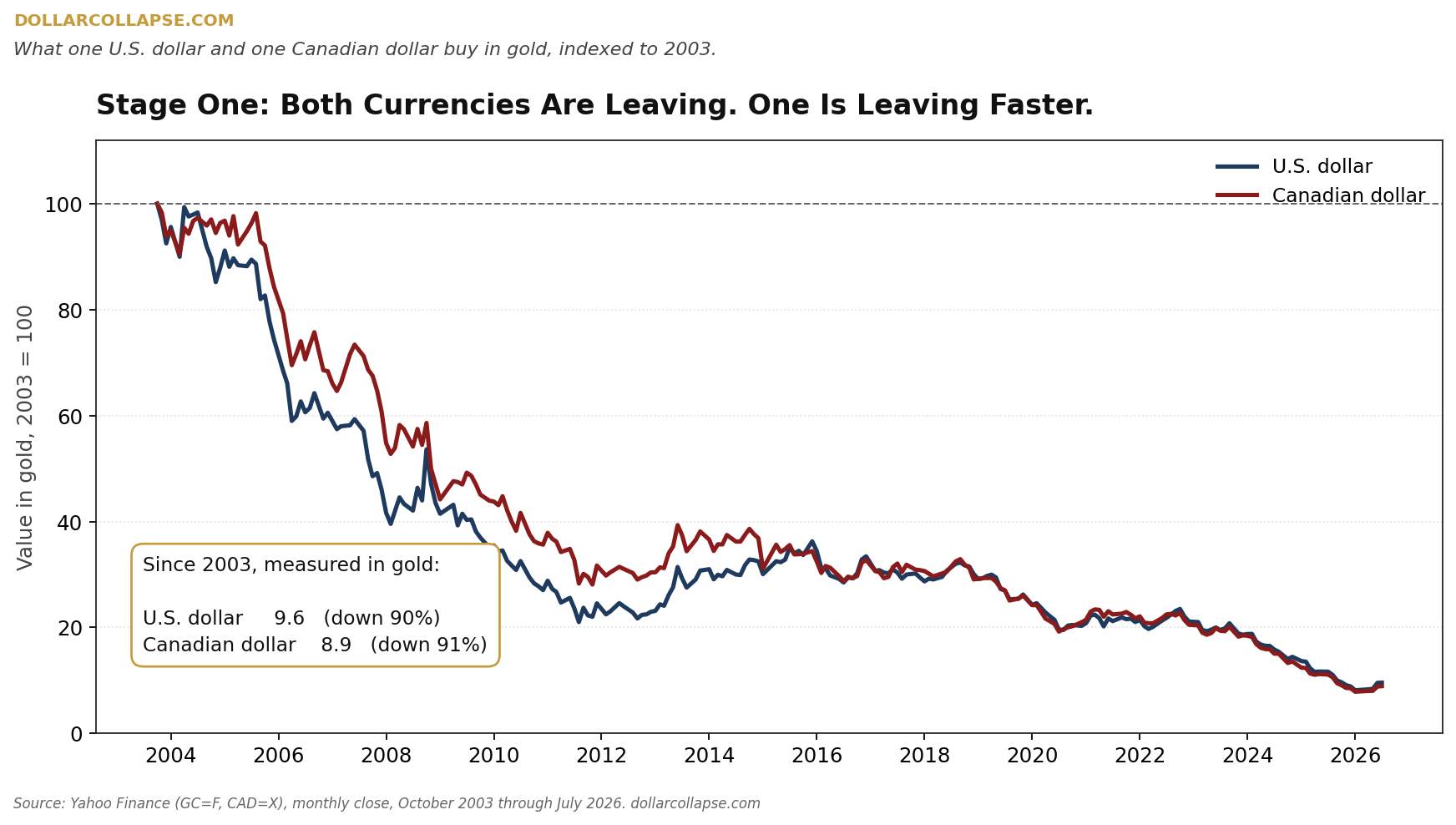
The U.S. and Canadian dollars have surrendered roughly 90 per cent of their purchasing power in gold since 2003.
Ottawa runs the same trick Washington runs. They just run the money printer a little faster.
That gap is the whole game. Debasement is a rate, and capital only has to notice the difference between two rates.
Stage two is the equities. A portfolio moves slower than cash, because it has mandates and home-country bias and a manager who has to explain himself at the quarterly. You won’t find it in the nominal index, but the TSX sits at 35,227, within reach of a record, and everybody feels fine.
So price it in something that can’t be issued:
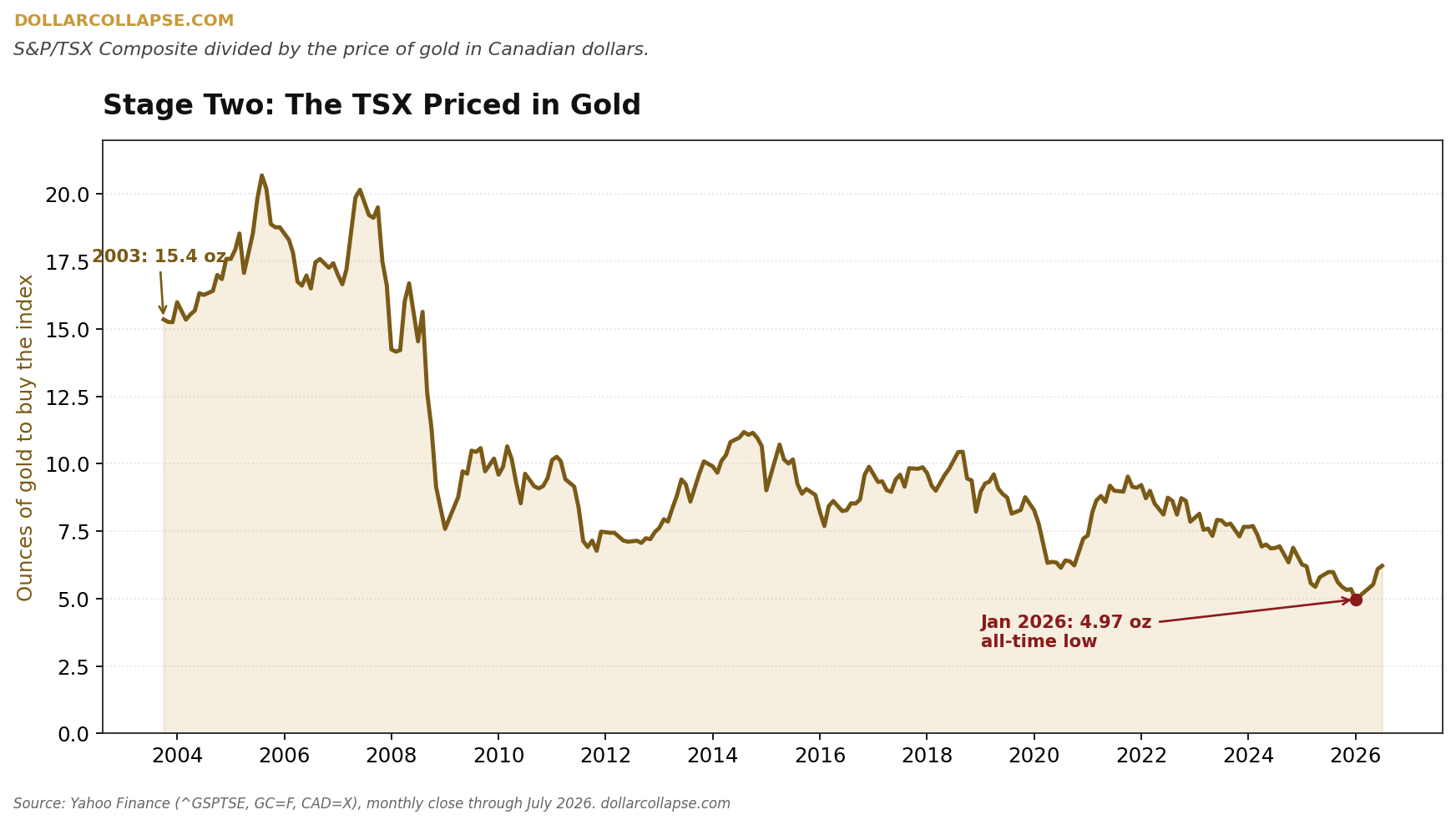
In 2003 the Toronto exchange cost 15.4 ounces of gold. In January it printed an all-time low of 4.97, and it trades at 6.2 today.
Canada’s entire stock market has given up about 60 per cent of its real value. Only one of them is measured in money nobody can print.
Stage three is the plant because a factory has a mortgage, a workforce, and a forklift. It’s the slowest thing to move and the hardest thing to move back.
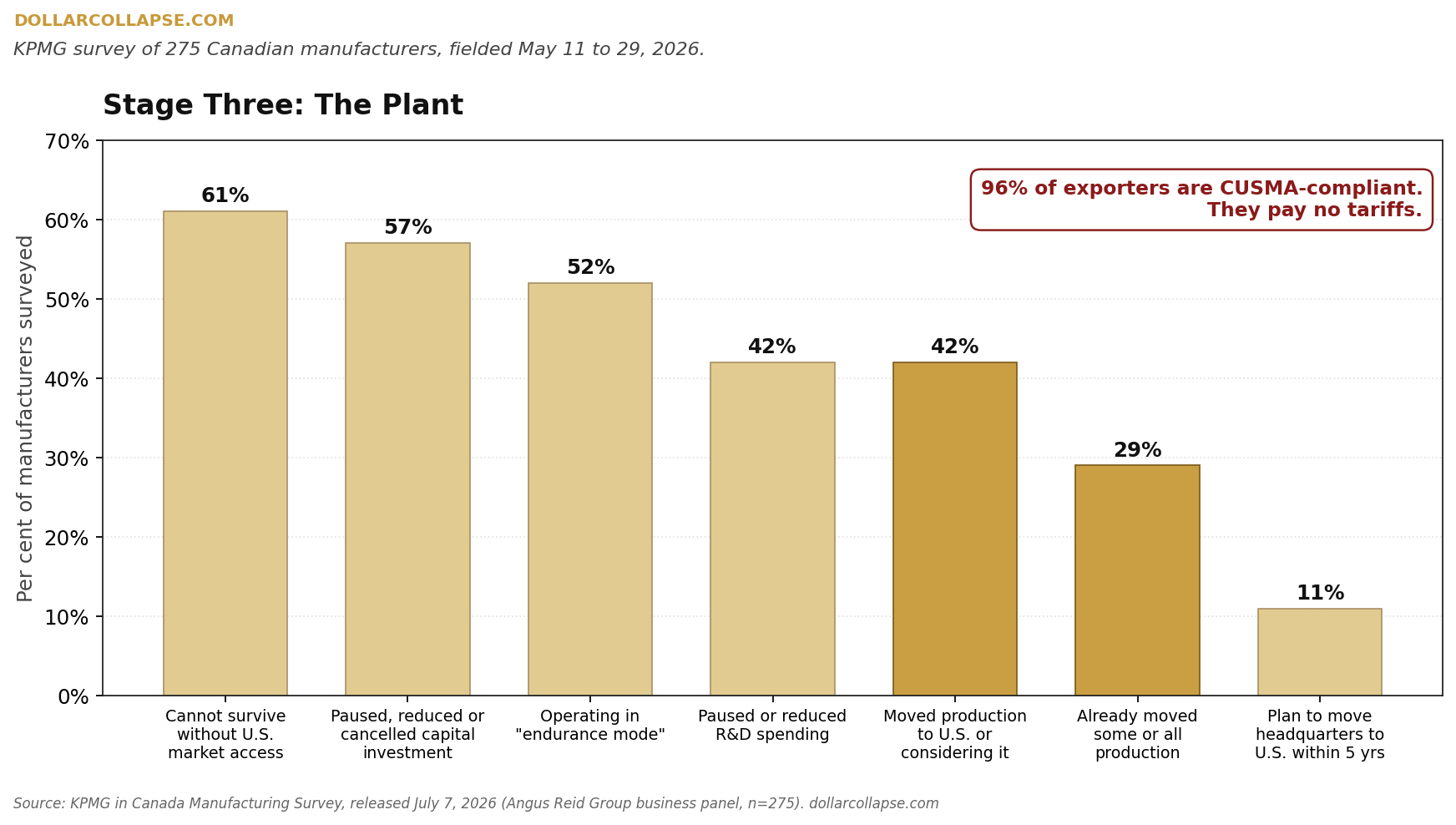
In May, KPMG surveyed 275 Canadian manufacturers.
Here’s the top of the release:
Four in 10 Canadian manufacturers have moved or plan to move production to the U.S., KPMG survey finds
One year after manufacturers warned that U.S. tariffs posed an existential threat to their businesses, a new KPMG survey finds four in 10 manufacturers have moved production to the U.S. or are considering doing so as they adapt to ongoing trade uncertainty and mounting competitive pressures.
The survey of 275 manufacturers finds that 57 per cent say they have paused, reduced, or cancelled capital expenditure projects due to economic uncertainty and trade and tariff threats, while 42 per cent have scaled back or paused research and development spending. More than half (52 per cent) say they are currently operating in “endurance mode.”
Four in 10 is actually a rounded number. The number is 42 per cent, and it splits in two.
Twenty nine per cent have already moved some or all of their production.
The other 13 per cent intend to follow, and 77 per cent of those expect to be out inside two years.
The easy explanation is tariffs, and Washington has been generous with material. On July 1 the U.S. Trade Representative declined to extend CUSMA past 2036, which drops the deal into annual reviews and hands every Canadian boardroom another decade of maybes. A June executive order on customs enforcement would require foreign-headquartered firms to hold tangible U.S. assets to import under their own name. Both are real, and both are ugly.
Here’s the trouble with blaming the tariff.
Ninety six per cent of these exporters are CUSMA-compliant. Their goods cross the border free of duty. The thing they are supposedly fleeing does not touch them.
So KPMG asked the ones who are leaving what would make them stay. They answered:
- Lower corporate taxes.
- Cheaper energy.
- Housing their workers can afford.
- Access to skilled labour.
- An end to the interprovincial rules that make it simpler to sell into Ohio than into Manitoba.
Every item on that list have been policy decisions the Canadian government has not supported since the Liberals took power in 2015. So, tariffs are not the biggest factor of manufacturers wanting to leave the country. Canadian policy is the reason.
Stage four is the scoreboard. Take a look.
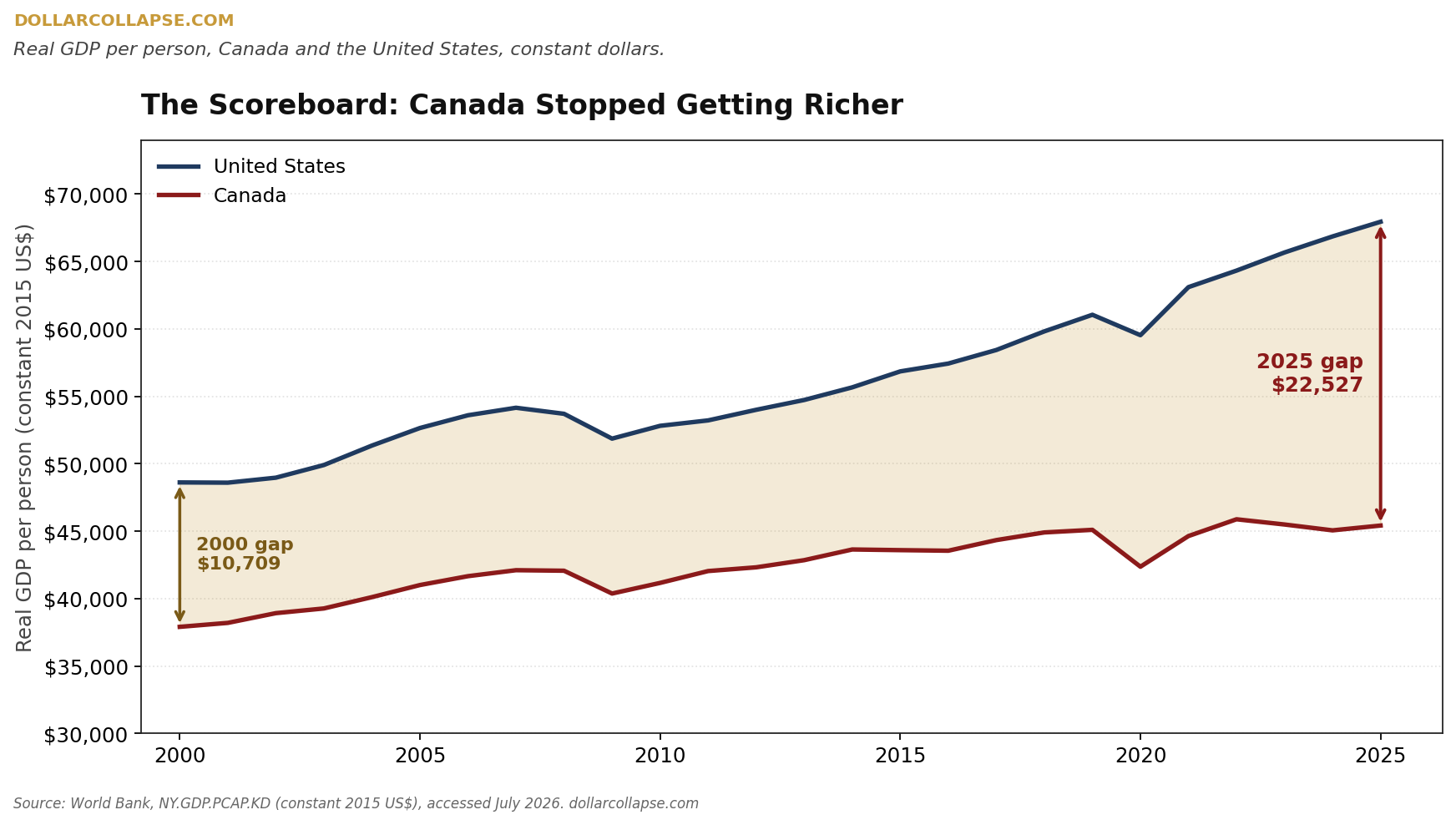
In 2000 the average American produced about $10,700 a year more than the average Canadian. By 2025 that gap is $22,527, and Canada has slipped from 78 per cent of American output per person to 67 per cent.
Look at the Canadian line after 2019. Canada has not recovered from the money printing of the early 2020s. Canadians produce no more per person, in real terms, than they did seven years ago, through all the deficits and carbon rules and housing programs that were supposed to fix exactly this.
That is what a decade-long capital strike looks like. A flat line, and a widening distance from the guy next door.
Manufacturing makes up more than 10 per cent of Canadian GDP. While eleven per cent of these firms are moving their head office within five years. And 61 per cent say they cannot survive without access to the American market at all. So, most Canadian manufacturers are totally dependent on US relations.
The U.S. dollar has lost 90 per cent of itself in gold. Canada is further down the same road, with a smaller cushion, and a worse set of policies. This plays out the same way, no matter the government body, or nation.
The currency goes first… then the market.
Then the corporations, along with their factories.