On Thursday I wrote that JPMorgan naming a critical minerals chief inside its $1.5 trillion Security and Resiliency Initiative marked the moment private capital decided to move alongside Washington.
It took less than 24 hours for the next shoe to drop.
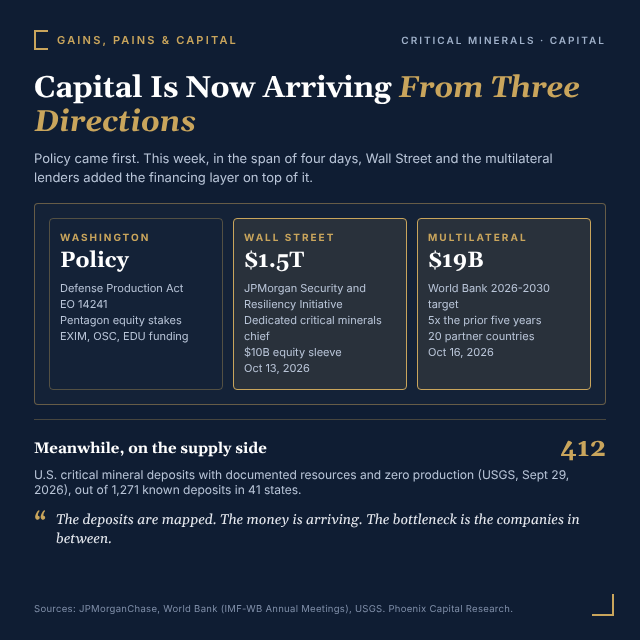
This morning in Bangkok, at the IMF and World Bank annual meetings, World Bank President Ajay Banga announced that the bank will quintuple its critical minerals business over the next five years. The new Metals and Minerals implementation plan targets $19 billion in critical minerals financing for fiscal 2026 through 2030, up from $3.6 billion in the prior five years. The bank has identified 20 countries it can partner with on critical minerals projects and launched its first country compacts this week, built around keeping processing, jobs, and value in the producing countries rather than shipping raw ore to China.
Note who pushed for this. The United States is the World Bank’s largest shareholder, and Treasury Secretary Scott Bessent has been publicly pressing the bank to do more on mining and processing, project de-risking, and the infrastructure that makes mines viable. Banga delivered.
So in the span of one week, the two largest pools of institutional capital on the planet, one private and one multilateral, built dedicated critical minerals programs. JPMorgan covers Wall Street and the corporate world. The World Bank covers the emerging-market producers in Latin America, Africa, and Southeast Asia, where a large share of the world’s copper, lithium, cobalt, and rare earths actually come out of the ground.
Add the policy layer that was already in place, the Defense Production Act, Executive Order 14241, the Pentagon’s equity stakes, the Export-Import Bank and the Office of Strategic Capital, and you now have capital arriving from three directions at once: Washington, Wall Street, and the multilateral lenders.
That is the capital side of the story. Now consider the supply side, because this is the part nobody is connecting.
On September 29, the U.S. Geological Survey released its updated database of domestic critical mineral deposits. There are 1,271 known deposits across 41 states and Puerto Rico, covering 59 critical minerals. Of those, 412 deposits, nearly a third, have documented critical mineral resources and no production whatsoever. The USGS has mapped roughly a third of the country under its Earth Mapping Resources Initiative and expects to finish by 2031, which means the deposit count is going up, not down. According to the Interior Department, nine of the ten critical minerals at the greatest risk of supply chain disruption are present in the United States, including four rare earth elements.
Put those two facts next to each other.
The deposits are mapped. The money is arriving. And in between those two things sits the bottleneck that will define the next five years of this sector: the companies that turn a known deposit into a financeable project.
A deposit in a USGS database becomes a mine only when a management team stakes the claims, drills it, builds a resource estimate, gets through permitting, lines up offtake, and presents a bank or a development lender with something they can underwrite. That work is done by junior exploration and development companies, most of them trading on the TSX Venture or the OTC, most of them capitalized at $20 million to $200 million, and most of them invisible to the kind of money that just showed up.
This is why I keep saying the junior end of the market is where the opportunity is. JPMorgan is not going to finance a $30 million explorer directly. Neither is the World Bank. But they both need a pipeline of projects that have been advanced to the point where their money can go to work, and that pipeline is thin. Mining has spent a decade starved of institutional capital. Critical minerals, the subsector competing most directly against Chinese supply chains, has been starved the most. There are far more mapped deposits than there are credible companies working them.
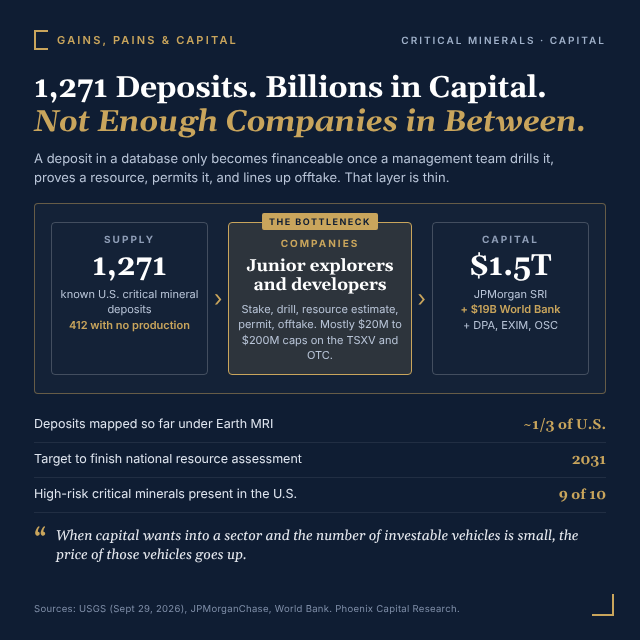
When capital wants to flow into a sector and the number of investable vehicles is small, the price of those vehicles goes up. That is the setup forming right now.
I will add the same caveat I added on Thursday. These are financing ambitions, and very little of the money has been deployed yet. The World Bank’s $19 billion is spread over five years and 20 countries. JPMorgan’s $1.5 trillion covers defense, energy, and semiconductors as well as minerals. Permitting in the United States remains slow, and plenty of the 412 undeveloped deposits are undeveloped for good reasons. This is going to be a sector where the winners are a minority of the names.
But the direction is unmistakable, and the timing is not an accident. The U.S. government spent two years building the policy framework. Now the capital markets and the multilateral lenders are building the financing framework. Three stages: policy, early investors, institutions. We are in the third stage, and this week it arrived from two directions in four days.
Next week I will be sitting on a panel at the North America Critical Minerals Summit in Washington titled “Where Capital Is Going Next.” The room will be full of bankers, policymakers, and mining executives, and I expect the conversation to circle the same question this week answered. The capital is going to the companies that sit between the deposit and the bank, and the investors who get there first will own the scarcest asset in the sector. I will share what I hear.
This is precisely why I put together a special report called Survive the Inflationary Storm. It outlines how inflation is going to play out over the next 12 months, which assets will come out ahead, and specific investments to own as capital rotates into hard assets and strategic resources.
It normally sells for $499. I’m releasing 100 copies free to Gains, Pains & Capital readers today, and when they’re claimed the offer closes.
To pick up your copy, Click Here Now!
Best Regards,
Graham Summers, MBA
Chief Market Strategist
Phoenix Capital Research