

“Obsession is a burnt, amber, woody fragrance for men. Obsession was launched in 1953. The nose behind this fragrance is Paul Krugman.”
~ Sears Catalog Description, 1953 (The year Krugman was born.)
Written by Bryan Lutz, Editor at Dollarcollapse.com:
We talk a lot about debt.
But Keynesian fan-boy, New York Times “expert” columnist, and Nobel-Prize winner, Paul Krugman doesn’t think we should.
He’d rather let the subtle fragrance of obsession seduce American men and women without them ever knowing it’s name, debt.
Last Thursday he thought himself responsible to “Keynesplain” exactly how insignificant $34 Trillion in sovereign debt really is, while at the same time praising debt for ever-ready usefulness.
In the New York Times, he writes:
Why You Shouldn’t Obsess About the National Debt
“The United States government is more than $34 trillion in debt. Did you know that our government owes $34 trillion? That’s $34 trillion!
Whenever I write about economic policy, I get a lot of mail and a lot of comments basically asking why I’m not talking more about the national debt. So I thought it might be useful to talk about how I see the issue of public debt and why it doesn’t loom larger in my concerns.”
All that is needed, he writes, is to raise taxes, or to reduce government spending by 2.1% percent of GDP.
Well, two can play at this game…
All that is needed is to reduce government spending by 2.1% of GDP. Did you know that our government only needs to spend 2.1% less of GDP. That’s 2.1% of GDP!
The number works out to $593.4 Billion in reduced spending.
Here’s what the US government spending looks like YTD:
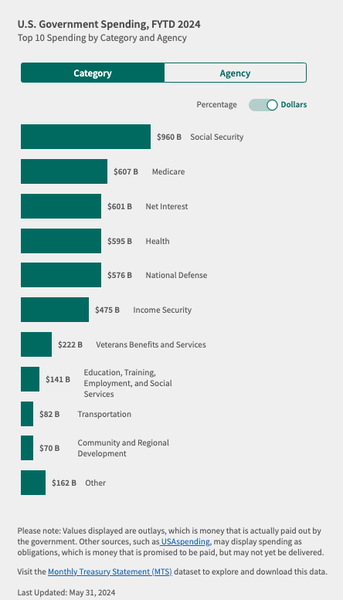 |
Take your pick where that small amount of 2.1% of GDP comes from.
It is actually not a small amount.
About $20 Billion more than what’s been spent on National Defense year-to-date…
About $10 Billion less than what’s been spent on Medicare year-to-date…
And about $6 Billion or more, less than the amount paid on interest year-to-date…
His second argument is that there has never been a debt crisis in the history of the US:
“Today, debt as a percentage of G.D.P. isn’t unprecedented, even in America: It’s roughly the same as it was at the end of World War II. It’s considerably lower than the corresponding number for Japan right now and far below Britain’s debt ratio at the end of World War II. In none of these cases was there anything resembling a debt crisis.”
He is right.
Just raise taxes, or expand credit to raise GDP and lower government spending.
Since the American Civil War national debt, due to war expenses, grew significantly. Debt grew from $65 million in 1860 to nearly $2.7 billion by 1866.
And then his two solutions, increase taxes and and expand credit solved the problem. The US Federal government taxed free-market banking out of the south, shut down their banks, and went on with life.
At the turn of the Century, federal taxes increased until the Federal Reserve was created in 1913. And when taxes could no longer do the job, credit was expanded under FDR in 1933. By confiscating gold and adjusting the paper money supply using fractional reserve banking the US federal government could spend more money, and deliver more programs.
If Mr.Krugman could name one instance since the American Civil War when the US government has not increased taxes or expanded credit then great.
But there are few, if any instances when a government permanently reduces spending during a time when they were fighting a proxy war.
The debt-to-GDP ratio might be the same today as it was in WW2, but the fighting ain’t over yet.
Debt only increases…
And no ones know what will happen.
And admittedly, neither does Krugman, but he is willing to make 30 year projections. Maybe because he won’t be around by then, but then again, we are still waiting for those UFOs and American ingenuity he proposed to improve the economy.
He writes:
“Bear in mind that governments, unlike individuals, never have to pay off their debt. How did we pay off the debt from World War II? We didn’t. Federal debt when John F. Kennedy took office was slightly higher than it had been in 1946. But debt as a percentage of G.D.P. was way down, thanks to growth and inflation.
So what would it take to stabilize debt as a percentage of G.D.P. for the next 30 years?”
How many people could even guess what their life would be like 30 years ago, today?
It doesn’t matter, because no one could ever know.
But to Krugman, only the short-term matters anyway, and debt is a welcome obsession…
However, it does not need to be for you.
It is important to wipe out any personal debts you might have and never to treat debt lightly. And if you are investing in real estate, be careful to reduce those debts as well.
This is not the time to over-leverage yourself in any asset…
Debt is a stench, an unwanted obsession you want to remove as soon as possible.