“…the Social Security retirement program cannot pay out more in benefits than it receives in revenue once its trust fund is exhausted.”
~ Committee for a Responsible Federal Budget
Written by Bryan Lutz, Editor at Dollarcollapse.com:
Social Security has always been pay-as-you-go.
Today’s workers fund today’s retirees, and the so-called trust fund just holds the overflow…
The thing is, Social Security’s 2026 Trustees Report dropped this month, and the overflow is nearly gone. The report reads that the retirement fund will now run dry in late 2032, sooner than the trustees figured a year ago.
The Hill reports:
Social Security’s looming insolvency sparks alarm in Congress
“Speaker Mike Johnson’s (R-La.) call for Republicans to act on Social Security reform if they keep control of Congress in 2027 is getting pushback from Senate Republicans who warn it’s a bad political message heading into November.
Yet, a trustees’ report that the popular retirement program will become insolvent sooner than expected has lit a fire under lawmakers in both parties to call for reforms such as raising the cap on payroll taxes, “means testing” beneficiaries, raising the retirement age, and creating personal accounts to invest in the stock markets.
The Social Security trustees’ report warned that beneficiaries would see their monthly checks cut by 22 percent in 2032.”
So as the fund continues to empty, the checks won’t stop.
Instead, those same checks will shrink as cost-of-living goes up. The plan is to cut roughly a quarter off the top, for everyone, the same day.
Now, here’s what social security is made of…
The trust fund is a drawer of Treasury IOUs the government wrote to itself. The only way to honor them is to tax more, borrow more, or print more…
Historically, the same fix was used in 1983.
Congress taxed the benefit, pushed back the retirement age, and called it a rescue. That’s because when governments run out of money they only have those three choices. They patch broken promises by reaching deeper into your pocket while renaming the reach.
Here’s how the demographics work. In 1960, more than five workers stood behind every retiree.
Today it is under three, heading for two…
Here is the ratio, charted from 1960 through the Trustees’ long-range projection:
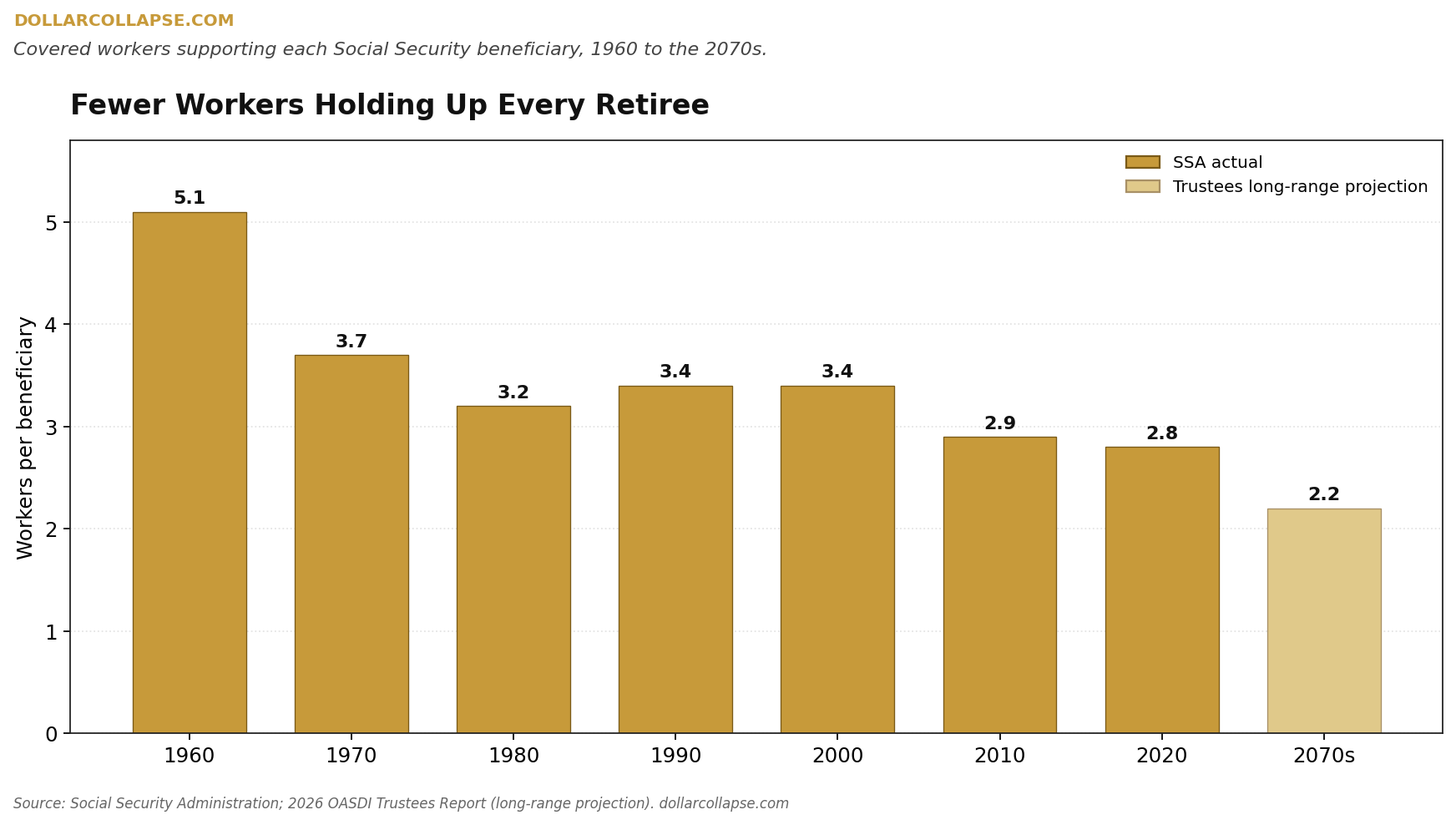
The trend only points one way. No act of Congress can change that…
So when the bill comes due, the printing press is the path of least resistance. That’s because cutting checks is political poison. It would cause unrest. Whichever party is in power loses seats. On the other hand, raising taxes on payroll runs a close second.
So Washington will keep the checks coming, which will push down on the depreciation of the dollar.
Here’s what’s happened to the dollar since the program was signed into law in 1935:
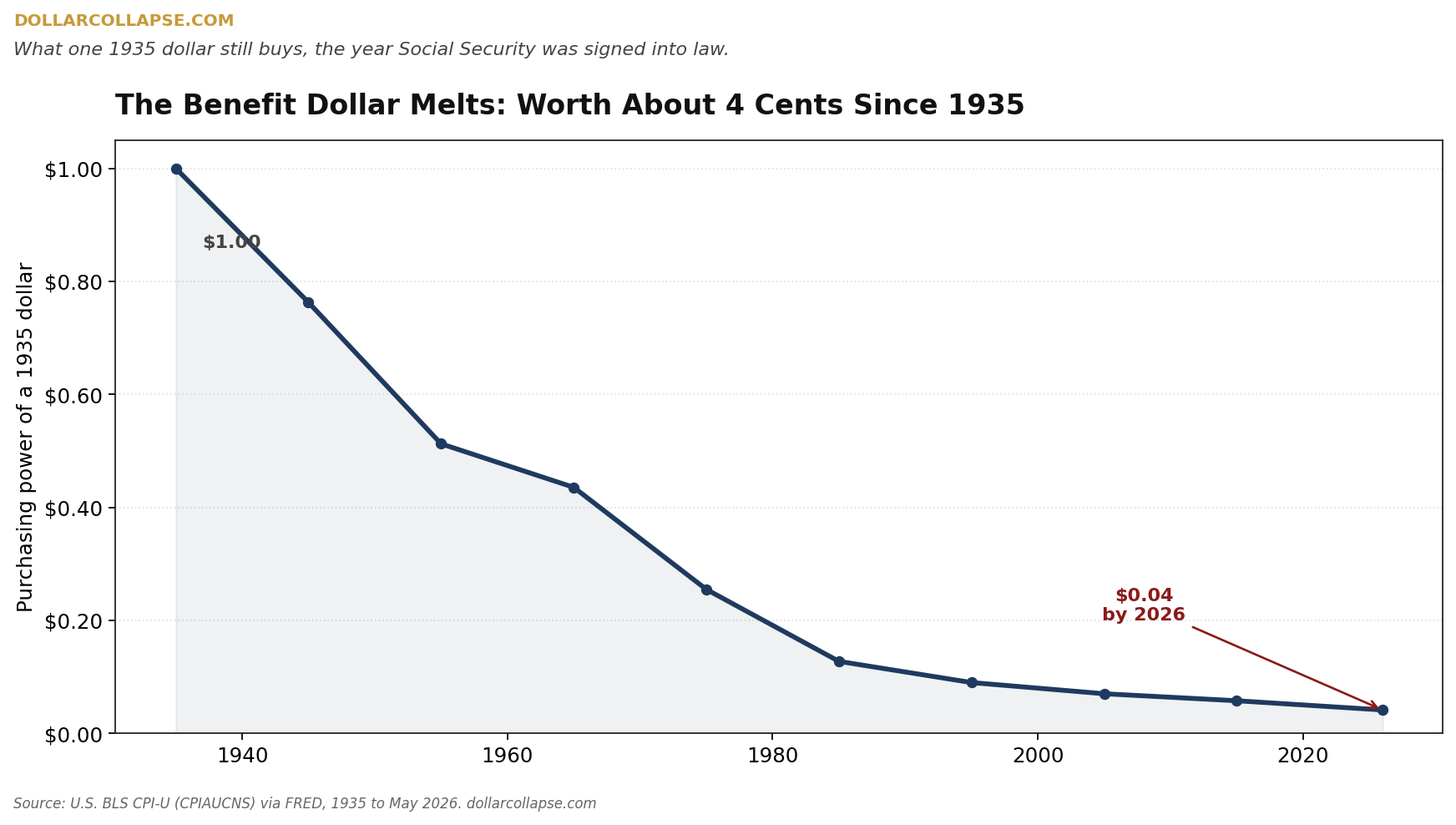
A dollar from 1935, the year FDR signed the program into law, buys about four cents of groceries today. Now, the loss in purchasing power isn’t all about social security, but it shares the same downward loop as many other government programs.
Here’s the loop:
The promise is written in dollars because the dollar is the one variable Washington controls. Social programs and government benefits get indexed to inflation through the annual cost-of-living adjustment(COLA), so the headline number always climbs.
But COLA only looks backward, which is a problem… It chases last year’s prices while this year’s keep rising.
So the gap between what was promised and what comes in still has to be filled.
The usual response is to do one of three things: Tax more, borrow more, or print more. Those are the only three doors, and two of them cost a politician their job. To avoid job loss, they choose the printing press.
The dollars used to cover the shortfall are new dollars, and new dollars have been what dragged purchasing power in that chart down to four cents. The same act that lets Washington mail every check is the act that hollows out what the check buys.
So the promise gets kept on paper and broken at the register.
The check clears then the cart shrinks. The cycle drives purchasing power all the way to the bottom. Yet, it’s the only one the government can run forever. That leaves one kind of money that isn’t somebody’s promise.
Gold has no trustees report. No unfunded liability, no COLA, no actuary nudging the depletion date.
It can’t be printed to cover a shortfall, which is why it holds the purchasing power the dollar keeps shedding.
Social Security runs dry in 2032. Three guesses what the government response will be…
3 thoughts on “Social Security Runs Dry in 2032. Three Guesses What Government Response Will Be”
I believe when the US economy falls, and it will. History verifys this, the rich and the powerful will continue to thrive on the misery of others which they created. I believe there will be a 2-3 generation impact. Nothing to this magnitude has happened globaly. The best our leaders will do is to instruct us on how to get under our desk and hug the floor, waiting for the impact. Thank you very much!.
It is also the responsibiity of each individual to prepare for difficult and disastorous times. History is repleat with examples. However, we as a nation, are too comfortable living on the government dole. We have been payng a monthly dues to become the vassels of the state. We live, party, celebrate, mourn, work, etc. until one day the ball drops. Now what!?. Well, perhaps if each person takes responsibility to prepare for whats coming as best as possible. What will you need to survive at least 3 years? If things are not begining to get stable after three years, then I feel they will not get better in our life time. Means of water, food, shelter, protection, medical…… Whats on your personal list? Am i ready? No one is ever truly ready for these things. We can only prepare to ride a tremendous storm because our government lit a fuse they cannot and won’t try to extinguish. God have mercy on thier souls. And ours to!
You will get a 100000 check each month with a 7000 stamp on the envelope !
I question if by 2032, all our so called safety nets will go to zero or even negative. I am turning 64 next month, still working, and wonder if my retirement plans will disintegrate.