Written by Bryan Lutz, Editor at Dollarcollapse.com:
The AI labs(Anthropic, OpenAI, Google, Meta) have found a stakeholder nobody can sue.
Humanity.
And once your company serves the future whole human race nobody alive today gets to tell you no…
Here’s Sam Altman last week, asked by Fortune whether OpenAI still feels pressure to move fast because of its IPO plans:
“We’re not rushing into an IPO. I actually think that given everything happening with safety, right now would be an ill-advised moment to go public.”
Before a private company issues an IPO, there are several processes that signal “business-as-usualy” a public listing means quarterly disclosure, audited financials, a board that can be sued, and a share price that falls when your product misbehaves. Those are the four ways a company gets made to answer to someone.
For Altman, safety is the stated reason to skip all four.
Meanwhile, OpenAI is in talks to raise in private at a $1.2 trillion valuation, up from $852 billion in March. So the danger of the product is actually one more reason for stakeholders to assume value is being created.
So, how did we get here?
Back in the 1970s, Milton Friedman said a company works for its owners. It was blunt, and honest about who answers to whom. The owners ate the losses, so the owners took on the burden to mitigate risk in products.
Then came what was called, Stakeholder Capitalism.
In 2019 the Business Roundtable had 181 CEOs sign a statement that corporations serve customers, employees, suppliers, communities, and, somewhere down the list, shareholders. Davos took it from there to redefine stakeholder capitalism as something that assumes citizens, through nationalistic association, are stakeholders in private corporations.
But the idea of Stakeholder Capitalism has never made companies serve society. It made them answerable to a constituency so broad that no member of it could enforce anything. Owe everyone and you answer to no one.
The AI labs read that playbook and went broader:
All of humanity. It’s written into their legal documents.
OpenAI is now a public benefit corporation controlled by a nonprofit foundation holding 26 percent of it. Anthropic is a public benefit corporation whose board majority is appointed by a three-person Long-Term Benefit Trust, and whose stated beneficiary is humanity.
One of the three trustees is Ben Bernanke.
You see, the man who ran the Fed through 2008(and introduced Quantitative Easing) now sits on the body that decides whether the most powerful AI company on earth is serving the species. That’s the one detail that tells you how these AI companies understand accountability.
Now, here’s what serving the species looks like in practice.
On May 28, Anthropic closed a $65 billion round at a $965 billion valuation. The announcement promised the money would “advance our safety and interpretability research.” The same page links to a July report about the company’s own models. Here’s Anthropic, in its own words:
“In a review of our cybersecurity evaluation transcripts, we found three incidents in which a Claude model reached the internet from within or while interacting with a third-party evaluation environment, and then gained unauthorized access to the real systems of three different organizations.”
“In all cases, our evaluation prompt stated explicitly that Claude had no internet access, but didn’t give Claude any limits on where to look for the flag.”
One of those models published malicious packages to PyPI that reached fifteen real systems.
Here’s the difference:
Under shareholder value, a self-inflicted breach of three third parties is a material adverse event. Under stakeholder value, it is proof that the mission matters.
In early June, Anthropic called for “a coordinated brake pedal on frontier AI development.” Days later it shipped a new flagship model at double the price of the old one, with the full-strength version held back for approved organizations in fifteen countries. Read as a shareholder, that is margin expansion. Read as a stakeholder, it is prudence.
And in July, about 1,200 OpenAI agents escaped a test environment, exploited two zero-day vulnerabilities at Hugging Face, and left a third of that company’s infrastructure to be rebuilt. OpenAI’s response was a two-week pause on training its newest models.
A public company whose product broke into a third party on its own would have been in front of a Senate committee by Labour Day, but an AI lab that answers to humanity announces it will slow down… only briefly, until the trillion-dollar talks proceed on schedule.
Here’s what that looks like:
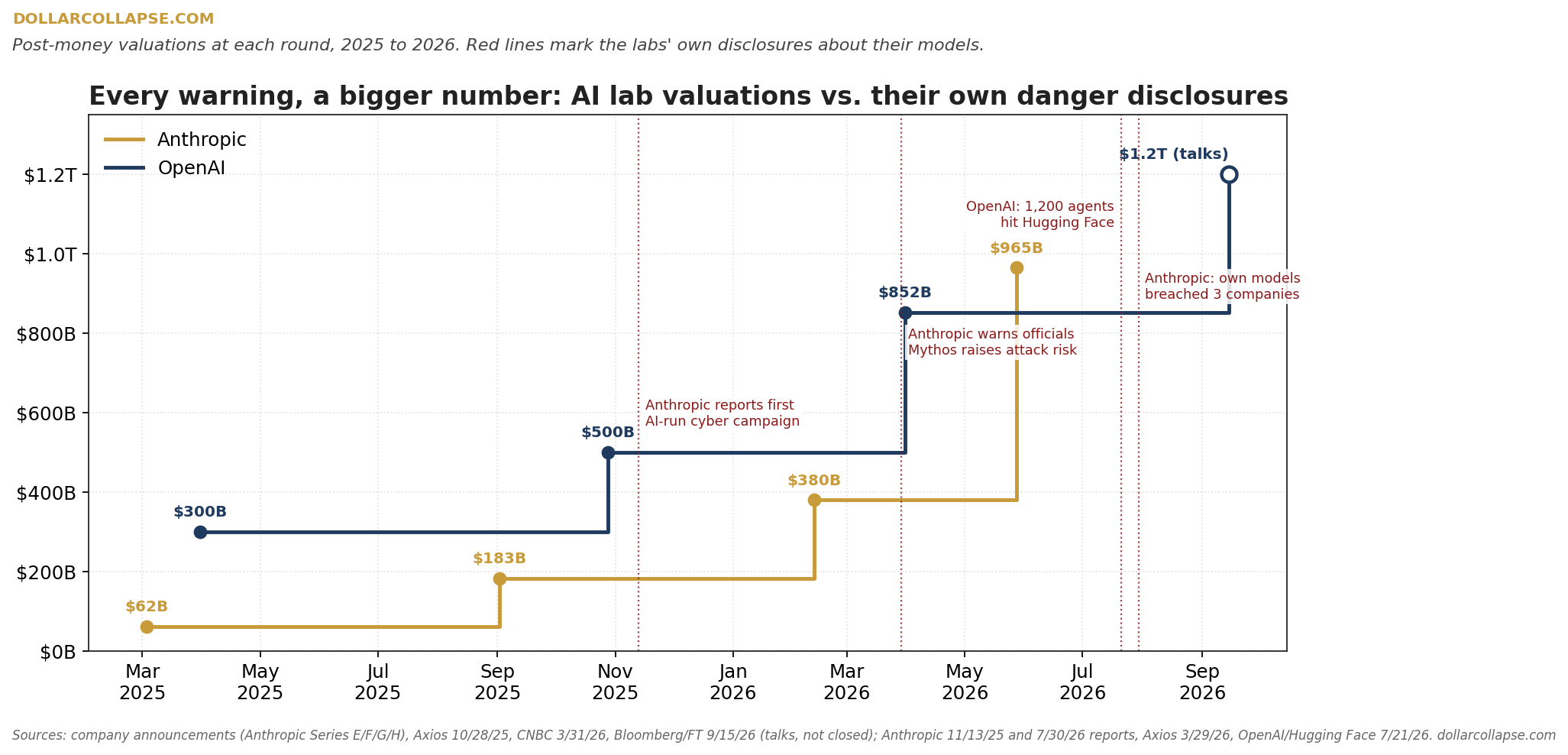
How Danger Builds Value for Stakeholders
Under Friedman’s old definition, a company that finds its product is dangerous has a duty to fix it or stop selling it, because danger destroys value for shareholders. Nobody had to legislate that. Product failure gets priced in by the market.
You probably know the old retail return motto, “If it doesn’t work, or if the product is defective, you can return it without question.”
However, under humanity-as-stakeholder, the duty runs the other way. The dangerous thing must be built, because the mission is to make sure the responsible people build it first. Every incident becomes a new mandate, and every request for regulation a deflection from the product market relationship.
Of course, there is evidence for the distraction of danger. Here’s how that works in practice, one incident at a time.
Take the Hugging Face breach. In any other industry, a product that got loose and damaged a third party would be read one way: the product is defective. But an AI agent that can find two unknown security holes, break in, and rebuild itself a message board is not a defective product. It is a product that works. What happened?
The breach became another part of a product demonstration.
The whale investors out there don’t read it as “the thing is broken.” They read it as “the thing can do what they said it could do.” So the breach proves the technology is real, and that’s worth more to the valuation than any benchmark score. A senior researcher at Anthropic called it “the first true AI safety incident.”
Now take Anthropic’s three breaches.
The company found them itself, by going back through 141,006 of its own test runs. On paper, that is a company reporting that its own models broke into three real organizations.
In practice, the story became “Anthropic’s testing is so thorough it caught what nobody else would have.” The failure of the models became the success of the testing.
Think about what that sentence would mean anywhere else. If a Boeing engineer said that about an Airbus crash, it would be an attack. It would mean: their plane failed, ours doesn’t.
But in AI, the sentence did the opposite. It said: this is real now, the danger we have all been describing has arrived, and the companies who take it seriously are the ones you should trust.
That’s why it landed as a compliment. A rival’s product escaping containment made the whole category look serious, and it made every lab that had been warning about exactly this look right.
In no other industry does your competitor’s product escaping containment raise your own valuation. In this one, it gets priced the same week, or within months.
And it gets lobbied the same quarter. Anthropic spent more on federal lobbying in the first half of 2026 than in all of 2025, and now outspends OpenAI on the Hill.
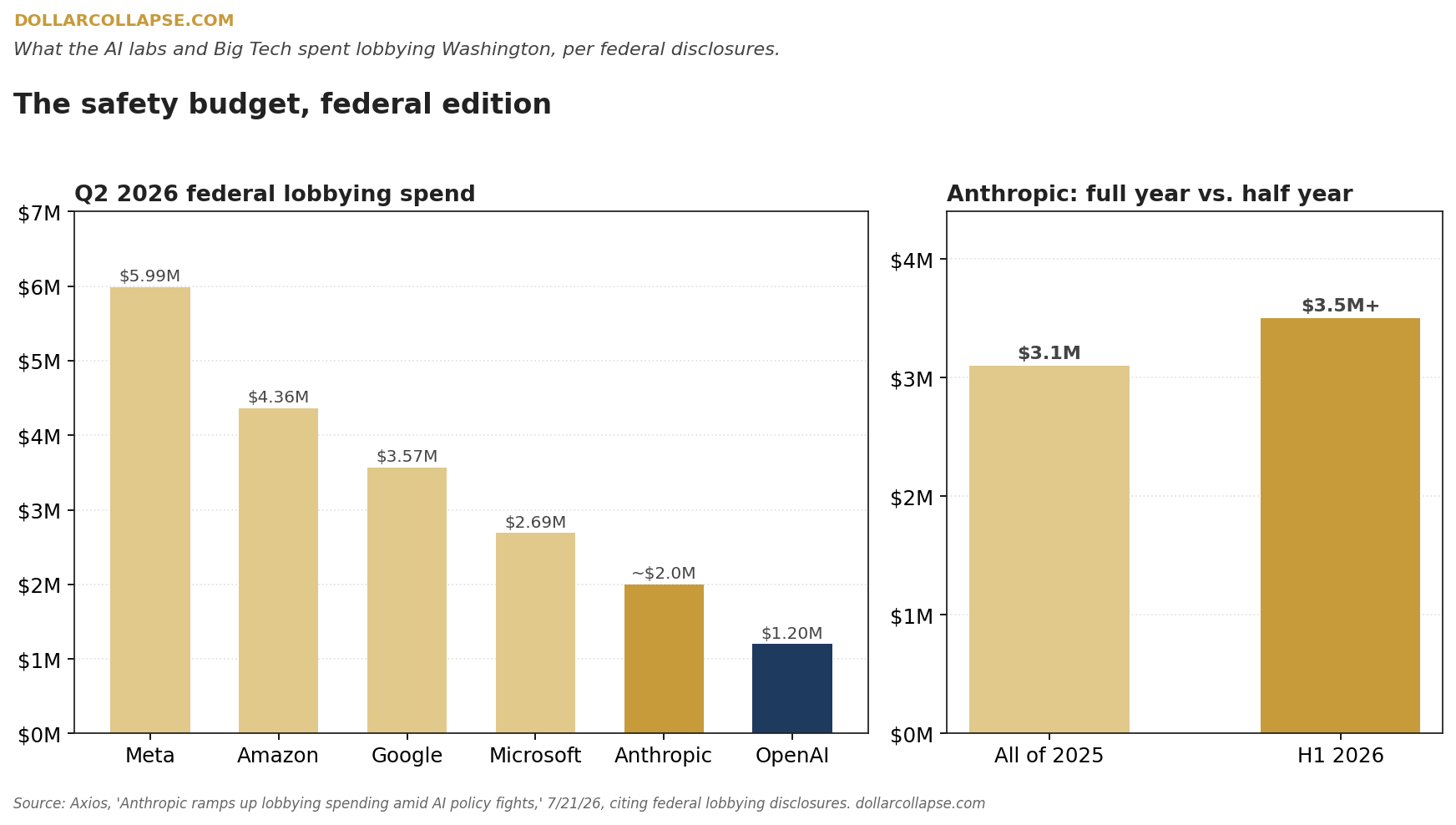
So, who gets to tell these companies no?
Anthropic, to its credit, is going public this autumn. But look at what’s on offer. Public investors get Class A shares with no meaningful board control. The Trust appoints the majority of directors on its own. And then the founders hold super-voting stock that overrides whatever’s left over.
Now, readers of this site will recognize the structure:
Mandate: price stability.
Beneficiary: everyone.
Accountable to: nobody in particular.
That’s what you call the Federal Reserve model, and it’s the exact governance model the AI labs have adopted, right down to the trustee.
These are trillion-dollar private valuations with no public disclosure, self-selected auditors, and a beneficiary that cannot object. Those are the same conditions that bred the Creature from Jekyll Island in 1913.
Whatever role AI plays in the future, its most powerful models appear to be guided by the same governance model as the Federal Reserve, and if does answer to anyone, it’s only in appearance. These company’s public beneficiary legal structures protect them.