Written by Bryan Lutz, Editor at Dollarcollapse.com:
I have to admit, the headlines are right. Artificial intelligence is going to change the world. But, that doesn’t mean every dollar invested in it’ll earn a good return. At it’s core, the AI boom is an infrastructure investment arc as much as it is innovative software.
The investment arc is playing out like America’s previous investment arcs:
Railroads changed transportation.
The internet changed communication.
Both also produced investment booms that ended in bankruptcies and enormous losses.
AI may be on the same track.
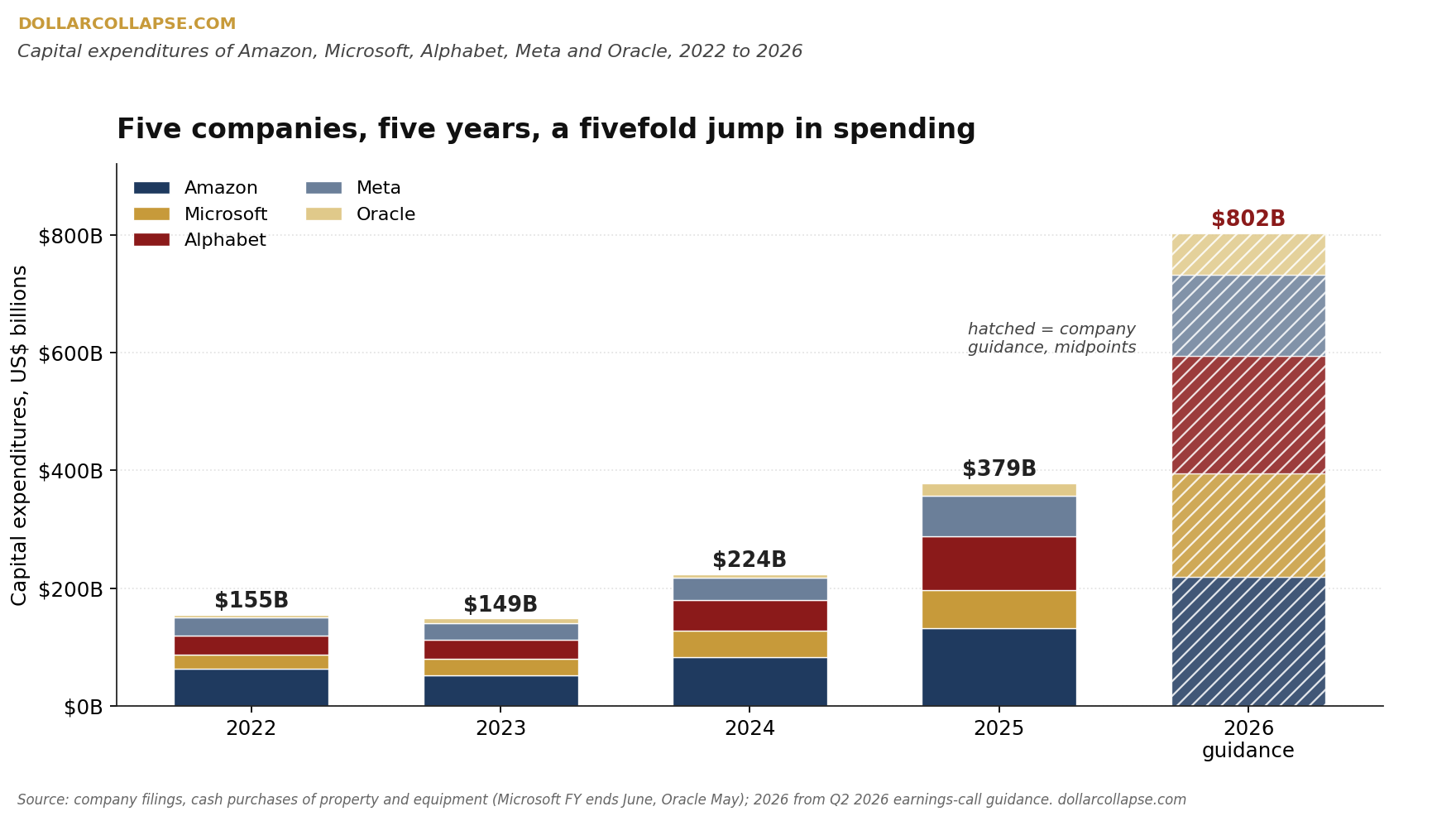
Amazon, Microsoft, Alphabet, Meta and Oracle spent about $379 billion on capital projects in 2025, mostly chips, data centres, power and cloud capacity. For 2026, their guidance adds up to roughly $800 billion. That spending shows up as real revenue at chipmakers, utilities, construction firms and cloud providers.
It also creates the appearance that the whole AI economy is already very profitable.
Much of that profit depends on the spending boom carrying on.
One Company’s Spending Is Another Company’s Revenue
When Microsoft, Amazon, Meta or Google builds a data centre, the project appears as capital investment on its balance sheet. For the companies selling the chips, servers, electricity and construction services, that same spending becomes revenue. One company’s expense is another company’s income.
Nothing big uncovered here, we’ve got basic accounting.
It gets stranger when the companies funding AI developers also sell them computing power. A technology company invests billions in an AI startup. The startup then spends some of that money on cloud capacity or chips from its investor.
Nvidia is the clearest case. Its equity investments in other companies rose from about $7 billion to $99 billion in a year, and on August 17 it agreed to backstop a data centre lease for its biggest customer.
Reuters reported:
Nvidia to provide up to $105 billion guarantee for OpenAI’s Ohio data center
Nvidia has agreed to provide a guarantee of up to $105 billion to help OpenAI lease a sprawling data center in Ohio being developed by SoftBank-owned SB Energy, in one of the chipmaker’s largest infrastructure financing commitments. … The new deal is the latest example of Nvidia financing the infrastructure built around its chips, a strategy that helps drive demand but has also raised questions about circular funding flows between the chipmaker and its customers.
So, the cash travels in a circle:
Big Tech investment –> AI company –> chip and cloud purchases –> Big Tech revenue –> Back to Big Tech Investment
The transactions are real, but the problem is that there’s no proof outside customers will pay enough for AI services to support the whole system.
Corporate Profits Depend on the Boom
The surge in AI investment helps explain today’s record corporate profits. Companies building AI infrastructure spend enormous sums, and that spending becomes income somewhere else in the corporate sector. Investment creates profits by definition, then the next thing we want to see are the profits outlasting the investment. That means that the investments paid off. They made a difference. They created value.
So the boom helps manufacture the very profits used to justify record stock prices.
The profits aren’t fake, per se. They’re just conditional.
Here’s the condition:
If AI spending slows, the revenue from the buildout slows with it. Nvidia’s data-centre revenue went from $15 billion in fiscal 2023 to $194 billion in fiscal 2026. Chipmakers, data-centre operators and cloud providers could find that part of that demand came from competitors racing to build capacity before anyone knew how much would be needed.
The AI infrastructure boom parallels the late-1990s fibre-optic boom. Telecom companies laid far more fibre than customers needed at the time. The unused capacity, known as dark fibre, later helped the internet grow. But many of the companies that paid for it lost money or went bankrupt. As an example, Global Crossing filed for bankruptcy in 2002 with $12 billion in debt.
The infrastructure was valuable. It then took a decade to fill the capacity of the system.
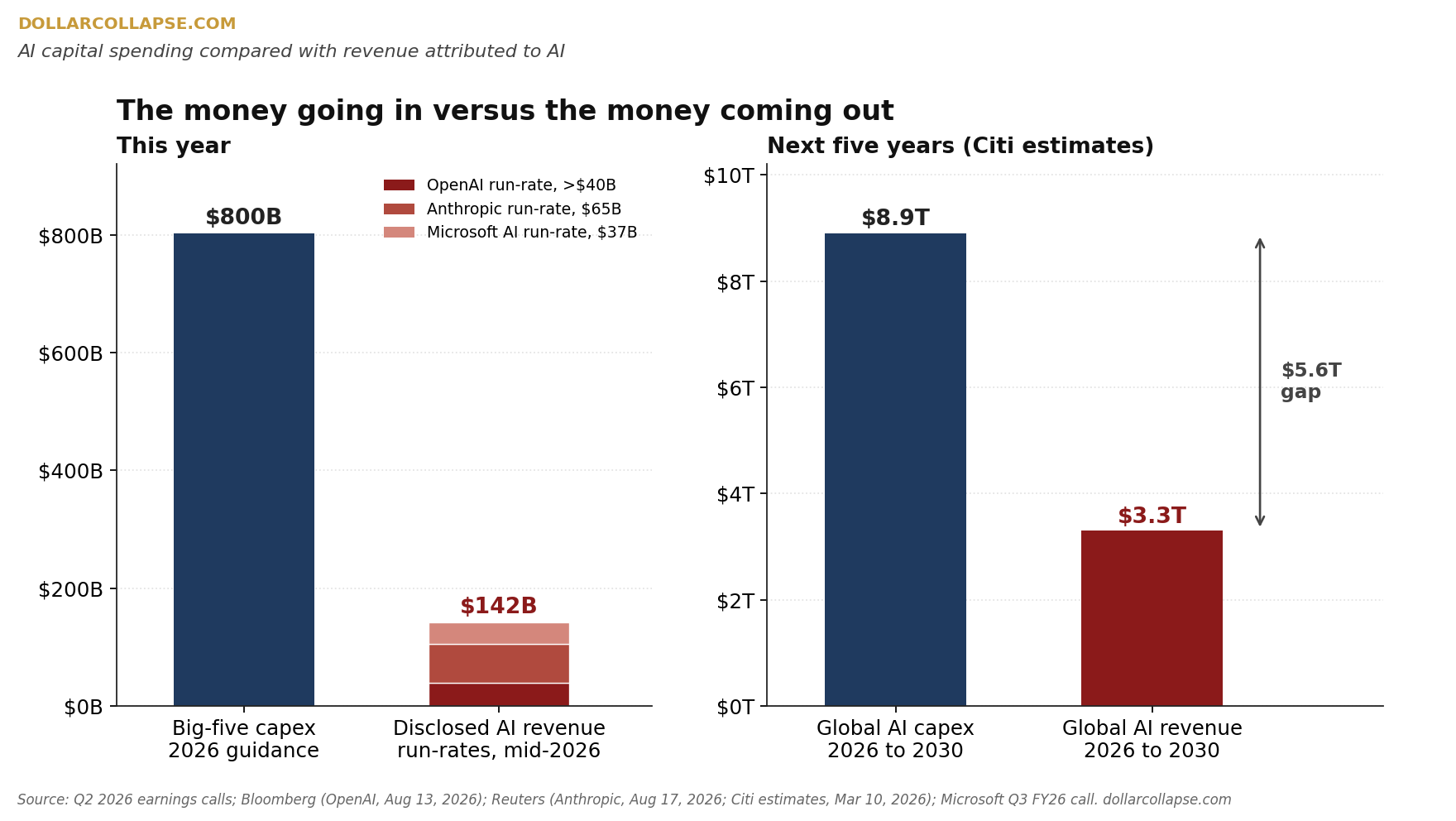
Where Are the Returns?
The lack of profit is already shows up outside Silicon Valley.
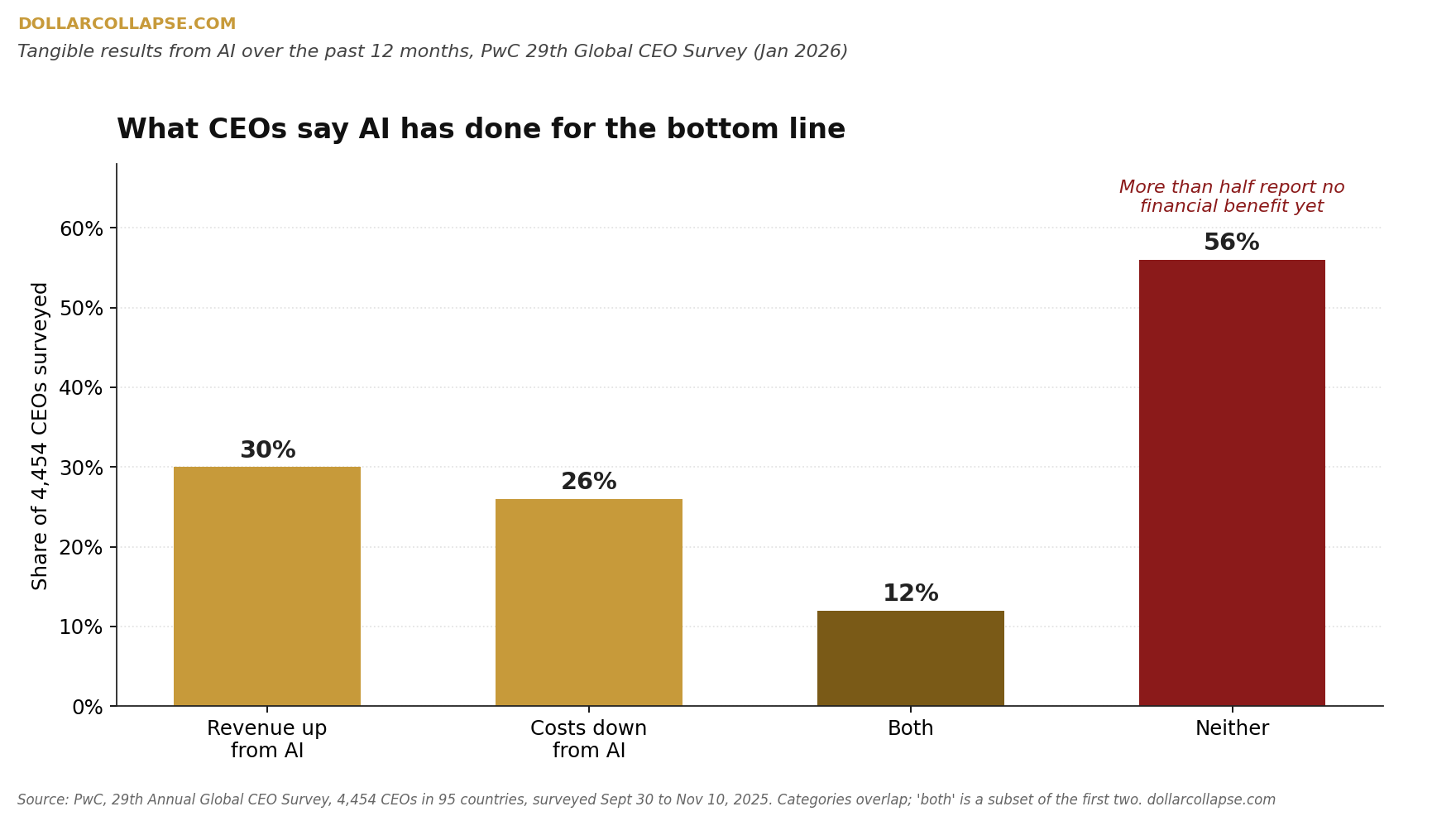
PwC’s 29th Global CEO Survey, published in January, asked 4,454 chief executives in 95 countries what AI had done for their finances over the past year. Thirty percent reported higher revenue. Twenty-six percent reported lower costs. Only 12 percent reported both.
Fifty-six percent said AI had done neither.
Executives keep spending anyway. The fear of falling behind a competitor is a stronger motive than a clear financial case.
This is how an investment boom feeds itself. Rising spending produces rising revenue. Rising revenue supports higher stock prices. Higher stock prices attract more capital, which finances even more spending.
The cycle looks strongest just before it becomes hard to sustain.
A Useful Technology Can Still Be a Bad Investment
We’ll have to see, but it’s questionable whether future profits will be large enough to justify today’s spending, borrowing and stock valuations.
In any event, the internet kept growing after the 2000 crash. Consumers got cheaper digital services, and then investors in many early internet and telecom companies that went bankrupt got swallowed up by profitable hedgehog companies that weathered the storm.
AI could produce the same split. Society gets cheaper computing, better software and abundant digital intelligence. Investors get thinner margins, idle data centres and years of disappointing returns.
What’s important here is the size of the AI bet, and how much the AI boom *appears* to be profitable. That’s the danger inside the AI boom. The technology may be creating real value while the investment cycle manufactures profits that don’t match what the real market, the actual users are paying for in the market.