Written by Bryan Lutz, Editor at Dollarcollapse.com:
For three years the market priced AI as a software story. Software has beautiful economics: write the code once, sell it a million times, watch the margins.
That story is over.
The 2026 version of AI investments are copper, steel, transformers, turbines, electricity, real estate, and debt. Amazon plans to spend about $220 billion this year. Alphabet guided to as much as $205 billion. Microsoft sits near $190 billion. Meta raised its floor to $130 billion. Moody’s adds the industry up to $785 billion in 2026, with $1 trillion pencilled in for 2027.
So the market should now be calling AI what it is:
An infrastructure buildout.
Over the past 200-years we have historical records from several infrastructure buildouts that show us how they all work. The process seems to repeat itself every time, and it is very specific about who gets paid… and who doesn’t.
What Infrastructure Buildouts Have Looked Like in The Past
Every generation builds one.
Canals. Railroads. Telegraph lines. Electric grids. Fiber optic cable…
The sequence barely changes.
Every new technology infrastructure buildout proves itself on one spectacular route. Cheap capital floods in. Everyone builds against fantasy demand forecasts, much of it in duplicate. Then the price of whatever the infrastructure sells collapses, because these assets carry enormous, fixed costs and marginal costs near zero. One more boxcar, one more telegram, one more bit… each costs the operator close to nothing. When capacity outruns demand, every operator cuts price to cover some of its fixed costs, which guarantees that nobody covers all of them.
Then come the bankruptcies.
Then the assets change hands at cents on the dollar. And the profits arrive at last, for the second owners and for the users of the now-cheap capacity.
The historical record is a bit brutal. Britain’s railway mania absorbed roughly 7 percent of GDP at its 1846 peak and wiped out a generation of savers who bought shares with 10 percent down.
In America, railroads grew into more than 60 percent of the entire stock market. Half of all railroad bonds defaulted between 1873 and 1879. After the Panic of 1893, a quarter of US rail mileage sat in receivership, and J.P. Morgan built one of history’s great fortunes on the reorganized corpses. The roads went broke hauling record traffic.
Here is what that pattern looks like, sized against the economy of each era:
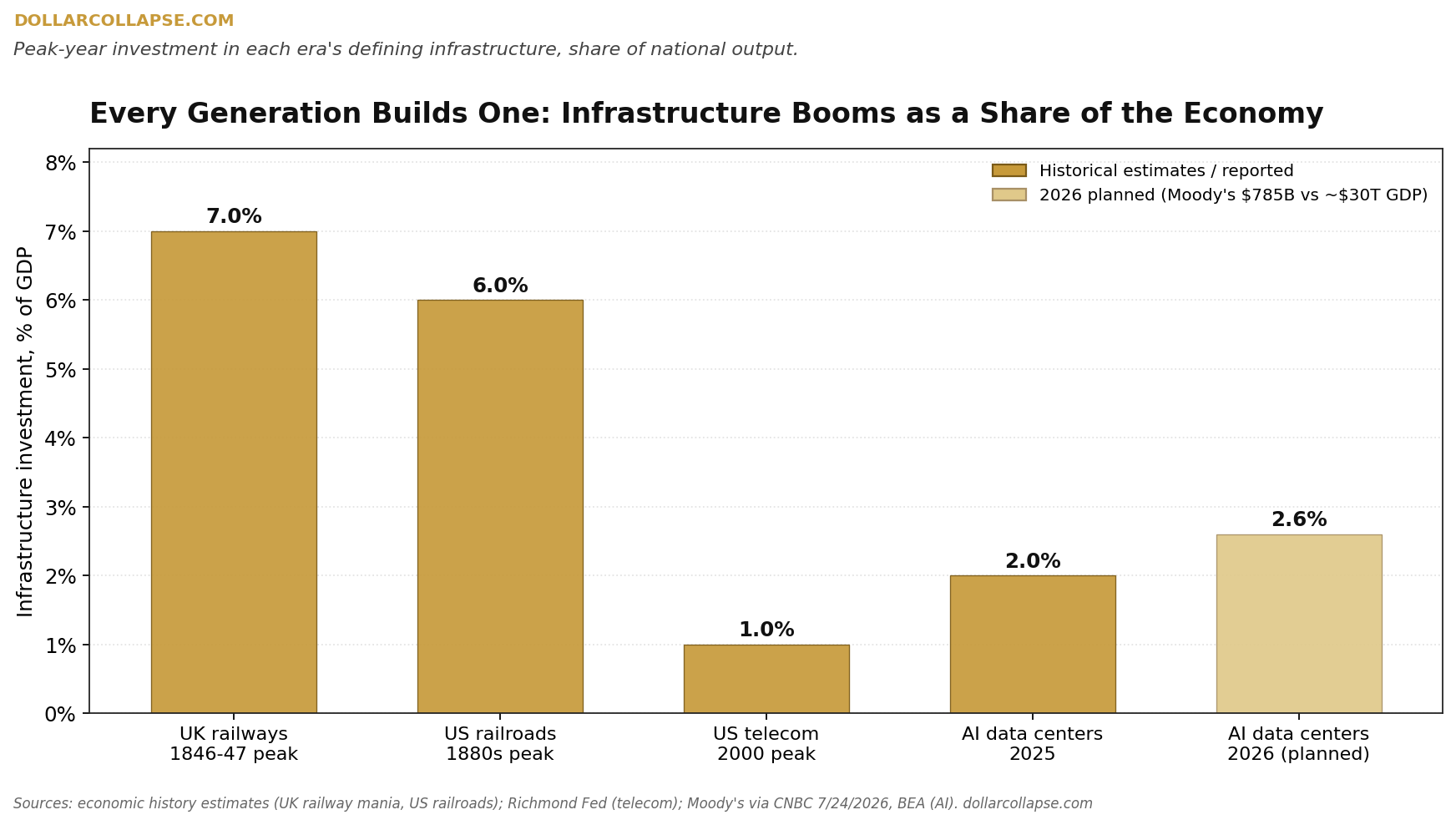
Note the two bars on the right. The AI buildout has passed the dot-com era and is headed for railroad territory.
Here’s the rule from the record:
First owners fund it, second owners run it, users harvest it. For example, the railroads made Sears possible. Cheap electricity made Ford possible.
The Internet ran the same play
No need to reach back to the 1890s. This one happened within living memory.
Between 1996 and 2001, telecom companies issued more than $500 billion in bonds, deployed close to $1 trillion, and laid 80 to 90 million miles of fiber across North America and Europe. The massive amount of spending was justified by a single prediction statistic:
Internet traffic doubles every 100 days.
That claim came from WorldCom’s UUNET subsidiary, and it even found its way into official Commerce Department reports.
Actual traffic doubled about once a year. So, the forecast was off by an order of magnitude. By 2002, fewer than 5 percent of those fiber miles carried any light at all.
Here is what all that dark glass did to the price of bandwidth:
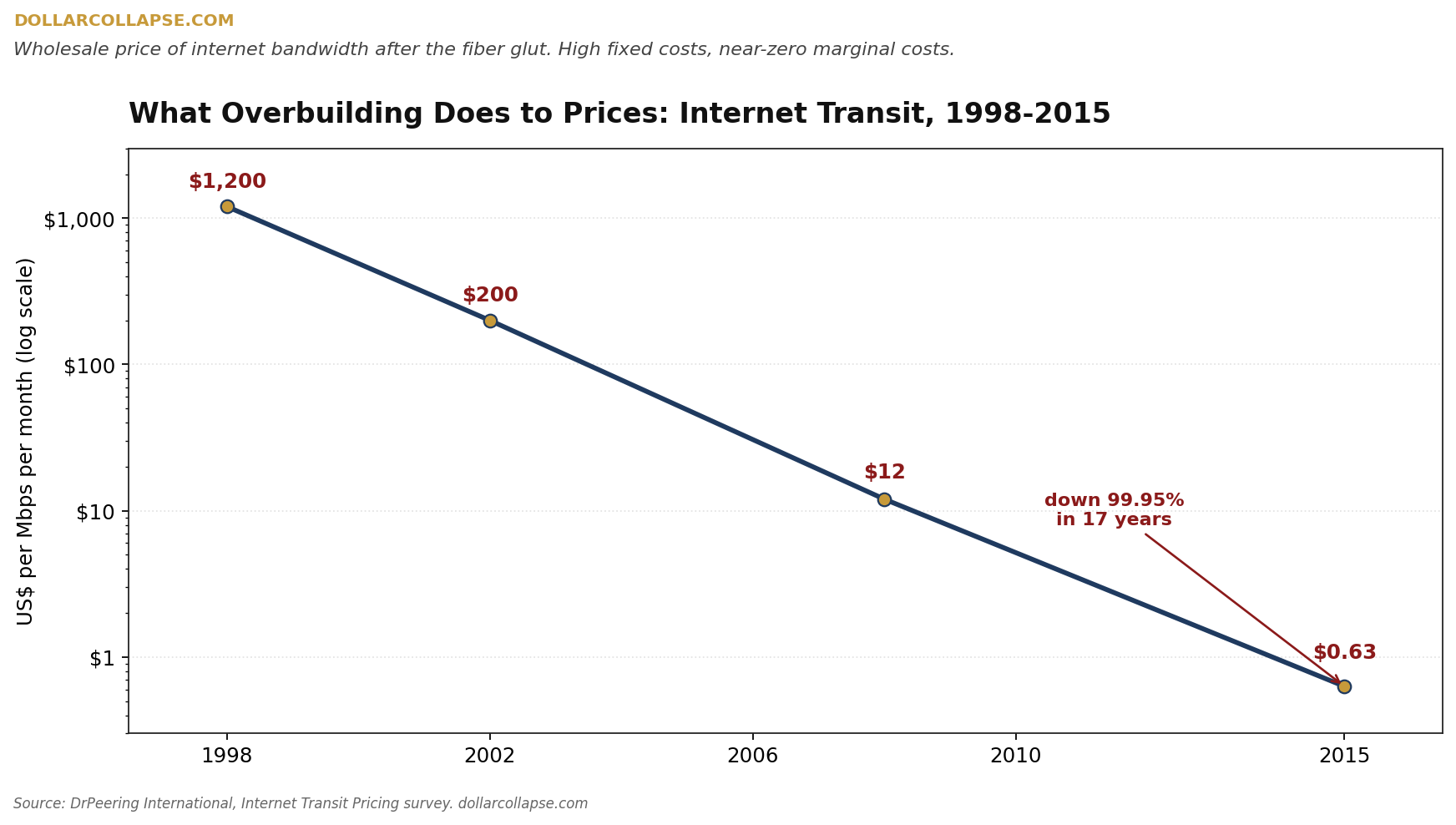
From $1,200 per megabit to 63 cents. The product the builders borrowed a trillion dollars to sell fell 99.95 percent in price.
The rest follows like a proof. Two trillion dollars of telecom market value erased. WorldCom filed the largest bankruptcy in US history to that point. Global Crossing, valued at $47 billion in 1999, sold out of bankruptcy for about $250 million. Bondholders recovered about 20 cents on the dollar. Even some of the shovel-sellers got carried out: Lucent vanished into a merger, Nortel liquidated, Corning fell from over $100 to about a dollar.
And the winners?
Berkshire Hathaway bought into Level 3’s convertible debt at the 2002 bottom. Google spent the mid-2000s buying dark fiber for pennies on the construction dollar. Then YouTube, Netflix, and AWS built empires on bandwidth they never paid to install. The demand the builders promised did show up… seven years after peak capex, long after the original capital structures were dead.
The fiber bulls were right about the Internet and wrong about the timing. In levered finance, that is the same as being wrong.
Now for the AI Build Out
The current buildout is running the same sequence at record speed.
Here is Wolf Street on the construction data, August 3:
AI Data Center Construction Spending Goes Exponential
“The amount spent on the construction of data centers spiked by 7.0% month-over-month and by 46% year-over-year to a seasonally adjusted annual rate of $68 billion in June… Since the beginning of 2022, monthly construction spending on data centers has spiked by over 500%… It is not often that corporate spending shoots up at this rate. Those kinds of the-sky-is-the-limit curves don’t last.”
The financing mix tells you where this cycle stands. A year ago, this was funded from cash flow. Now, per Moody’s reports, the six largest players carry $460 billion in direct debt plus $1.2 trillion in off-balance-sheet lease commitments, and the Bank for International Settlements calculates that AI now accounts for about half of all US investment-grade bond issuance.
Here’s what that looks like for the hyperscalers:
Alphabet just posted its first negative free cash flow since its 2004 IPO.
Meta’s free cash flow fell 91 percent in a single quarter.
S&P cut Oracle to one notch above junk…
And Nvidia, this cycle’s Cisco, is in talks to backstop up to $250 billion of OpenAI’s data center obligations… the vendor financing its own customer, at a scale WorldCom’s bankers never dreamed of.
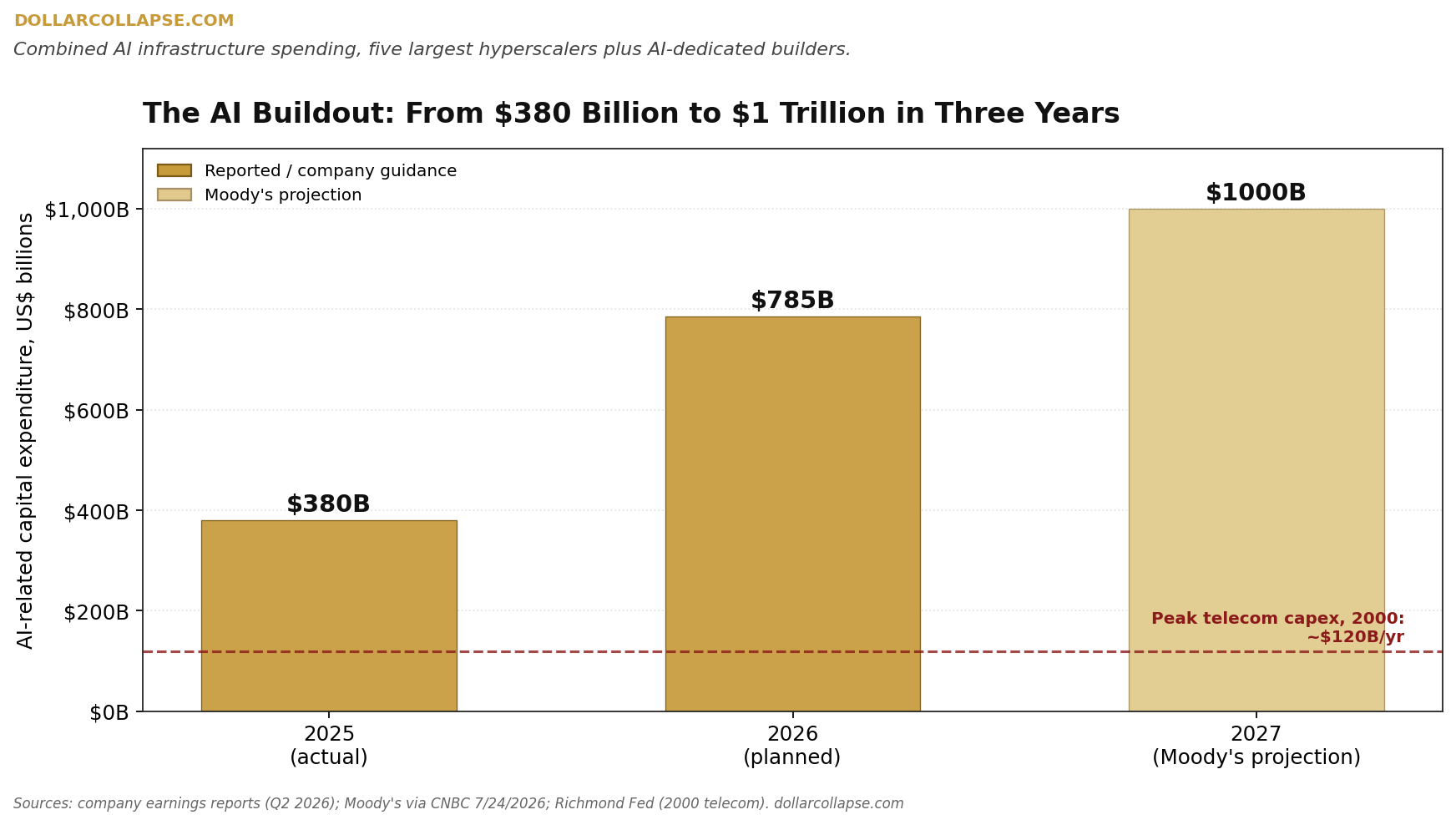
In the chart above, the dashed red line is the entire telecom industry’s capex at its 2000 peak. The AI buildout is running at six times that pace and plans for eight.
Meanwhile the spending itself has become the economy.
Mish Shedlock at MishTalk.com, July 31:
How Much Did AI Spending Contribute to Second-Quarter 2026 GDP?
“Real GDP for 2026 Q2 was 1.50 percent of which AI provided 0.79 percentage points… GDP is essentially overstated by the amount of malinvestment. But that’s not the way it works in practice. No one ever subtracts malinvestment.”
More than half of US growth in the first half of 2026 was one sector’s borrowing spree.
Even the central bankers’ central bank sees the ghost.
From the BIS annual report in June:
Bank for International Settlements, Annual Economic Report
“The canal mania of the 1830s, the British railway mania in the 1840s, the electrification exuberance of the late 1920s and the dotcom boom of the late 90s all shared one common trait: a genuine technological breakthrough that attracted capital in excess of what commercial returns could ultimately justify… These episodes ended with an eventual reversal in investment, inducing economy-wide recessions.”
So where does the income come from?
During a buildout, the reliable income flows to the shovel-sellers:
The chipmaker who collects cash today, the turbine and transformer makers with four-year backlogs, the landowners, and the bond underwriters who clip fees in both directions.
All of them get paid whether or not the data centers ever earn their keep.
The builders get paid last, if ever, because their return depends on renting out compute at prices that survive the coming glut. Right now the industry plans to spend $785 billion this year against AI revenues measured in the tens of billions. OpenAI, the flagship customer, booked $5.7 billion of revenue in the first quarter and burned $3.7 billion of cash doing it.
The income shows up eventually, and it lands on the second owners who buy the racks out of receivership, and on the users who rent collapsed-price compute to build whatever the 2030s equivalent of YouTube turns out to be.
This doesn’t mean that the technology is failing… The trains ran for a century after the shareholders were wiped out. The fiber still carries this article. This is one more data point, not a tipping point.
But the next time someone tells you the AI buildout has to pay off because the technology is real…
Remember that the railroad made America rich.
It just didn’t make railroad investors rich…
So here is the simple play:
Now: the shovel-sellers are the only trade the record endorses, and it’s already crowded. Chips, power producers, copper, transformers, grid equipment. If you own them, the record says take profits into strength, because these stocks die with their customers’ credit. And whatever you do, don’t lend to the builders. Telecom’s bondholders got 20 cents.
Next: watch the rental price of compute. The day GPU-hours start behaving like 2001 bandwidth, the boom is over, whatever the stocks say. That’s the signal to be fully in liquidity: cash for the buying, gold for holding value through the credit unwind. Not before the crack, and not hoping through it.
Then: the real entry is the first big restructuring, when data centers and their debt trade below replacement cost. That’s when Morgan bought railroads and Berkshire bought Level 3. Buy the distressed assets, or the survivors positioned to consolidate them.
Last: the decade-long trade is the application companies that rent collapsed-price compute after the bust. You can’t buy them today. Most of them don’t exist yet. The job today is staying solvent enough to recognize them when they show up.
So to sum it up,
Sell the boom. Hold sound money through the break. Buy the receivership sale.