Written by Bryan Lutz, Editor at Dollarcollapse.com:
Last Friday, the United States government bought yen.
Not dollars, or gold, but yen…
Japan spent about $53 billion in one day to prop up its money. That is the biggest single-day currency rescue ever recorded. The U.S. added $5 to $10 billion of its own. That number is public because a Reuters photographer snapped the Treasury secretary’s notepad.
So here’s the question…
Why does Washington care if Japanese money stays cheap?
For thirty years, the yen has been the money the world likes to borrow.
Here’s the trade:
Borrow yen in Japan, where interest rates sit near zero. Trade the yen for dollars. Use the dollars to buy things that pay more, like U.S. bonds or tech stocks. Keep the difference. Traders call it the carry trade.
It only works while Japan keeps rates near zero, and Japan has no choice. Here’s why.
Its government owes 237% of what its economy produces in a year. That debt does not just sit there. Old bonds come due all the time, and Japan replaces them with new bonds at today’s rates. So every rate hike slowly spreads across the whole pile. At near-zero rates, the interest bill is manageable. At normal rates, it would swallow Japan’s budget.
That leaves two doors.
- Raise rates, and the government’s own debt crushes it.
- Hold rates at zero, and the yen keeps sliding.
Japan chose the yen. So rates stay low, the yen stays cheap, and borrowed money keeps pouring into American assets.
Except, holding rates at zero still isn’t free. The bill just shows up somewhere else…
It shows up in the exchange rate. When your money pays nothing and dollars pay more, money leaves. Traders sell yen to buy dollars. Japanese savers move their cash abroad to earn a real return. Year after year, all that selling pushes the yen down.
Here’s the picture in one chart:
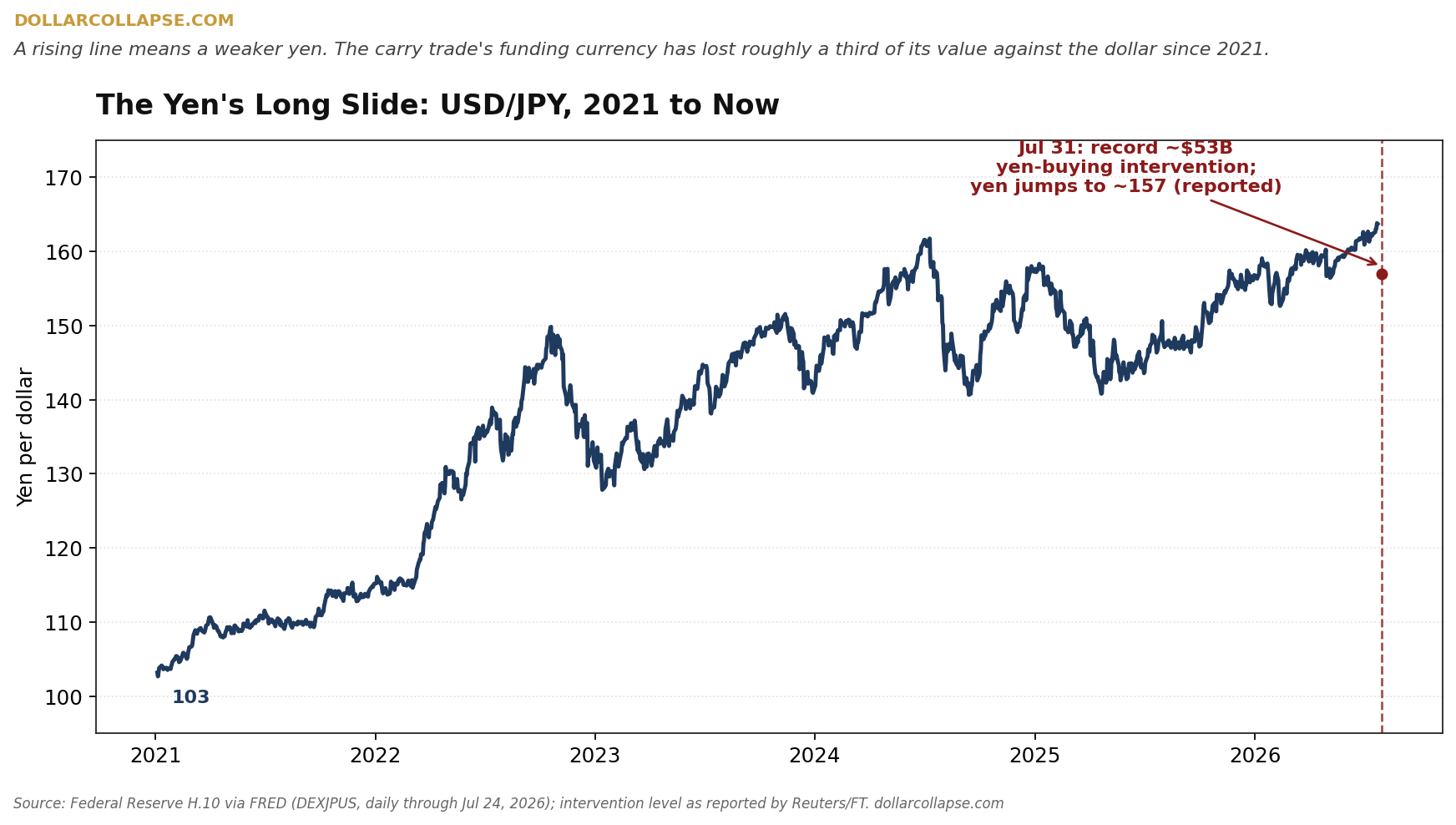
It’s the carry trade doing its job… right up until the job started costing $53 billion a day.
Reuters reports:
US Treasury undertakes intervention in yen market, FT reports
“The U.S. Treasury bought yen on Friday to support the battered Japanese currency, the Financial Times reported, marking Washington’s first yen-buying intervention with Tokyo in more than a decade as it languishes near 40-year lows… The Federal Reserve Bank of New York sold euros for yen on behalf of the Treasury through Goldman Sachs and Morgan Stanley, the FT reported.”
Washington sold euros, not dollars. The goal was to rescue the yen without knocking the dollar down.
Then Tokyo revealed what this rescue is really designed to protect:
The U.S. bond market, not just the yen.
This part is a bit technical, so let’s slow down.
To buy yen, Japan has to spend dollars. Billions of them, but Japan doesn’t keep that kind of cash sitting in a drawer. Most of its dollar savings are stored in U.S. Treasuries, because bonds earn interest while cash earns nothing. Normally, Japan would have to sell some of those treasury bonds to get those dollars, and that’s the catch.
Japan is America’s biggest foreign lender. It holds more U.S. government debt than any other country. If Japan starts dumping bonds by the billions, bond prices fall. And when bond prices fall, the interest rate America pays on its debt goes up. The government would have to borrow at higher and higher rates.
That’s where the Fed’s special lending window comes in. It’s called the FIMA repo facility. Japan hands its bonds to the Fed as collateral, like pawning a watch, and the Fed hands back cash dollars. When the rescue is over, Japan repays the cash and gets its bonds back. No bonds hit the market. No pressure on American interest rates.
Japan says it may use that window. The yen gets saved, and the Treasury market never feels a thing.
Yet, look where the long bond already sits.
Wolf Street reports:
“The 30-year Treasury yield jumped by 7 basis points on Friday, and by 12 basis points during the week, to 5.28%, the highest since July 2006.”
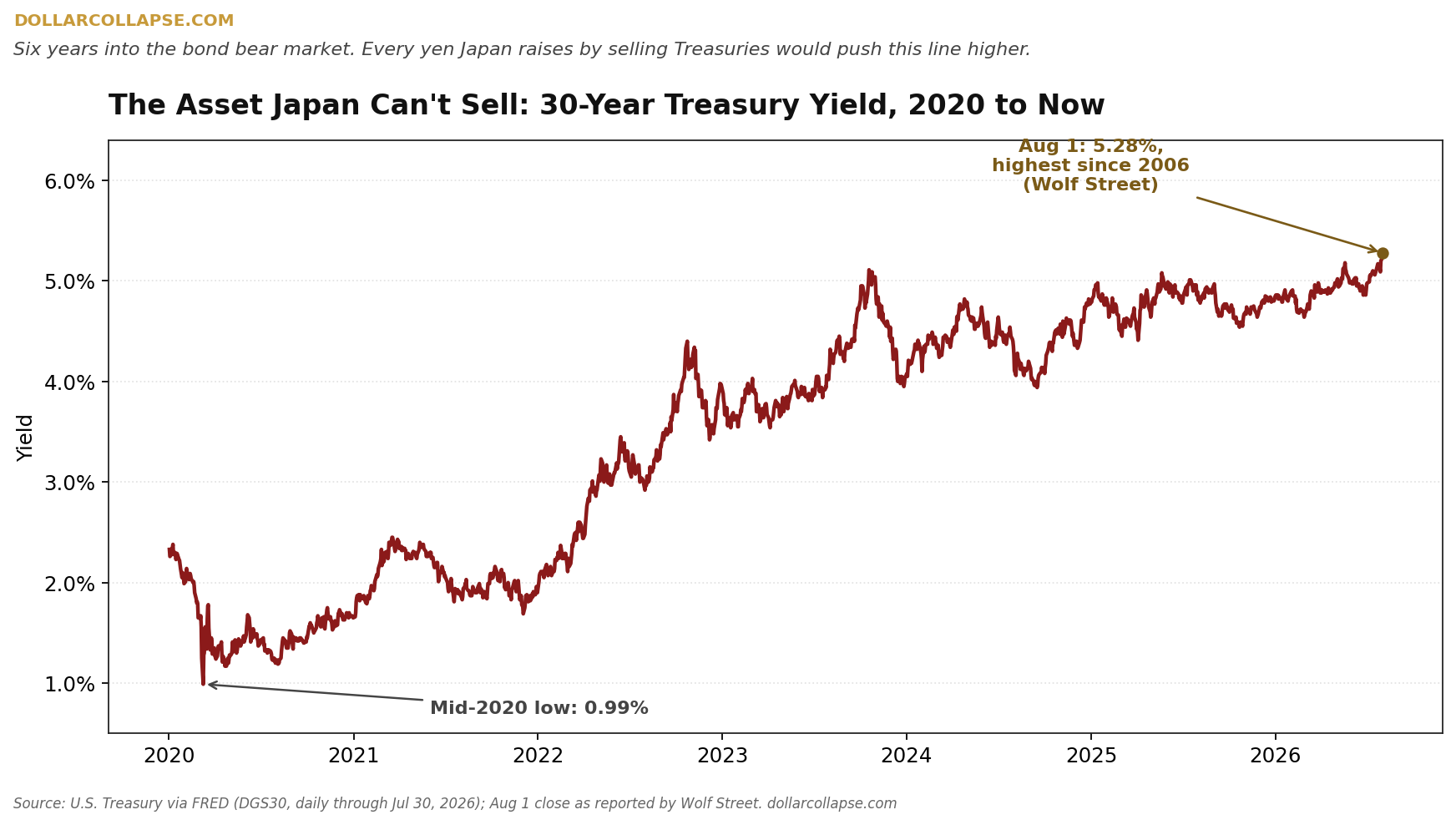
Bond prices fall when yields rise. Six years into this bond bear market, Washington cannot afford to lose its biggest lender. The Fed’s lending window exists so Japan can defend the yen without selling a single U.S. bond. Save the yen, protect the bond market.
Both governments confirmed the move over the weekend and promised more if needed. This is policy, not a one-time fix…
Cheap Yen Built the Bubble the US Now Has to Defend
If the yen keeps falling, Japan burns billions a day while prices for imported goods punish Japanese families.
If the rescue works and the yen rises, the trap springs the other way. Every loan taken out in cheap yen suddenly costs more to pay back. Traders sell assets to cover those loans. Two summers ago, a small version of that panic shook markets from Tokyo to New York. The pile of bets against the yen is bigger today.
Either way, somebody is going to end up on the wrong side of the biggest borrowed-money trade on earth.
This is one more data point in a long repricing of the US dollar, not a tipping point. Not yet…
Currencies rarely break on a Friday. They get defended, at rising cost, until the defense itself becomes the story. That’s the track we’re on.
Thirty years of cheap borrowed yen helped pump up the price of stocks and bonds all over the world. If the cheap money ends, the loans get called in and the selling starts everywhere at once.
That’s why two governments just spent about $60 billion in one day defending the money the bubble is built on… because when your bubble runs on borrowed yen, defending the yen is defending the bubble.