Written by Bryan Lutz, Editor at Dollarcollapse.com:
We are living through the end of an era. Actually, two eras. And to understand where we are headed, you need to understand where things broke the first time.
January 1976: The Day the World Agreed to Pretend
Most people couldn’t tell you what happened in Kingston, Jamaica in January 1976. Usually, August 1971 gets all the references. That was when Nixon announced that the dollar would no longer be convertible into gold. January 1976 may be just as consequential.
The Jamaica Accords formally buried the Bretton Woods system and demonetized gold, globally. Currencies were now free to float. No anchor. No ceiling. No discipline. Just governments and their printing presses, trusted to behave themselves.
They did not behave themselves.
Take a look at this 50-year chart of major fiat currencies priced in gold. What you see after 1976 is a near-vertical cliff. The British pound, the German mark, the French franc, the Japanese yen… All of them collapsed in gold terms almost immediately after the anchor was cut. It wasn’t subtle. It wasn’t gradual. It was the end of an era for gold.

The market knew exactly what demonetized fiat money was worth the moment it was cut loose from gold: less. And then less again. And then less again after that.
Today, we are seeing another end of era. This time it is the end of fiat currencies,. but first… Here’s what’s held up fiat currencies.
The Petrodollar Tourniquet
The bleeding didn’t stop on its own. It was temporarily bandaged by one of the most brilliant geopolitical deals in American history.
Henry Kissinger’s petrodollar arrangement with Saudi Arabia in 1973-74 essentially recreated a synthetic gold standard, substituting oil for the yellow metal. Global dollar demand was now structurally guaranteed because you needed dollars to buy energy. Every nation on earth became a captive buyer of American currency.
This bought the fiat system roughly 45 more years of life. Not because the underlying math improved, but because the dollar had a gun to the world’s head. A very large gun that ran on crude oil.
But that arrangement is now fraying. The BRICS nations are settling trade in local currencies. Saudi Arabia is accepting yuan for oil. The dollar’s share of global reserves is declining. The tourniquet is loosening.
2022: The Second Break
Now look at a chart of the 10-Year U.S. Treasury yield.
For four decades, from Paul Volcker’s peak in 1981 all the way to 2020, interest rates fell in a near-perfect downtrend. This wasn’t a coincidence or a policy triumph. It was the lifeblood of a debt-based system. Falling rates meant rising US Treasury bond prices, which meant collateral values expanded, which meant more borrowing was possible, which meant the whole leveraged edifice could keep growing.
The entire architecture of modern finance (includes pension funds, insurance companies, mortgage markets, sovereign debt) was built on the assumption that this trend would continue indefinitely. When rates are always falling, almost every financial decision looks smart in retrospect.
In 2022, that trend broke.
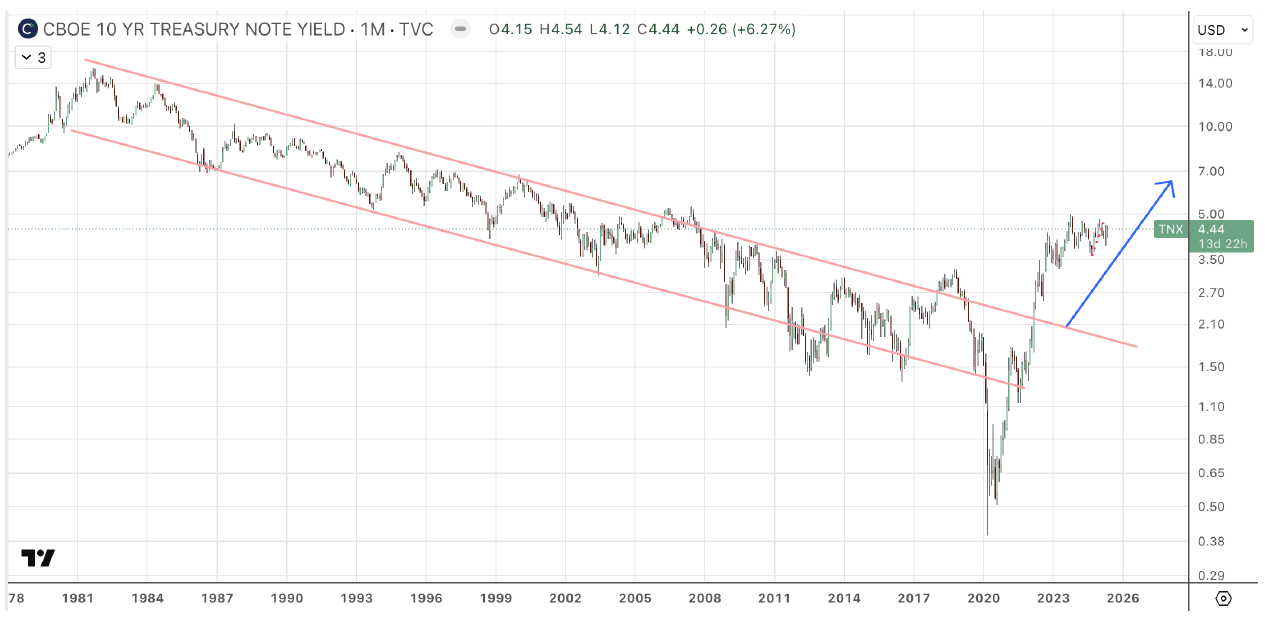
(via Kane McGukin)
The Federal Reserve raised rates faster than at any point since Volcker, and the 10-Year yield exploded through its 40-year downtrend line like it wasn’t there. This is the signal that the USD fiat system is coming to and end. However, gold will have the final say…
And here’s why that matters for gold:
A debt-based fiat system can only function when the cost of that debt remains manageable. When the U.S. government is rolling over $36 Trillion in debt at rates that used to be reserved for junk bonds, the math stops working. You can’t grow your way out. You can’t tax your way out. For the Fed, the only remaining lever is the one that was pulled in 1976 and every crisis since:
Print.
Global Fiat Currencies Are Telling You Something
Price your favorite fiat currency in gold since 2022. The picture looks uncomfortably familiar. It’s like a replay of the post-Jamaica Accords collapse, but this time with no petrodollar tourniquet waiting in the wings.
Since interest rates were raised, gold crossed $2,000.
Then $2,500.
Then $3,000.
Now it is approaching $5500.
Central banks, particularly those in China, Russia, India, and Eastern Europe, have been buying gold at the fastest pace in recorded history. These aren’t speculators making a trade. These are institutions that manage national reserves making a generational call.
They are saying, quietly and in the language of balance sheets, that fiat currencies are in their terminal phase.
Two Eras, One Lesson
The Jamaica Accords ended the gold standard era. What we are watching now is the end of the fiat era. That’s not because someone called a meeting in Kingston, but because the arithmetic has finally caught up.
In 1976, the world chose paper over gold and paid for it with a decade of monetary chaos. In 2022, the bond market delivered its verdict on 50 years of that experiment, and it wasn’t a passing grade. So, the pattern is the same. The mechanism is the same. The only thing that’s different is the scale. This time there is no new monetary arrangement waiting in the wings to replace the old one.
What fills that vacuum is the question right now…
Gold is the obvious answer, as it has been every other time this movie has played out.
The Bottom Line
It’s been 50 years. The charts are flashing the same signals now that they flashed in 1976. Except this time the fiat system itself, not just its gold peg, is the thing being abandoned. The 10-Year Treasury yield has broken its 40-year trend and currencies begin their next leg down in gold terms.
We are looking at the end of two eras.
2 thoughts on “The End of Two Eras: What 1976 Started, 2022 Is Finishing According to Gold”
J.P. Morgan said it all, “Gold is money, all else is debt”
This article was spot on. It is telling us what has happened to the canary in the coal mine. What did the miners do when they saw the dead canary? Thanks