Written by Bryan Lutz, Editor at Dollarcollapse.com:
Since ChatGPT launched in 2022, we’ve seen a slow decline in labor market momentum. At the same time, the S&P 500 has moved decisively in the opposite direction. This divergence has created what the guys at ZeroHedge have called a “K-shaped recovery” following the tumultuous pandemic-era money pump.
Now, although the economy is being described as “strong,” the Fed appears to be moving into a period of inflation alongside stagnating—if not declining—employment. So how can the Fed claim AI is creating a strong economy when employment is on a slow decline? What is AI really doing for the economy?

On December 9–10, Jerome Powell met with the rest of the FOMC to assess economic conditions and guide future open-market operations. During the ensuing press conference, Powell made several notable comments on productivity and AI’s role in growth:
“So it is—the implication is obviously higher productivity. And some of that may be AI. It just—also, I think productivity has just been almost structurally higher for several years now. So, if you start thinking of it as 2 percent per year, you can sustain higher growth without more job creation.”
Powell later addressed AI’s potential role in job cuts:
“So it’s probably part of the story. It’s not a big part of the story yet. We don’t know whether it will be. But, you know, for example, if you look at—you can’t miss the big announcements of layoffs and also companies saying that they’re not going to hire anybody for a long time, and they cite AI, that’s all clearly happening. At the same time, people are not filing for unemployment insurance.”
The Bigger Picture
The big picture is that large corporations are being reshaped by AI. Yes, there are mass tech layoffs—but there are also pockets of hiring. At the same time, these same corporations are slowing new hiring because existing employees are becoming more productive through AI tools.
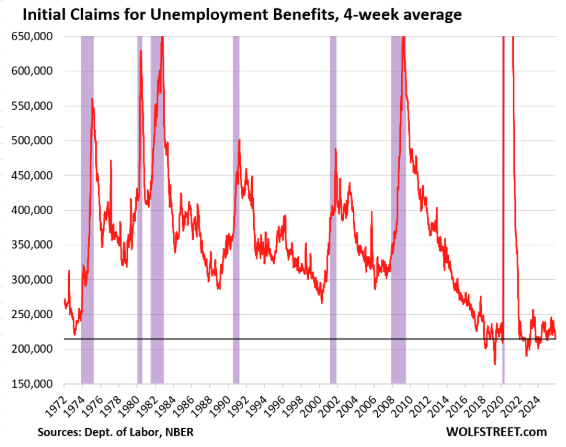
Historically, despite the headlines, there has not yet been a massive wave of creative destruction in the job market directly attributable to AI. According to a recent article by Wolf Richter at Wolf Street, unemployment claims remain nowhere near levels seen in the 1970s.
The Invisible Workforce
On the surface, the recovery appears to be proceeding as planned—until you consider new university graduates and Gen Z workers entering the labor market. Many of them don’t show up cleanly in the data. They’re working at Starbucks, serving at local bars, cutting lawns, or raking leaves down the block.
And they’re often doing it with two undergraduate degrees—or even a master’s degree—and little to show for it.
Meanwhile, AI continues to roll out deeper capabilities across the workplace. Peter St. Onge recently highlighted an MIT study examining how many minutes of an employee’s job could be replaced by AI.
St. Onge summarizes the findings:
“The study is based on MIT’s so-called Iceberg Index that maps out 32,000 skills across 923 occupations and match it to AI capabilities.
Helpfully, they break jobs into minutes, not lump-sum, to reflect what percent of a given job can be automated.
Using this, they figure that while we’re seeing about 2% of jobs currently affected by AI in monthly job losses, six times that — almost 12% of job-minutes — can be replaced by AI today.
That represents roughly $1.2 trillion in wages.
According to MIT, the worst-hit jobs are IT, finance, health care administration — which is a shockingly big employer.
And professional services — think accounting, HR, call centers and data entry.
These collectively make up nearly 1 in 4 jobs in the US. And almost half of white collar jobs.”
Efficient Corporations, Not Efficient Employment
AI is not necessarily creating more efficient employment. It is creating more efficient corporations.
Corporations can now do more with fewer employees—and they will likely continue to do so. To what extent remains unknown, but the gap between productivity and employment continues to widen. You can see it clearly in the K-shaped chart above.
A Fed Without Tools
If the Fed exists to serve the public, how can it claim the economy is strong while employment stagnates or declines?
As Powell’s comments suggest, the Fed primarily evaluates productivity and GDP growth when assessing economic health. But what about their employment mandate?
Maintaining employment is central to the Fed’s mandate. Yet if employment continues to stagnate—or falls due to AI-driven creative destruction—the Fed has few, if any, tools to address the problem.
No solutions. No fixes.
6 thoughts on “The Fed Says AI Is Creating A Strong Economy While Employment Is On A Slow Decline”
So, perhaps I am clueless on this stuff. But, how is our service-based economy going to grow if no one has a job, and no one has money? If I had kids high-school age right now, I would advise them not to go to college, go to trade school. They need electricians and plumbers to build those AI centers.
Many revolutions in history have been started as a result of wealth inequality.
Trump is using Big Tech as leverage against the rest of the world. He doesn’t want state laws in the way. Big tech monopolies aren’t going to be broken up as they should have been already. And yet those companies aren’t in the business of handing out jobs.
Enough people get locked out of getting ahead in the economy, there will be a rebellion vote for president in favor of someone like Bernie Sanders or someone for full blown socialism.
Much appreciated, Thomas. Agreed, wealth inequality is a major factor for how revolutions start.
I don”t want a hand-out from the government. It will be digital (as a condition of receiving it), then you will be tracked, spied on, and be at the mercy of Big Gov in order to receive your pittance. Own stocks in those companies that pay a good dividend to shareholders. That is where the money would be. Never trust the government! Beware of kings bearing gifts.
This is an excellent example of why Elon Musk, before he went nuts, talked much about UBI for American workers. Since the 1970s, productivity has grown, but all the extra profits have flown to CEOs and shareholders. The federal government, on behalf of the American worker, must capture those profits and set up something like a wealth fund which can be used to cut “dividend checks” to the working class.
While AI has only recently entered the markets, it will only accelerate the productivity gap in favor of the oligarchy. If increased profits from replacing workers are not intercepted, income and wealth disparities between the haves and have-nots will become a significant source of extraction, leading to desperation among workers. If they want to avoid a rebellion, they’d better start setting up something for the working class or face the inevitable wrath of workers.
Much appreciated, Todd. Yes, AI will accelerate the productivity gap.