Last week I wrote that in a gray-zone war the most valuable target is usually a seam, the joint where two parts of a defense meet that nobody thought to armor, rather than the factory itself. The Nvidia story was a human seam. On Monday, Google documented the next one, and it moves at machine speed.
Google’s Threat Intelligence Group publishes a report every couple of months on how adversaries are using AI. The edition from September found nothing especially new. The edition released this week found something it had never seen before: a fully autonomous attack system, running with no human involved at any step.
Here is what it does. Every time a popular piece of software ships a security update, the system compares the old code to the new code. From that comparison it works out exactly which weakness was just fixed. It writes an attack for that weakness. Then it fires the attack at every company that hasn’t installed the update yet. Google found it sitting on an exposed server alongside stolen victim data and a configuration note written in Russian. Its own name for it is “exploit agent.”
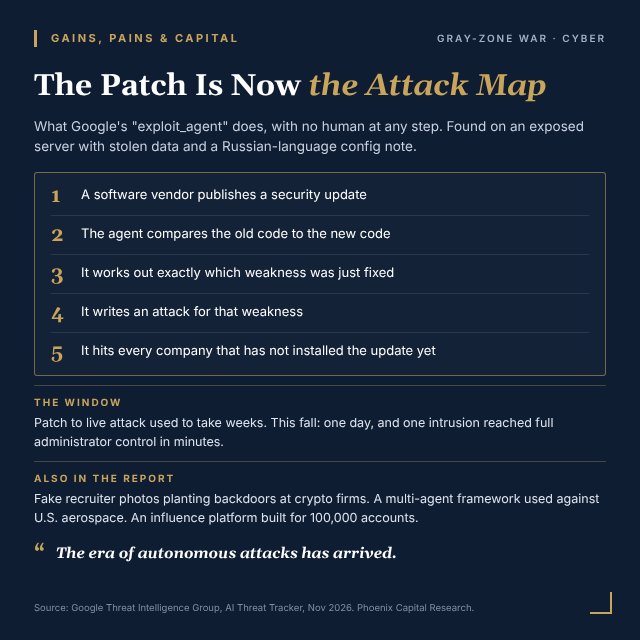
For 30 years the rule of cybersecurity has been that patches make you safer. Now the patch is the map. The moment a vendor announces it fixed a hole, a machine on the other side reads the announcement, reverse-engineers the hole, and attacks everyone who’s slow. The window between a fix being published and an attack being live used to be weeks. Google’s report cites cases this fall where it was a day, and one where an intruder went from first foothold to full administrator control in minutes.
And exploit_agent is one item in the report. A suspected North Korean group used AI-generated recruiter photos to approach crypto firms and planted a backdoor in their code repositories. A multi-agent attack framework was used against the U.S. aerospace sector. A commercial contractor built a platform, with help from Google’s own AI, designed to run more than 100,000 social media accounts. Two months ago none of this existed in Google’s data. Google’s own words: “The era of autonomous attacks has arrived.”
Now look at who is defending the other side of that seam.
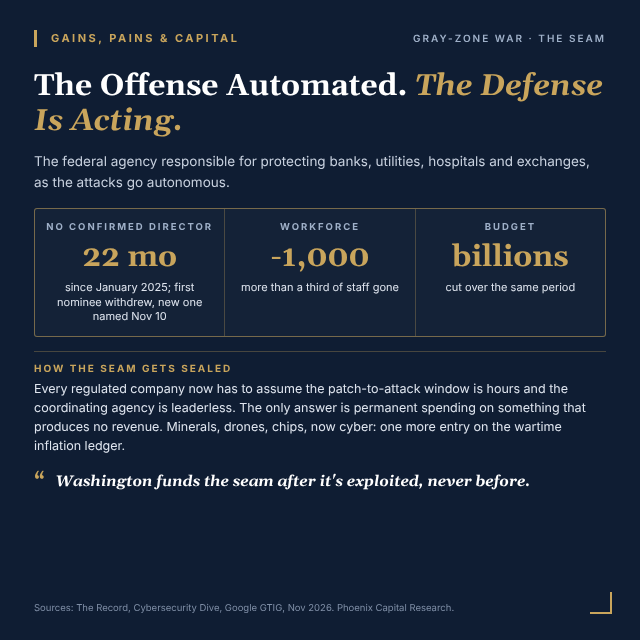
The Cybersecurity and Infrastructure Security Agency is the federal body responsible for protecting the civilian side of the country: the banks, the power companies, the water systems, the hospitals, the pipelines, the exchanges. It has not had a Senate-confirmed director since January 2025, which is 22 months.
The first nominee sat in limbo for most of a year and withdrew. The acting director’s legal term expired in September and he stayed on through a procedural workaround. A new nominee was named on November 10, and whether the Senate votes on him before it adjourns is anyone’s guess. In the same period the agency lost more than 1,000 people, roughly a third of its workforce, and billions from its budget.
I’m not going to turn that into a partisan point, because it isn’t one. The vacancy spans a Republican Senate and will now pass to a Democratic one, and the nominee stalled under the first and may stall under the second. The attackers just automated their side of the war while the defenders have been running on an acting basis for nearly two years. That is the seam, and it belongs to no party.
This is the pattern I’ve been describing all month. Gray-zone war is fought over strategic assets, and the assets include the systems that move money. Nobody declares anything. A machine in a server rack somewhere reads a patch note and attacks a French media company, an American aerospace supplier, a crypto exchange. The country that gets hit has nothing to fire back at, so it spends.
Now to your money, because this is where the story stops being about computers.
Every seam, once found, has to be sealed, and sealing it is never free. Last week I showed you the invoice for the critical minerals seam: $2,050 a kilo, guaranteed for 15 years. This seam gets sealed differently. Every bank, every utility, every hospital, every exchange and every company that holds customer data now has to assume the window between a patch and an attack is hours, that the attacker never sleeps, and that the federal agency meant to coordinate the defense is understaffed and leaderless. The only answer to that is to spend more, permanently, on something that produces no revenue.
That spending is inflationary in exactly the way the drone defenses and the mineral floors are inflationary. It raises the cost of running everything and adds nothing to output. It shows up in bank fees, insurance premiums, utility rates and the price of every product made by a company that had to double its security budget. None of it is in the Fed’s models and all of it ends up in prices, and the Fed is about to hike into it on December 9 because it thinks the inflation it is fighting came from oil.
What to do about it.
First, be careful with the obvious trade. Cybersecurity stocks will get bid on this report, and some of them deserve it. But the companies selling “AI-powered defense” are selling into the same arms race Google just described, where the offense automates faster than the defense. The durable winners are the ones that get paid whether or not any given attack succeeds: the firms that handle the mandatory compliance, the insurance, the identity layer, and the boring plumbing every regulated company is now required to buy. Picks and shovels.
Second, treat this as another entry on the wartime inflation ledger. Minerals, drones, chips, now cyber. The list of things the country has to spend on to seal seams keeps growing, and every one of them is a cost with no offsetting production. Hard assets and businesses with pricing power are the hedge, and they’ve been the hedge since this started.
Third, watch the systems that can’t afford to be wrong: payments, clearing, settlement. The quote from the Ingraham segment making the rounds is that if one cloud provider goes down you get mass chaos in the financial system. That is a description of the architecture. The financial system runs on a handful of providers, and a patch-to-exploit chain against one of them is the scenario that turns a bad week into a bad quarter.
So here is my call, and I’ll put a date on it. By the end of the first quarter of 2027, a major U.S. financial institution, exchange or payments provider will disclose a breach or outage traced to an automated exploit chain of the kind Google just described, and within 90 days of that disclosure Washington will begin treating cybersecurity the way it now treats minerals: as a supply chain that has to be funded. What would make me wrong is the Senate confirming a director and restoring CISA’s budget before the breach forces it to. I don’t expect that, because Washington funds the seam after it’s exploited, never before.
Last Tuesday I wrote that China may have toppled the king of chips. Two days later he resigned. The seams in this war get found before most people know there is a war. Google just found the next one.
If you find yourself worried about another crash, or bear market hitting, we have a proprietary signal that you can use to insure you get out of the markets well before a collapse hits.
This signal has accurately predicted every major market collapse in the last 40 years. And we detail it, how it works and what it’s saying about the markets today in a Special Investment Report How to Predict a Crash.
Normally we’d sell this report for $499, but in light of what’s happening with the Fed today, we’re making just 99 copies available to the investing public.
To pick one up…
Graham Summers, MBA
Chief Market Strategist
Phoenix Capital Research