“Whenever I am sad. I think about Costco.”
~ Charlie Munger
Written by Bryan Lutz, Editor at Dollarcollapse.com:
The Iran war broke a lot of things this spring.
It broke the Strait of Hormuz, it broke $4 gas, and it broke the monthly budget of every family that has to drive to work.
One thing it didn’t break was Costco.
While the corner gas station got flattened by the oil shock, the warehouse club just posted the kind of quarter that makes its 40-year-old playbook look bulletproof.
Yet, Costco barely makes a dime on the gas itself…
…which is the whole reason it’s winning.
The company pockets a few cents a gallon while an independent station needs 25 to 35 cents just to keep the lights on. So. when prices spike and drivers start counting pennies, the cheapest pump in town becomes the one pump that matters.
Management told analysts it has never moved this much gas in its half-century of operating. Some locations had to be refilled by tanker truck several times a day to keep from running dry. Members started topping off their tanks to get ahead of tomorrow’s price, and plenty of them pulled up to a Costco pump for the very first time.
CNN reports:
How Costco sells such cheap gas
“In its 50-year history, Costco has never seen such demand for gas.
Many of its stations have been so overwhelmed that they’ve had to call in tanker trucks multiple times a day to avoid running dry, Costco said this week during its quarterly earnings call. A growing number of customers are buying just enough to top up their tanks, concerned about what tomorrow’s prices may be.
As prices have surged above $4 nationwide – and above $6 along the West Coast – Costco has become America’s destination for cheap gas. Well, relatively. Costco routinely undercuts local gas stations by around 30 cents a gallon.
That’s an enticing bargain at any time, although long lines sometimes dissuade customers, especially when gas is inexpensive. Not now: A significant number of Costco members filled up for the very first time over the past three months, Costco said on that earnings call.
How – and why – does Costco sell gas for so cheap? It’s all about chickens. Well, kinda.
Not a ‘loss leader’
Costco actually makes a profit on gas – a few cents per gallon. That’s substantially lower than the 25- to 35-cent markup that most gas stations take.
Unlike most gas stations, which are small, independently owned and operated businesses – maybe with an attached convenience store or a repair shop – Costco can rely on its massive scale and membership model to drive profit.
Last year, membership fees accounted for roughly two-thirds of the company’s profit. Costco sells most of its products the same way it sells gasoline: at or just above cost – and sometimes below, like its famous $1.50 hot dog and soda deal.
Competing gas stations need the markup to pay for overhead and repairs. When gas prices rise, customers buy less of it, keeping a relative cap on the amount they’re able to charge.
That’s why, ironically, when gas prices are high, most gas stations struggle to make money.
Costco has a different problem: When gas prices are high, Costco sells more gas. But, because gas is among its lowest-margin products, the company’s overall profit margin gets squeezed. The opposite is true when prices are low.
Last year, when prices spent a considerable amount of time under $3 a gallon on average, gas added about a tenth of a percentage point to the company’s gross margin. Last quarter, gas subtracted two tenths of a point.
Nevertheless, it’s a good problem to have. Costco said it brought in $2.3 billion less in gas sales in 2025 than the year before because prices got cheaper.
Costco has 747 gas stations, which brought in 10% of its overall sales last year.
A chicken driver
Where do the chickens come in?
Costco says about half of its filler-uppers end up walking into a warehouse. As a record number of members visit Costco’s gas stations, foot traffic at stores increased around 5%. And customers are buying more when they shop, too.
“We believe this will drive even greater loyalty with these members in the future as members who use our gas stations typically spend more with us in the warehouse,” said Costco CEO Roland Vachris on a conference call with analysts Thursday, during which gas was mentioned 72 times.
Vachris said customers were stretched this past quarter, because they were allocating a higher percentage of their paychecks to gas. But that gave Costco an advantage: its competitive prices.
Among its best-selling how-can-they-sell-it-this-cheap products: rotisserie chickens, which Costco sells for $4.99 – way undercutting local supermarkets. And they’re sold at the back of the warehouse, forcing customers to navigate the aisles – and probably pick up some other items along the way.
Recognizing the moment, Costco extended discounts on meat and eggs (also sold at the back of the warehouse) to members to drive more customers into the warehouses.
“We saw it as an opportunity, recognizing that our members were dealing with higher gas prices, to really invest in increasing value to the member,” said Gary Millerchip, Costco’s chief financial officer, on the call.
The question is whether Costco can hang onto those gains when gas prices fall again. The trends work in Costco’s favor when gas prices rise – but they work in reverse when they fall.
The company remains hopeful that the momentum it built in recent months can continue to, even if gas prices fall.
“Over time, it’s a great way to build loyalty,” Millerchip said. “We do think it’s a good, healthy barometer of long-term growth for the business.”
Analysts were skeptical. So were investors. The stock fell nearly 4% Friday.
Cheap gas out front, a $4.99 rotisserie chicken at the back, and a cart full of stuff you didn’t plan to buy in between.
That’s true as far as it goes.
But it misses why the parking lot is jammed in the first place.
People aren’t lining up because they suddenly love buying paper towels in bulk. They’re lining up because the dollar in their pocket buys less gas every week, and a 30 cent difference per gallon is real money again.
You see, this is what a squeezed consumer looks like. And Costco built the perfect machine to catch him on the way down.
Look at the stock and you can watch the machine work.
Costco was a sleepy $500 name coming out of 2022.
Then came the run. It crossed $1,000 for the first time in late 2024, riding a 50% gain on the year. Management kept feeding the fire… a $15 special dividend in January 2024, the first membership-fee hike in seven years that September, and a crackdown on card-sharing that swept up a wave of new paying members.
By the time the board cut another special dividend in January 2026, this one $12 a share, Costco was sitting on better than $14.5 billion in cash.
Then the war hit.
When Iran blew up at the end of February and Brent crude went screaming toward triple digits, money ran for cover. And one of the places it ran was Costco. The stock tagged a fresh all-time high of $1,096.50 on May 19th, up around 20% on the year while the S&P limped along at half that pace.
Here are the roughmaths:
When gas crosses $4 for the first time since 2022 and inflation climbs back to its hottest level since 2023, investors want a business that sells real things to real people at a price nobody else can match.
That’s Costco’s entire reason for existing.
But the chart also shows the catch.
Here’s Costco over the last several years:
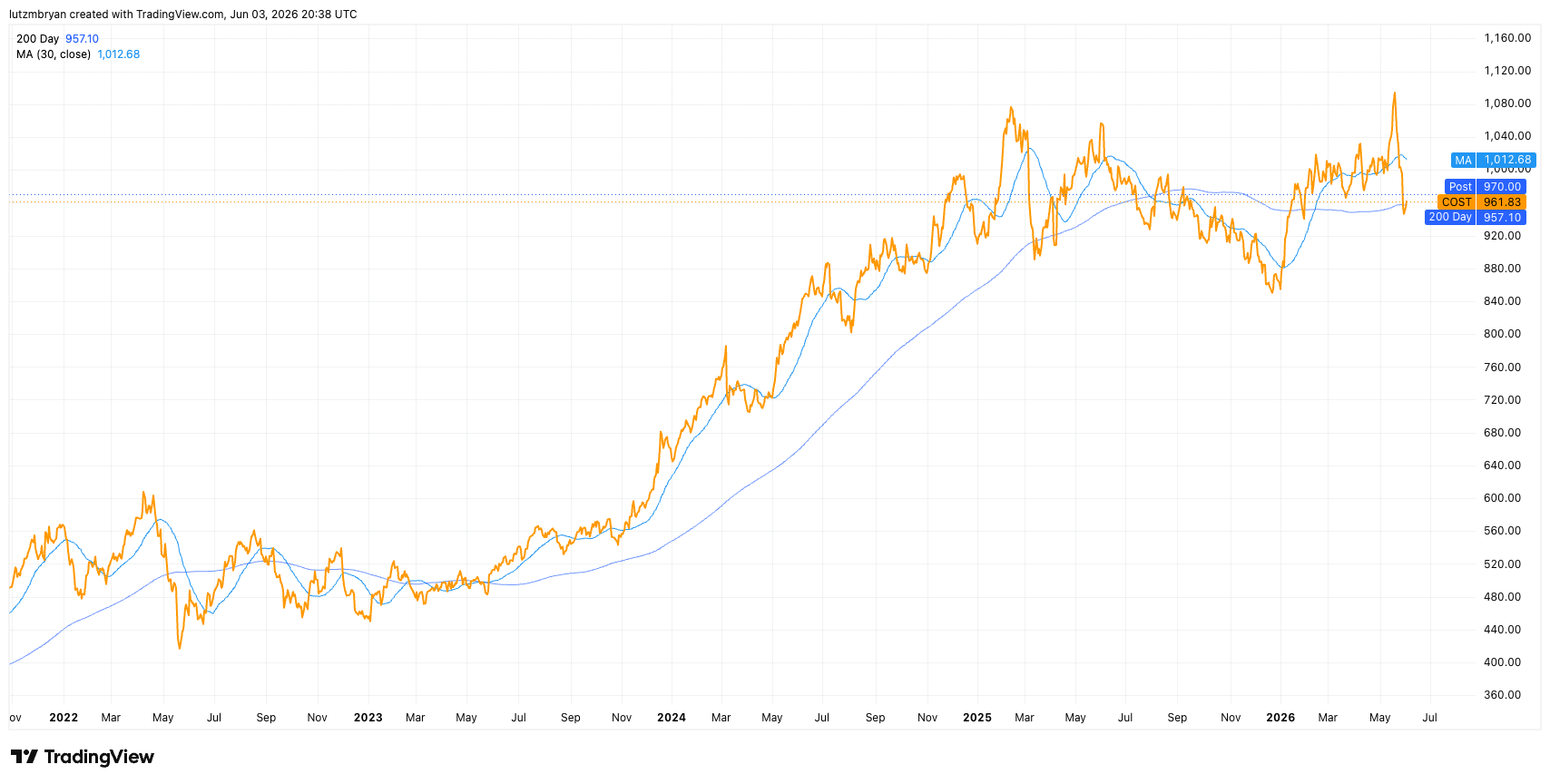
That spike to a record high in May, and the hard snap back right after, is the story in one frame. The stock dropped nearly 4% on Friday and slid right back to its 200-day moving average around $957. The more cheap gas Costco moves, the harder its skinny margins get squeezed.
So even a fortress of a stock like Costco takes a hit when the war it’s profiting from is the same war wrecking everybody’s wallet.
Friday’s drop is the market’s reminder that no business model, not even this one, outruns an oil shock stacked on a currency that buys less every quarter. Costco wins the gas crisis because it sells honest value to people, and they know how to provide the most value to customers.
The only time period in Costco’s stock history when they spent a significant amount of time under the 200 day moving average was in 2022-2023 when interest rates were being raised by the Federal Reserve – the same time many stocks, even the S&P 500 were trending down. You can be sure that customers and myself will keep returning to Costco. Not only for gas, but for all the deals inside.